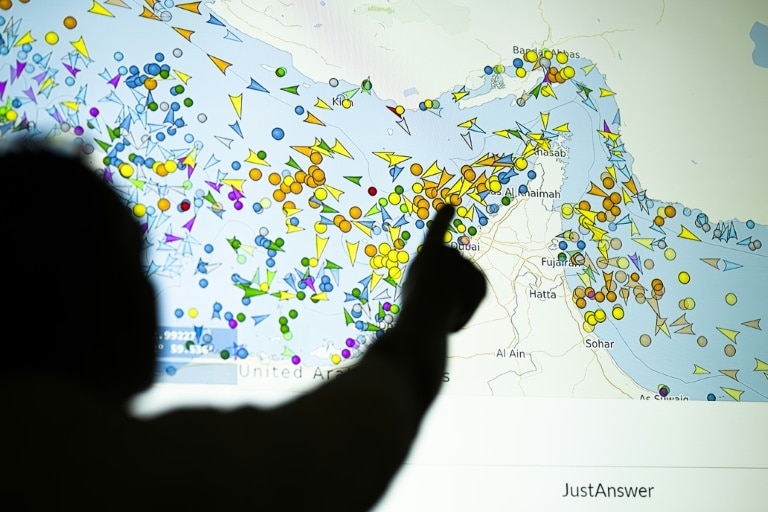
A fresh escalation of geopolitical friction in the Persian Gulf has sent global energy markets into a sharp upward swing, with oil prices jumping more than five percent at one point on Monday after Iran launched drone and missile attacks targeting the United Arab Emirates, just hours after U.S. Navy destroyers completed a passage through the strategically critical Strait of Hormuz.
The confrontation unfolded in sequence: over the weekend, former U.S. President Donald Trump announced a new naval escort mission for commercial shipping transiting the strait, a chokepoint that carries roughly 20 percent of the world’s daily oil and gas trade. On Monday morning, the UAE’s defense ministry confirmed that Iranian-origin drones and missiles had struck targets in the emirate of Fujairah, home to a major oil storage and export terminal. The attack sparked a visible fire at an onshore energy facility, authorities confirmed. Iran’s state media reported that the Iranian navy fired a cruise missile as a “warning shot” in response to the U.S. naval movement, while prior reports indicated Tehran had also targeted an Emirati oil tanker with unmanned aerial vehicles.
Tehran’s forces have effectively blocked access to the strait since early March, a retaliatory move against the joint U.S.-Israeli military campaign launched on February 28. This action comes amid a sustained U.S. economic blockade on Iranian ports, and while Trump has extended an initial two-week ceasefire indefinitely, the core conflict and its far-reaching economic disruptions remain unresolved. The latest escalation immediately rippled through energy markets: by 1530 GMT, the July Brent crude contract, the global benchmark for oil, had climbed 5.5 percent to settle at $114.14 a barrel, while the U.S. domestic benchmark West Texas Intermediate for June delivery rose 3.4 percent to hit $105.44 per barrel.
While the Middle East crisis roiled energy markets, global equity performance diverged sharply on Monday, driven by a resurgent rally in artificial intelligence stocks fueled by stronger-than-expected corporate earnings. Across Asian exchanges, the euphoria around AI pushed benchmark indices in Seoul and Taipei to all-time record closes, with Seoul’s Kospi surging more than five percent and Taipei’s weighted index jumping more than four percent. The gains were led by top semiconductor firms that power global AI infrastructure: South Korea’s SK Hynix climbed 12.5 percent, rival Samsung added more than five percent, and Taiwan’s leading contract chipmaker TSMC gained 6.6 percent.
This rally was sparked by blowout first-quarter earnings reports last week from tech giants including Apple, Google, Microsoft and Samsung. The results rekindled investor appetite for AI stocks after a period of market volatility triggered by the February U.S.-Israeli strikes on Iran. Ipek Ozkardeskaya, a senior analyst at Swissquote, noted that investors are clinging to “optimism that AI continues to mask the pain elsewhere” across geopolitical hotspots. Data from financial analytics firm FactSet shows S&P 500 companies are on track to post overall first-quarter earnings growth of 27.1 percent, the fastest pace recorded in more than four years. More tech earnings are on tap this week, with reports expected from Palantir Technologies on Monday, followed by Advanced Micro Devices and Arm Holdings later in the week.
However, the rally lost steam on U.S. exchanges after the oil price surge. The tech-heavy Nasdaq composite, which opened at a new record high following its Friday close, fell into negative territory to end the day down 3.4 percent at 25,041.69. The Dow Jones Industrial Average dropped 0.8 percent to 49,117.04, while the S&P 500 dipped 0.4 percent to 7,203.95. Major European benchmarks also closed in the red: Germany’s DAX 40 fell 1.2 percent and France’s CAC 40 dropped 1.7 percent. Markets in Tokyo, Shanghai and London were closed for public holidays.
Patrick O’Hare, an analyst at Briefing.com, pointed out that despite the downward move, many investors who missed the earlier AI rally are waiting for market pullbacks to enter positions. “That is perhaps why the indices just aren’t selling off to any large degree,” he explained. Hong Kong’s Hang Seng Index bucked the global downward trend to close 1.2 percent higher. In currency markets, the Japanese yen saw volatile trading, spiking higher against the U.S. dollar early Monday amid fresh speculation that Japanese authorities had intervened again to support the battered currency. Media reports estimate Tokyo spent as much as $31 billion on a currency intervention last Friday, which also pushed the yen sharply higher. By Monday’s close, the dollar traded at 157.15 yen, up slightly from 157.06 yen on Friday.