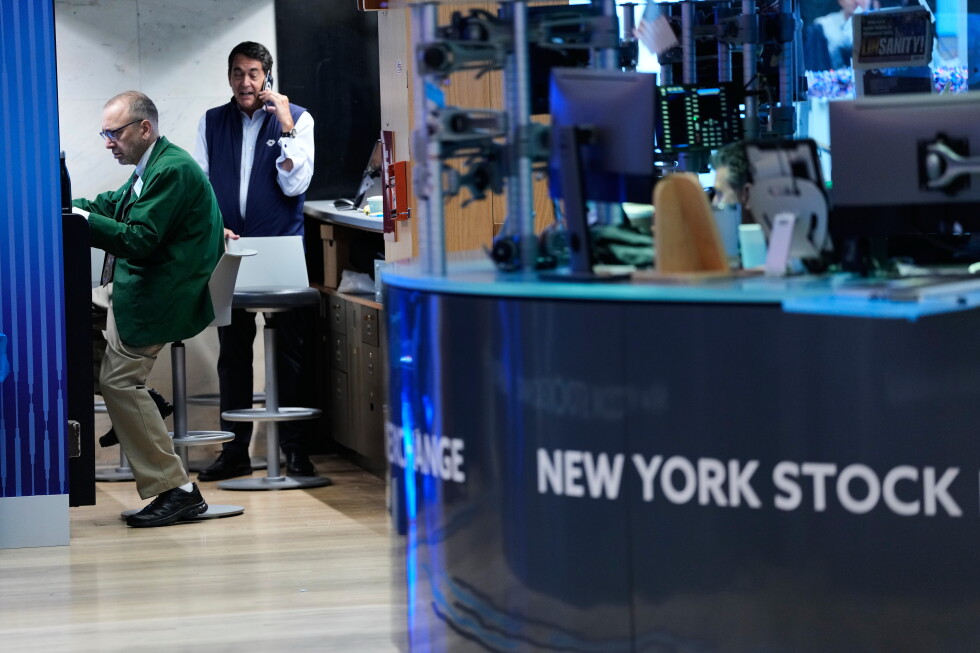
Global financial markets found tentative stability on Thursday, as strong gains from artificial intelligence-linked semiconductor stocks offset widespread investor anxiety sparked by renewed volatility in U.S.-Iran tensions. The rebound came a day after sharp sell-offs across global assets triggered by President Donald Trump’s public questioning of a recently reached temporary truce between the two nations.
As of 11 a.m. Eastern Time, major U.S. stock indexes were on track to erase most of the previous session’s losses. The broad S&P 500 climbed 0.4%, the Dow Jones Industrial Average gained 141 points, or 0.5%, and the tech-heavy Nasdaq composite rose 0.5%. International markets followed the upward trend, with most European and Asian indexes posting solid gains. South Korea’s Kospi index bounced 0.6% after a 5.3% drop on Wednesday, while China’s Shanghai composite added 1.7% and Paris’s CAC 40 rose 0.7%. Hong Kong’s Hang Seng was a notable outlier, slipping 0.7% amid weak debut trading for Apple supplier Luxshare.
Oil prices pulled back slightly from the sharp spikes seen on Wednesday, but remained far above levels from the end of last week. Brent crude, the global benchmark for oil pricing, fell 0.5% to $77.61 per barrel, down from $78.02 the prior day but well above the $71.80 closing price recorded last Friday. The pullback came as investors weighed the risk of a full-scale conflict that could disrupt crude shipments through the Strait of Hormuz, a chokepoint that carries roughly a fifth of global oil supplies.
Widespread concern persists that prolonged conflict in the Persian Gulf would keep oil prices elevated, derailing forecasts for easing inflation across major economies. If oil prices remain high, central banks including the U.S. Federal Reserve could be forced to hold interest rates higher for longer, or even implement additional hikes. Higher interest rates are designed to cool inflation, but they also slow overall economic growth and put downward pressure on equity and asset valuations. The volatility in energy markets has already reversed a months-long steady decline in U.S. retail gasoline prices: motor club AAA reported a 5-cent overnight jump in the national average for a gallon of regular gasoline, bringing the benchmark to $3.85 — 68 cents higher than the same time last year.
The primary driver of Thursday’s market rebound was a wave of strength in AI-linked semiconductor stocks, which have become the most influential sector on Wall Street in 2024. Seoul-based SK Hynix, which is preparing to launch a U.S. public listing of its shares, jumped 5.3% in local trading. On Wall Street, memory chip giant Micron Technology led market gains with a 7.1% surge, after the company released a bullish update highlighting “surging demand for memory in the AI era” as it progresses on construction of what it calls the largest semiconductor manufacturing site in U.S. history, located in central New York.
Even with Thursday’s gains, the AI sector has faced growing downward pressure in recent weeks, as investors question whether valuations have run ahead of actual expected profits and productivity gains from new AI technology. Markets also received mild support from stabilizing U.S. Treasury bond yields, which pulled back slightly to 4.55% on the 10-year note, down from 4.56% on Wednesday. Yields had climbed sharply earlier in the week on fears of higher oil prices and sustained high interest rates.
Beyond geopolitical tensions, investors are turning their attention to the upcoming second-quarter earnings season, which kicks off next week with reports from the nation’s largest banks. Analysts note that broad-based strong earnings growth will be required to justify the sharp run-up in stock prices seen over the past year. Even after beating analyst consensus revenue forecasts for the most recent quarter, PepsiCo fell 3.9% on Thursday after the company reported weakening demand trends in its core North American food and beverage segment, which owns household brands including Gatorade and Doritos.