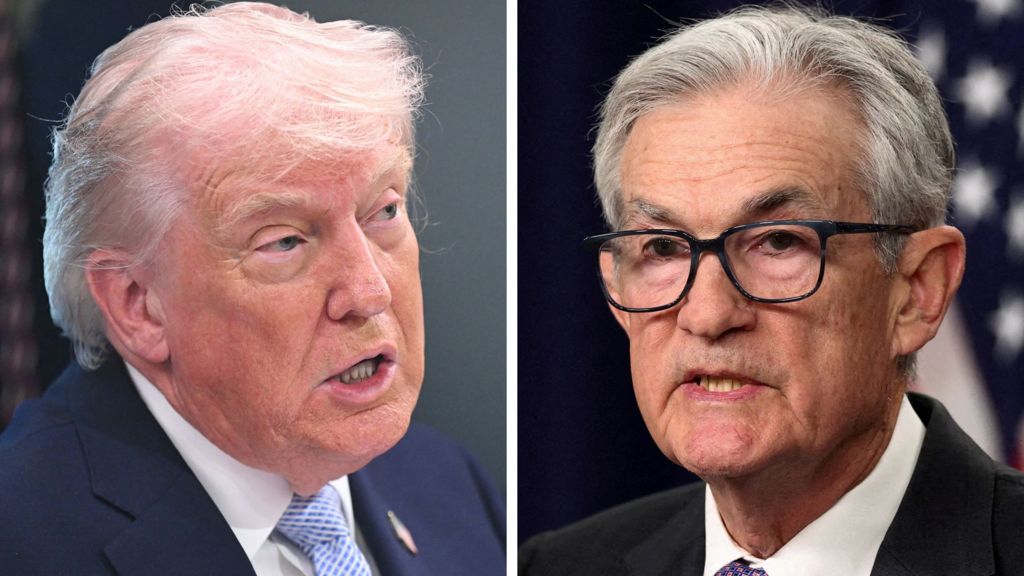
The fractious public feud between former and current U.S. President Donald Trump and departing Federal Reserve Chair Jerome Powell stands as one of the most bitter confrontations between a sitting American president and a central bank leader in modern history. Since Trump reclaimed the White House following the 2024 election, he has launched nonstop attacks on Powell, driven entirely by his frustration that the Federal Reserve has not cut interest rates at the speed the president has demanded. As Powell prepares to exit his post to make way for Trump’s nominee Kevin Warsh, a look back at the series of high-profile clashes that shaped this unprecedented relationship reveals deep threats to the central bank’s long-guarded independence.
Ironically, it was Trump himself who first appointed Powell to the role of Fed chair during his first presidential term. Back in November 2017, Trump argued the nation’s central bank needed “strong, sound and steady leadership,” and publicly praised Powell as a “strong, committed, smart” candidate perfectly suited for the position. But after President Joe Biden reappointed Powell to a second term, Trump soured on the Fed chair dramatically once he returned to the Oval Office, even claiming he was shocked Biden extended Powell’s tenure. “He’s a terrible Fed chair,” Trump told reporters last July, ignoring his own role in bringing Powell to the job in the first place.
Trump’s criticism has not been limited to policy disagreements; he has repeatedly resorted to personal insults and derogatory nicknames for the nation’s top central banker. After the Fed cut rates three times in 2025, central bank officials opted to hold rates steady to assess how Trump’s new trade tariffs would impact persistent inflation. For every decision to hold rates that ran counter to Trump’s demands, the president lashed out. In April of last year, he dubbed Powell “Too Late”, and declared that Powell’s “termination cannot come fast enough.” That set the tone for months of attacks that followed: Trump has called Powell a “numbskull”, “moron”, and “a real dummy” in media interviews, and doubled down on these insults on social media. In one typical viral social media post, Trump wrote: “Jerome ‘Too Late’ Powell has done it again!!! He is TOO LATE, and actually, TOO ANGRY, TOO STUPID, & TOO POLITICAL, to have the job of Fed Chair. He is costing our Country TRILLIONS OF DOLLARS, in addition to one of the most incompetent, or corrupt, renovations of a building(s) in the history of construction! Put another way, ‘Too Late’ is a TOTAL LOSER, and our Country is paying the price!”
The conflict spilled beyond interest rate policy into a public disagreement over the ballooning cost of a planned renovation of Federal Reserve office buildings. During a joint on-site visit where both men wore hard hats, Trump claimed the total cost of the project had ballooned to $3.1 billion, well above the original $2.7 billion estimate. Standing directly beside the president, Powell immediately disputed the claim, telling Trump he was not aware of any such cost overrun. When Trump pulled out a document he claimed proved the higher total, Powell countered that Trump had incorrectly added the cost of a separate completed building constructed five years earlier to the renovation project’s total. When asked how he would handle a project manager who went over budget as a former real estate developer, Trump did not mince words: “Generally speaking, I’d fire him.”
Tensions escalated to a new level in early January, when Powell released a Sunday evening video revealing that federal prosecutors had opened a criminal investigation that could lead to an indictment over testimony he gave to a Senate committee about the renovation project. Powell, who had largely stayed silent about Trump’s attacks for months, framed the Department of Justice’s move as part of the administration’s sustained campaign to pressure the Fed. He argued that the investigation raised existential questions about the central bank’s core mission: “This is about whether the Fed will be able to continue to set interest rates based on evidence and economic conditions, or whether instead monetary policy will be directed by political pressure or intimidation,” Powell said in the video. The development immediately created political headwinds for Warsh’s nomination: Republican Senator Thom Tillis announced he would not support confirming Warsh while the investigation remained open, calling the probe a “serious threat” to the central bank’s independence. Earlier this month, the Department of Justice dropped the criminal investigation, clearing the way for Tillis to announce he would now support Warsh’s confirmation ahead of a full Senate vote.