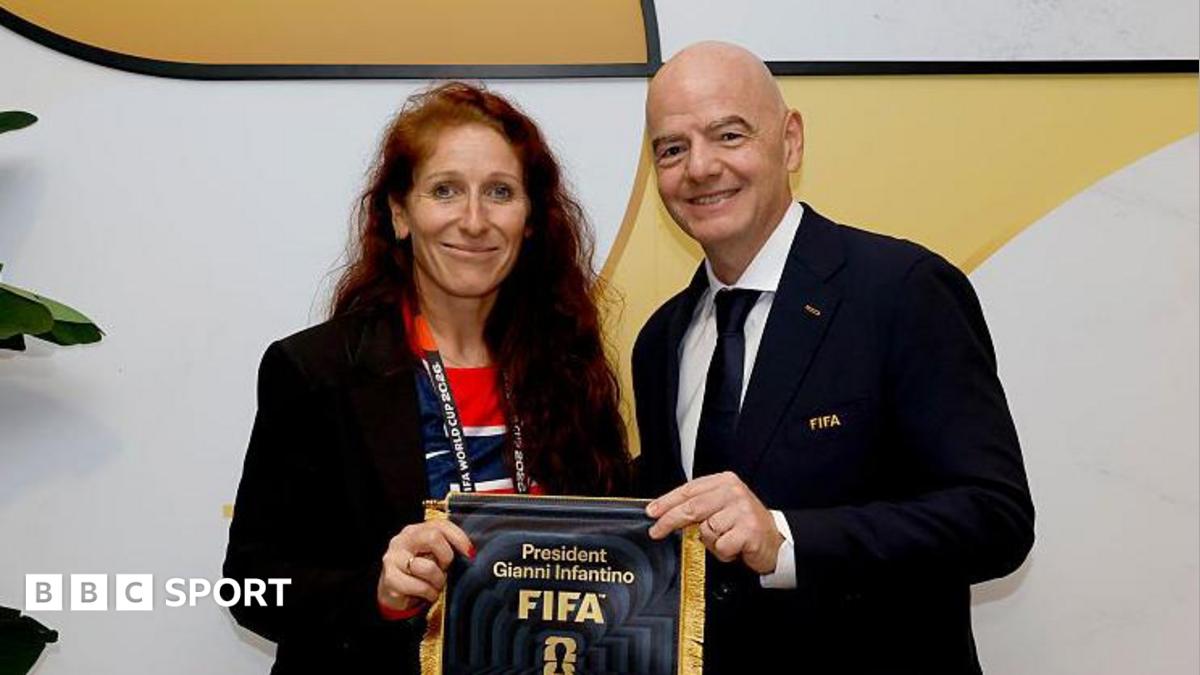
A major split has erupted across global football governance after the Norwegian Football Federation (NFF) became the first major governing body to explicitly call for FIFA President Gianni Infantino to step down, triggered by his withdrawn controversial plan to sell private stakes in the World Cup. The move pushes a growing crisis over leadership of world football to new heights, as regional confederations and national associations remain sharply divided over Infantino’s future.
NFF President Lise Klaveness, a longstanding public critic of Infantino and a trained lawyer, announced the call for resignation on Friday, arguing the FIFA leader no longer holds the institutional trust required to steer the global governing body through its current challenges. “International football cooperation is deeply troubled, and we must come together to move forward,” Klaveness stated. “That is why we are asking the FIFA president to resign now.”
Norway’s demand goes further than the positions taken by the football associations of England, Wales, Croatia and Albania, all of which have already withdrawn their backing for Infantino but have stopped short of calling for his immediate departure. Klaveness outlined a long list of long-held concerns the NFF has raised during her four-year tenure, including questionable processes behind tournament awarding, the controversial 2024 decision to grant the inaugural FIFA Peace Prize to former U.S. President Donald Trump, and the reversal of a ban on American forward Folarin Balogun ahead of the recent World Cup that came after a direct phone call from Trump to FIFA leadership. FIFA has not yet issued a public comment in response to Norway’s call.
While opposition mounts in Europe, Infantino has received public backing from key nations ahead of March’s presidential election. The Mexican Football Federation, co-host of the 2026 World Cup, broke ranks with its regional governing body CONCACAF to confirm its support for the 56-year-old FIFA president. “The FMF supports president Infantino’s leadership in continuing to promote the development of football through institutional strengthening,” the federation said in an official statement.
Mexico’s endorsement echoes a public statement from CONMEBOL, South America’s continental confederation, which has committed to rejecting any efforts to remove Infantino from office that do not follow a full vote by all 211 FIFA member associations. CONMEBOL did, however, express public concern over what it called “repeated unilateral actions” taken by Infantino without following established institutional dialogue mechanisms. Argentina, one of the 2026 World Cup co-host runners-up and one of the world’s most prominent football nations, has also praised Infantino, noting he has recognized and apologized for his missteps, and framing his decade-long tenure as focused on global football development and stable, transparent governance.
The current crisis was sparked by the aborted Fifa Forward Enterprise (FFE) plan, which would have sold minority stakes in World Cup tournaments to private investors. After widespread backlash, Infantino withdrew the proposal, but critics say the plan itself exposed deep flaws in his leadership. UEFA, European football’s governing body, has already labeled the FFE proposal a “shabby, back room, opaque deal” and confirmed it has lost all confidence in Infantino. European nations have not ruled out a full boycott of future World Cup tournaments if their demands for leadership change are not met, as UEFA says its conditions for resolving the crisis have not been satisfied.
Regional bodies have taken varying stances: CONCACAF, which governs football across North America, Central America and the Caribbean, has called for a “comprehensive reckoning” of Infantino’s presidency, criticizing the FFE plan as “a symptom of leadership that has stopped putting football first.” It stopped short of declaring a full loss of confidence, however. The Asian Football Confederation joined UEFA and CONCACAF in opposing the FFE plan before it was withdrawn, but has not issued any public stance on Infantino’s leadership since the plan was aborted. The Confederation of African Football (CAF) has reaffirmed its unanimous full support for Infantino, while the Oceania Football Confederation has yet to announce an official position, with its president previously praising Infantino as a “leader par excellence” for his investment in grassroots football.
The coming months will lead up to FIFA’s presidential election scheduled for March 18 at the 77th FIFA Congress in Rabat, Morocco. Under normal FIFA statutes, Infantino would be ineligible to run for a fourth four-year term, as the rules cap tenure at three terms. But Infantino successfully argued that his initial partial term, which lasted three years after he replaced disgraced former president Sepp Blatter in 2016, should not count toward his tenure limit, clearing the way for him to stand for re-election. Before the FFE controversy, he was widely expected to win re-election unopposed, as he did in 2019 and 2023.
Now, UEFA and Infantino’s opponents are scrambling to find a viable candidate to challenge him, with a November 18 deadline for candidates to submit their nomination alongside at least five letters of support from member associations. Under FIFA election rules, a simple majority is enough to win if only two candidates stand, while a 75% supermajority is required for an outright win if three or more candidates enter the race. If no candidate hits the supermajority threshold, the lowest-performing candidate is eliminated and successive rounds of voting are held until a winner emerges.
Infantino has long built support among member associations through two key tools: extensive global outreach and expanded development funding for national associations. His Fifa Forward development program, which allocates direct funding to member associations for football infrastructure and growth, currently provides up to $8 million to each national federation over a four-year cycle, a 30% increase from the previous cycle. The program’s next iteration, Fifa Forward 4.0, is expected to increase funding levels further, a move that has cemented loyalties especially among lower-resourced developing football nations that rely on FIFA funding to grow the sport. Going into the election, Infantino remains the clear favorite due to this broad base of support outside of Europe, even amid the growing controversy over his leadership.