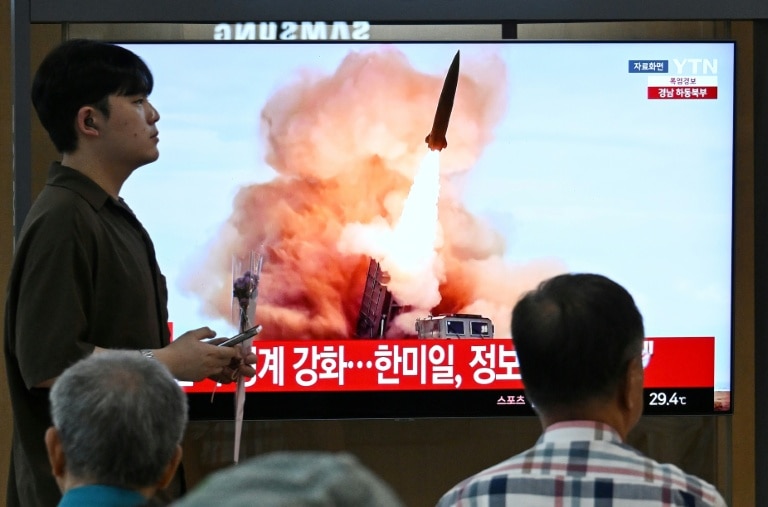
On Thursday, North Korea launched multiple short-range ballistic missiles, South Korea’s military confirmed, just hours after former U.S. President Donald Trump revealed he planned to meet North Korean leader Kim Jong Un later in 2025. The missile tests came as Washington and Seoul held a truncated version of their annual joint military drills, Ulchi Freedom Shield, after Trump ordered the exercises to be scaled down.
Pyongyang has a long history of denouncing U.S.-South Korea joint military drills as invasion rehearsals, and regularly test-fires missiles in tandem with these exercises. Trump, who is seeking to rebuild the personal rapport he claims to have built with Kim during his first presidential term, told reporters at the White House on Wednesday that a meeting with the North Korean leader was scheduled for later this year. He added that building a positive working relationship with Kim was a critical priority, and noted that Pyongyang currently possesses an estimated 57 highly capable nuclear weapons – a figure that conflicts with Seoul’s estimate of between 80 and 120 nuclear devices.
South Korea’s Joint Chiefs of Staff reported that more than 10 short-range ballistic missiles were launched from the Pyongyang region at approximately 5:00 p.m. local time, headed toward the East Sea. Each missile traveled roughly 300 kilometers, the JCS added, noting that South Korean and U.S. national security agencies are currently conducting a deep analysis of the missiles’ technical specifications.
Following the launches, South Korea’s presidential office convened an emergency national security meeting, where officials condemned the tests as a clear violation of United Nations Security Council resolutions and ordered a dramatic increase in military readiness across the country.
Trump’s unexpected renewed focus on Kim and his decision to cut the joint drills short have already sparked alarm among U.S. allies in Asia, with political analysts speculating that the move is an attempt to secure a high-profile foreign policy victory amid stalled negotiations over Iran’s nuclear program.
Kim Yo Jong, the influential sister of North Korea’s leader, released a statement Wednesday saying that Kim Jong Un retains positive memories and personal feelings toward Trump, and that the relationship between the two leaders remains strong. However, she also clarified that there is no awareness of any ongoing diplomatic communication between the two sides at this time.
Her comments came just hours after Seoul confirmed that Ulchi Freedom Shield would wrap up on Friday, roughly one week ahead of its originally scheduled conclusion, following a formal suggestion from the U.S. to cut the exercises short. Pentagon officials have pushed back against concerns, saying the reduced scale of the drills does not undermine U.S. military training goals. The drills are formally structured to prepare allied forces for a potential large-scale attack from North Korea.
The U.S. currently stations roughly 28,500 military personnel in South Korea to reinforce the country’s defensive capabilities, a lingering security arrangement from the 1950-1953 Korean War, which ended in an armistice rather than a formal peace treaty that would formally end hostilities.
South Korean Defense Minister Ahn Gyu-back has confirmed that Seoul remains firmly opposed to officially recognizing Pyongyang as a legitimate nuclear-armed state. When asked if Washington had abandoned its long-stated goal of North Korean denuclearization, Ahn said he does not believe that is the case. South Korean President Lee Jae Myung, who has long pushed for stronger indigenous South Korean defense capabilities to reduce reliance on the U.S. security umbrella, said Wednesday that his administration will do everything in its power to support Trump’s diplomatic outreach to Pyongyang.