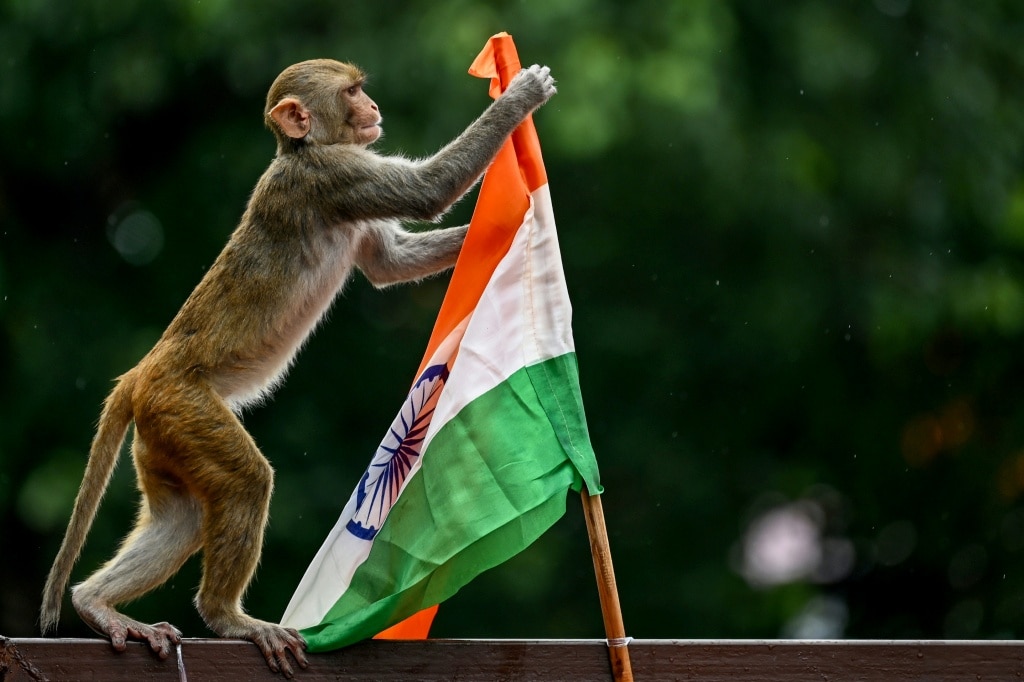
As the world’s top-ranked badminton athletes arrive in New Delhi for one of the sport’s most high-profile annual global tournaments, one unlikely team of local specialists has been brought on board to handle a uniquely South Asian problem. Instead of focusing on the on-court action between the world’s best players, these four men keep their gaze trained on the tree lines, rafters and open spaces surrounding the Indira Gandhi Indoor Stadium, watching for mischievous rhesus macaques that have a long history of disrupting events in the Indian capital.
Sixty-five-year-old Nazar Khan, a third-generation monkey handler, is the lead member of this specialist team hired to keep simian intruders from crashing the championship, which kicks off Monday. The venue already has a problematic reputation for uninvited animal guests: during January’s India Open tournament, a rhesus monkey was spotted wandering through the spectator stands, while bird droppings and fallen nesting debris interrupted competitive play, sparking widespread public criticism of event organizers. Eager to avoid a repeat of this embarrassing disruption, tournament planners turned to a time-tested local solution: “monkey whisperers”, also called monkey wallahs, who use specialized calls mimicking langurs — the natural predator of the smaller, more aggressive rhesus macaques that roam New Delhi’s urban areas.
Khan explained that his family has worked in animal-related trades for multiple generations. “We started doing street performances with trained monkeys and dancing bears,” he told AFP in an interview on site. “But that trade was banned, so to keep food on the table, we shifted to chasing problem monkeys away from residential and event spaces. We used to keep live langurs with us to scare off the macaques, but that practice was also banned by regulators.”
Monkeys hold a revered cultural status in majority-Hindu India, but they have become a persistent public nuisance in the national capital. Troops of urban macaques regularly destroy gardens, ransack office and residential spaces, and have been known to launch vicious attacks on humans while searching for food. For decades, handlers with trained black-faced langurs were a common sight on New Delhi’s streets, patrolling to shoo away troublesome macaque troops. However, that practice ended after a high court ruling banned the capture and commercial use of wild langurs, leaving legacy handlers like Khan to rely on generations of learned skill, sharp observational instincts, and remarkably accurate mimicked animal calls to do the job.
Speaking about the macaques that frequent the badminton championship venue, Khan noted: “There are three or four regulars that hang around here, including two large ones that locals say are particularly aggressive. But we use specific, specialized calls that scare them off — we know our trade inside and out.”
Beyond managing macaques, Khan added that the team takes on extra animal control work around the stadium: “We also have to round up stray dogs that wander onto the grounds and move them outside the venue perimeter. But we always make sure no animal is hurt in the process.” He shared a point of family pride, noting that his own grandson is part of a similar team assigned to keep monkeys away from Indian Prime Minister Narendra Modi’s central office complex.
Faryad Ali, Khan’s nephew and fellow monkey whisperer, recently demonstrated the team’s craft, unleashing a rapid, convincing sequence of hoots, screeches and guttural growls that match langur warning calls perfectly. Like any trade centered on working around wild animals, the job comes with inherent risks. “There are always dangers in this work — sometimes we get bitten by the monkeys,” Ali explained, showing old bite scars on his back. “But that’s just part of the job. We get bitten, we treat it with chilli powder to keep infection away, and we get back to work. No fancy injections, no time off.”
News of the unusual hire for the global badminton championship sparked waves of ridicule on Indian social media, but top Indian badminton star and Olympic medalist P.V. Sindhu came out in defense of the strategy, writing on X: “You can laugh at the solution, but you have to love the effort.” Sindhu drew a parallel to one of the world’s most iconic sporting events, noting that Wimbledon has long employed Rufus the hawk to keep feral pigeons away from its legendary grass courts. “Every major sporting event has its own local challenges,” she explained. “This is just one additional safety measure on top of the dozens of other precautions organizers have already put in place.”
Tournament organizers confirm that the monkey whisperer team is only one small part of a broader, multi-layered animal control plan designed to prevent a repeat of the January disruptions. Non-toxic, sticky gel has already been applied to roof beams and ventilation ducts across the stadium to deter feral pigeons from roosting on site. Sanjay Mishra, secretary of the Badminton Association of India, said officials are leaving nothing to chance this year. “I am 100 percent confident that we will not see any repeats of the pigeon, bird or animal-related disruptions that happened during the India Open this January,” he said. “This tournament will go off without any of those issues.”