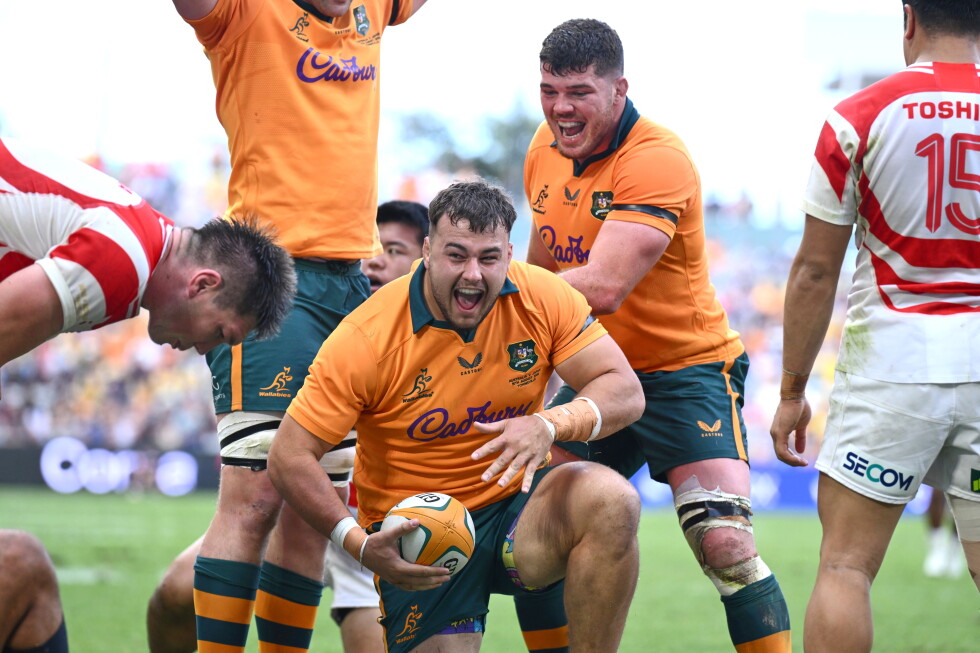
In a landmark moment for Australian rugby played out in Townsville on Saturday, 22-year-old forward Massimo De Lutiis etched his name into Wallabies history: when he came on as a 50th-minute replacement for veteran prop Taniela Tupou, he became the 1,000th player to earn a senior cap for the national side. Not content just to claim the milestone, De Lutiis capped his debut with a try, powering Australia to a dominant 56-17 victory over Japan that sealed a two-test series sweep for the home side. Tupou, the player De Lutiis replaced, had already set a strong first-half foundation, crossing the try line twice to anchor Australia’s attack in a tightly contested opening 40 minutes. Just one minute after entering the field, De Lutiis was in the right place to support fellow front rower Angus Bell’s try, which stretched Australia’s lead to 26-17. Eight minutes later, the debutant scored his own try, finishing a clinical Australian attacking move that began when flyhalf Carter Gordon broke through Japan’s defensive line and charged 30 meters toward the right corner. Scrumhalf Ryan Lonergan converted De Lutiis’ try — his fifth successful conversion of the match — extending Australia’s advantage to 18 points with 20 minutes still left to play. The first half had been far from comfortable for the Wallabies, who were caught off guard by Japan’s blistering defensive line speed and unrelenting attacking enterprise that pushed the Australian side onto the back foot for long stretches. Japan capitalized on their early momentum to hold a one-try lead at one point in the opening half, forcing new Wallabies head coach Les Kiss to deliver a galvanizing halftime team talk that turned the tide of the match. Wallabies captain Harry Wilson noted after the game that the squad responded to Kiss’s challenge by playing with far more energy and attacking spark after the break, with De Lutiis’ introduction injecting an extra jolt of intensity into the Australian lineup. “A team like Japan, if you’re not up for it, they’re really going to make you pay,” Wilson said. “It’s really special — 1000 Wallabies, incredible. Someone like Massimo, he’s a proud Australian. Really special moment.” Three late tries from the Wallabies blew out the final scoreline, turning a narrow 21-17 halftime lead into a 39-point winning margin. The victory also gave Australia their first three-match winning streak since 2024, building on early momentum for new head coach Les Kiss. The side defeated Italy last month in Joe Schmidt’s final match as interim head coach, then notched a narrow 35-32 win over Japan in Osaka the previous weekend in Kiss’s first test in charge. Japan captain Warner Dearns said after the match that his side had executed their game plan effectively in the opening half, doing everything possible to compete with Australia’s physically larger forward pack. “Really hard battle,” Dearns said. “We knew that the Wallabies were going to come out hard. We put a real emphasis on trying to move them around and play fast rugby. We did it well in the first half.” Japan’s half-back pairing of Naoto Saito and Ryunosuke Ito consistently generated quick, clean possession in the opening 35 minutes, repeatedly finding gaps in Australia’s defensive line. Australia twice claimed early leads through tries from Josh Nasser and Tupou, but Japan rallied back both times to turn the game on its head. Australian-born lock Harry Hockings, who previously played 28 games for the Queensland Reds, charged down a poor exit kick from Lonergan at the base of a ruck and dived on the loose ball in the in-goal area for a try. Saito then caught Australia’s defense napping with a quick penalty tap, darting over from close range to add another five points. Japan moved into the lead in the 33rd minute when center Dylan Riley, another Australian-born player in the Japan squad, beat two tackles and stretched over the line to score. But the Wallabies hit back just before halftime, working through a set piece lineout platform to advance upfield, where Tupou crashed over for his second try of the half. By the end of the match, front-row forwards had scored six of Australia’s eight tries, highlighting the forward pack’s dominance in the second half. For De Lutiis, the moment was more than just a historic milestone. “Like, even 1,000 is awesome, but just to be a Wallaby in general is just crazy to me — it’s a dream come true,” the debutant said.