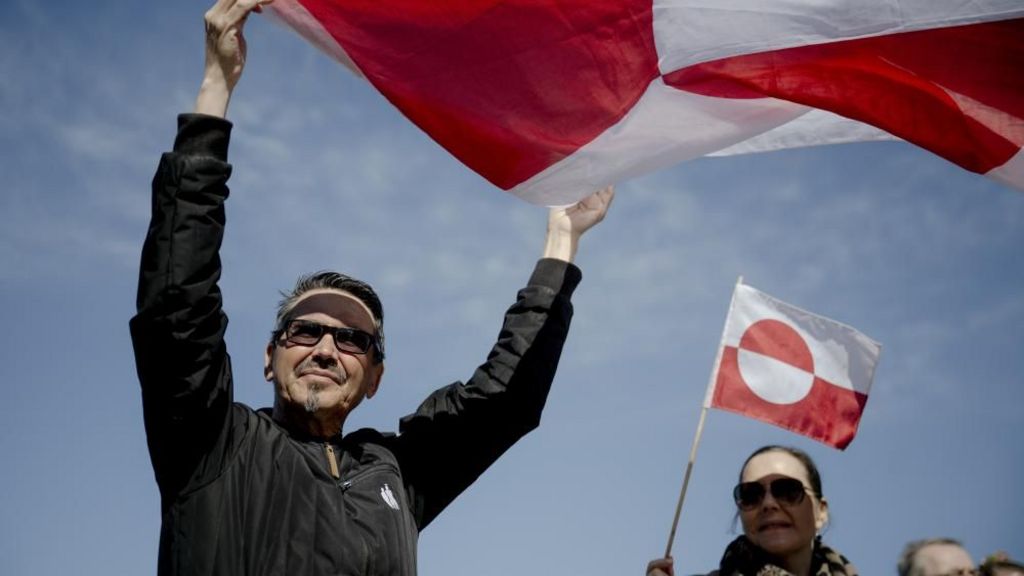
On a crisp Friday in Nuuk, the capital of Greenland, hundreds of local residents gathered outside the newly inaugurated American consulate to push back against what they see as growing United States overreach in the semi-autonomous Danish territory, sparked by former President Donald Trump’s long-stated ambition to expand U.S. influence over the Arctic island.
The demonstration capped a tense week that included the first official visit to Greenland by Jeff Landry, Trump’s special envoy for the region and the sitting Governor of Louisiana, a close ally of the U.S. president. Landry’s uninvited trip stirred immediate controversy, coming as high-stakes negotiations continue to resolve a diplomatic crisis triggered by Trump’s repeated public calls to acquire full control of Greenland for U.S. national security purposes. Landry departed for Washington D.C. on Wednesday evening and met with Trump at the White House Thursday, according to reporting from the BBC, though no readout of the closed-door meeting has been released.
Organizer Aqqalukkuluk Fontain made the crowd’s position clear from the start: Greenland’s elected government has already repeatedly rejected any U.S. claims to the territory, and that rejection remains unchanged. “Our government already told Donald Trump and his administration that Greenland is not for sale,” Fontain told reporters. Protesters marched through central Nuuk chanting “Greenland is for Greenlanders”, before gathering outside the new consulate to turn their backs on the building and stand in a united, silent demonstration against the U.S. presence. “Our message is for the American people and to the rest of the world,” Fontain, 37, told the BBC. “That in a democratic world, no means no.”
Many protesters echoed Fontain’s frustration, saying Landry’s trip and the opening of the new consulate represented a clear disregard for Greenlandic sovereignty. Inge Bisgaard, a protester in the crowd, told the BBC that residents were still recovering from the initial shock of Trump’s 2025 declaration that the U.S. should “own” Greenland, only for the debate to reignite early this year. “We get this fear from the United States. People were just recovering from last time, when it all began again in January,” she said. Twenty-five-year-old protester Parnuna Olsen went a step further, questioning why the U.S. required a large new diplomatic mission in Greenland at all.
The 3,000 square-meter consulate, a major upgrade from the United States’ previous small, cabin-sized diplomatic outpost, occupies a prominent central spot in downtown Nuuk. Locals have already nicknamed the high-rise building “Trump towers”, a nod to the president’s personal role in pushing for expanded U.S. presence, and for many Greenlandic residents, the new facility is an unwelcome marker of growing American influence at a deeply sensitive moment for regional relations. While U.S. Ambassador to Denmark Kenneth Howery opened the mission last week with a ukulele performance of the American national anthem and a plaque unveiling, Greenland’s top political leaders largely boycotted the event. Prime Minister Jens-Frederik Nielsen declined the invitation to attend, and no members of his cabinet were present. Naaja Nathanielsen, one of two Greenlandic members of the Danish parliament, also turned down her invitation, noting that the boycott was an intentional signal to Washington.
During his three-day trip, Landry attended a scheduled business summit but spent minimal time at the event, instead holding meetings with Nielsen, current and former Greenlandic foreign ministers, and local business leaders as part of what the U.S. describes as an effort to “build ties and make friends”. This so-called “charm offensive” failed to win over many local stakeholders, however, with multiple Greenlandic figures turning down meeting requests from Landry. In an interview with local newspaper *Sermitsiaq*, Landry stoked existing tensions by openly backing Greenland’s long-held hopes of full independence from Denmark, claiming “I think Greenland could have an equally good or even better economy as an independent country.” When pressed on whether the Trump administration would respect Greenland’s clearly stated red lines on sovereignty, Landry gave a provocative response: “There is only one line for us. It is red, white and blue.”
In a statement to the BBC following Landry’s meeting with Trump, a White House spokesperson offered only a vague, optimistic update on U.S. goals in the region, saying “The United States is optimistic that we are on a good trajectory to address U.S. national security interests in Greenland.” The spokesperson also praised Landry’s work, calling him “a strong asset to the world-class team that President Trump has put together.”
Trump has repeatedly framed his push for greater control over Greenland as a matter of critical U.S. national security, pointing to the island’s strategic location in the Arctic, where the U.S. competes for influence with Russia and China. A bilateral working group has been meeting to negotiate a new agreement that would expand U.S. military presence in Greenland, but no final deal has yet been reached. At the height of the Cold War, the U.S. maintained 17 active military bases across Greenland; today it only operates one, the Pituffik Space Base. Earlier this year, a U.S. Northern Command spokesperson confirmed the military is pursuing infrastructure upgrades at Pituffik, and is also evaluating additional potential base sites at Narsarsuaq and Kangerlussuaq.
While Greenland’s prime minister suggested this week that the working group talks were making gradual progress, a New York Times report published earlier this week laid bare deep sovereignty concerns among Greenlandic leaders and residents. According to the report, U.S. negotiators are demanding two key concessions: the right for U.S. troops to remain in Greenland indefinitely, and authority to veto major third-party infrastructure investments in the territory to block Chinese and Russian influence. The growing tensions come ahead of a key NATO security summit in Sweden Friday, where U.S. Secretary of State Marco Rubio is set to meet allied ministers to discuss Arctic regional security.