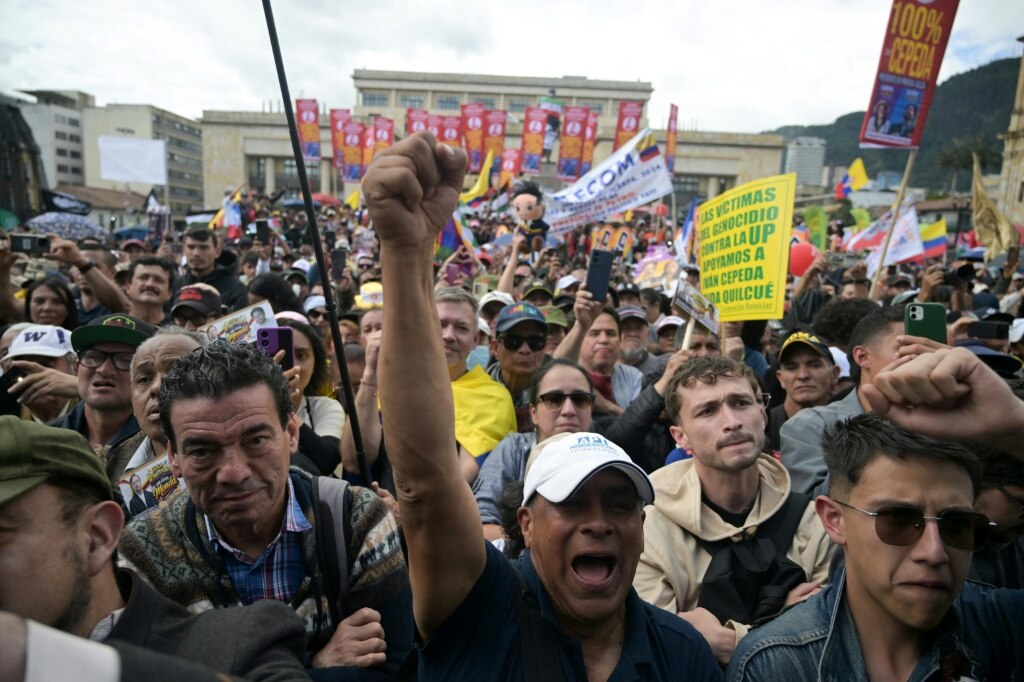
As Colombia prepares to head to the polls on May 31 to elect a successor to its historic first leftist government, working-class voters and left-wing political leaders are drawing a firm line in the sand: there will be no return to the old order that dominated the country for generations.
Four years after former guerrilla Gustavo Petro made history by winning the presidency, breaking a century of conservative and elite rule, two right-wing contenders are fighting to flip the executive branch and roll back the progressive social and labor reforms Petro enacted during his term. But at a raucous May Day rally held in central Bogota on Friday, thousands of working-class supporters packed the plaza outside Congress to rally behind Petro’s handpicked political heir, Senator Ivan Cepeda, who is currently leading polls in the race’s first round.
Cepeda used the address to warn attendees that hard-won labor gains—including an unprecedented 23% increase to the national minimum wage, and expanded overtime pay for night and weekend shifts enacted as part of Petro’s landmark 2024 labor reform—would be immediately rolled back if a right-wing government took power. He slammed his two leading rivals, ultra-right lawyer Abelardo de la Espriella and conservative Senator Paloma Valencia, as standard-bearers for the same neoliberal model that concentrated wealth in the hands of a small, unproductive elite for decades before Petro took office in 2022. “Comrades, don’t allow them to take away what we have achieved!” Cepeda told the cheering crowd under the hot Andean sun. Former Health Minister Carolina Corcho echoed the rallying cry, telling supporters: “The people have awoken. There’s no going back.”
Just a few months ago, political analysts widely predicted a right-wing wave would wash over Colombia, following a regional trend that saw voters oust left-wing governments across Latin America from Argentina to Chile and Bolivia, with critics faulting incumbents for mismanaging economies, failing to curb rising crime, and tolerating corruption. Petro himself faced intense scrutiny from U.S. President Donald Trump earlier this year, who threatened the Colombian leader after he supported ousted Venezuelan left-wing president Nicolas Maduro. But a diplomatic reset during a recent White House meeting between the two leaders, paired with the popular minimum wage hike, has sent Petro’s approval ratings soaring—and lifted Cepeda’s polling numbers with them.
For ordinary working Colombians, the labor reforms have delivered tangible change. Alejandro Guayara, a 38-year-old doorman at a Bogota apartment building and father of two who struggled to make ends meet for years, said the minimum wage increase brought his family much-needed “peace of mind.” While only 2.4 million Colombians earn the federal minimum wage, millions more have benefited from the overtime pay expansions included in Petro’s labor overhaul. “People have experienced new-found hope with this president because ordinary people are being taken into account,” Guayara said. Jose Cruz, a 60-year-old former member of the M-19 guerrilla group that Petro belonged to in his youth, echoed that sentiment, telling Agence France-Presse: “Today the power is in our hands, that of the people.”
Still, Petro’s administration has faced persistent criticism over a sharp rise in guerrilla and dissident violence across the country, a issue the right-wing candidates have centered their campaigns on. Critics have long used Petro’s past as a member of M-19, which disarmed in 1990, to accuse him of being too soft on the dozens of armed groups and cocaine trafficking networks that control large swathes of northeastern and southern Colombia. Last year was the most violent Colombia has seen in the decade since the FARC Marxist rebel army signed a historic peace deal ending a 50-year civil war, and just last weekend, a dissident FARC faction opposed to the 2016 peace deal bombed a southern Colombian highway, killing 21 people—a attack the faction later called an “error.”
Yann Basset, a political science professor at Bogota’s University of Rosario, noted that for decades, Colombia’s left was tarred by its public association with leftist guerrilla violence. But today, he said, “a large part of the population associate it with something else, with the social reforms of the Petro government in particular, and much less with violence.” Still, the surge in violence has eroded support for Cepeda, who was a key architect of Petro’s peace negotiation strategy with armed groups, among some left-leaning voters. The security crisis has also boosted support for the right-wing candidates’ signature “mano dura” (hard hand) crackdown policy, which calls for harsher prison sentences and aggressive policing of armed groups. For many younger voters like 18-year-old engineering student Juan Manuel Cespedes, the security situation has become untenable. “Security has been terrible in recent years,” Cespedes said, echoing the right’s call for harsher penalties.
Polling currently shows Cepeda leading the first round of voting, but no candidate is projected to hit the 50% threshold needed to win outright, meaning the race will almost certainly go to a run-off. It remains unclear whether Cepeda can hold onto his lead against either de la Espriella or Valencia in a head-to-head race, leaving Colombia’s political future hanging in the balance as voters head to the polls next week.