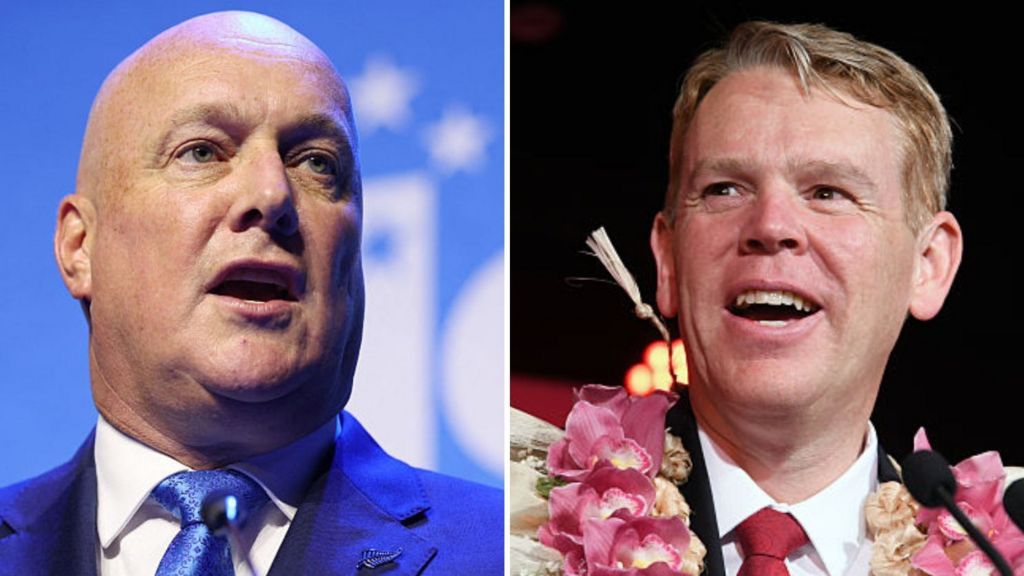
In the immediate aftermath of New Zealand’s Saturday general election, no definitive governing victor has emerged, setting the stage for weeks of tense coalition negotiations as the country’s top political leaders navigate a fragmented parliamentary landscape. Preliminary vote tallies, which account for over 99% of all standard ballots cast, show centre-right incumbent Prime Minister Christopher Luxon’s National Party as the single largest faction with 42 seats, still 19 seats short of the absolute 61-seat threshold required for a standalone majority in the 120-seat legislature. Even with its traditional ideological allies, the libertarian ACT Party and populist New Zealand First, the centre-right bloc only holds a razor-thin potential seat advantage over the opposing left-leaning coalition, pending final vote verification and formal negotiation agreements. Opposition Labour Party leader Chris Hipkins, whose centre-left party secured 36 seats in the preliminary count, has refused to concede defeat, emphasizing that the final shape of New Zealand’s next governing administration will remain undetermined for the foreseeable future. The unusually tight electoral race was dominated by voter priorities around skyrocketing cost of living pressures and stagnant unemployment rates, which overshadowed most other policy debates across the 2024 campaign trail. Full preliminary seat allocations list the Green Party at 16, ACT at 13, New Zealand First at 12, the newly represented centrist Opportunity Party at 7, and Te Pāti Māori – the dedicated party advocating for Indigenous Māori community interests – at 5. The official, final certified results will not be published by New Zealand’s Electoral Commission until 27 November, after the three-week processing window for special votes, which include ballots cast by voters outside their home electorate and New Zealand citizens residing overseas. In his first public address to supporters on election night, Prime Minister Luxon extended congratulations to Hipkins for a fiercely competitive campaign, noting that his National caucus had much to be proud of regardless of the final tally. He confirmed he would lead a caretaker administrative government to oversee routine state operations until the official results are released, at which point formal, binding coalition negotiations can commence. For his part, Hipkins acknowledged that New Zealand’s electorate had made its voice heard, but noted it would take additional time to fully unpack the public’s collective mandate, adding that the upcoming parliamentary term would demand unprecedented levels of cross-party compromise and collaborative problem-solving. Notably, the two traditional major parties – National and Labour – posted a historically low combined vote share of roughly 60%, marking a dramatic shift away from New Zealand’s longstanding two-party political norm. The centrist Opportunity Party, which crossed the 5% popular vote threshold required to secure parliamentary representation for the very first time, has emerged as the election’s undisputed kingmaker, with party leader Qiulae Wong confirming the faction is open to forming a governing partnership with either the centre-right or centre-left bloc. Wong specified that the Opportunity Party will initiate negotiation talks first with whichever faction finishes with the highest total number of seats once all votes are counted, framing her party’s entry into parliament as a chance to rewrite conventional political norms to prioritize long-term, future-focused policies for younger generations. University of Otago election law expert Professor Andrew Geddis emphasized that the Opportunity Party’s status as an unaligned wildcard gives it the decisive leverage to determine which political bloc can secure enough seats to form a stable government, noting that final seat allocations could shift dramatically based on razor-thin margins in individual electorates once special votes are tallied. Roy Morgan polling director Julian McCrann confirmed that cost of living was the singular top issue driving voter decision-making across the country, pointing out that many New Zealand voters felt Luxon’s government had failed to deliver on 2020 campaign promises to ease household financial strain. An annual national social cohesion survey released ahead of the election found that more than half of New Zealand residents no longer view the country as a “land of opportunity”, coinciding with record levels of Kiwi emigration, most of it directed to neighboring Australia. Under New Zealand’s longstanding mixed-member proportional (MMP) electoral system, voters cast two separate ballots: one for their local constituency representative, and one for a national political party list, a framework that has made coalition governments the standard rather than the exception for most of the country’s modern political history.