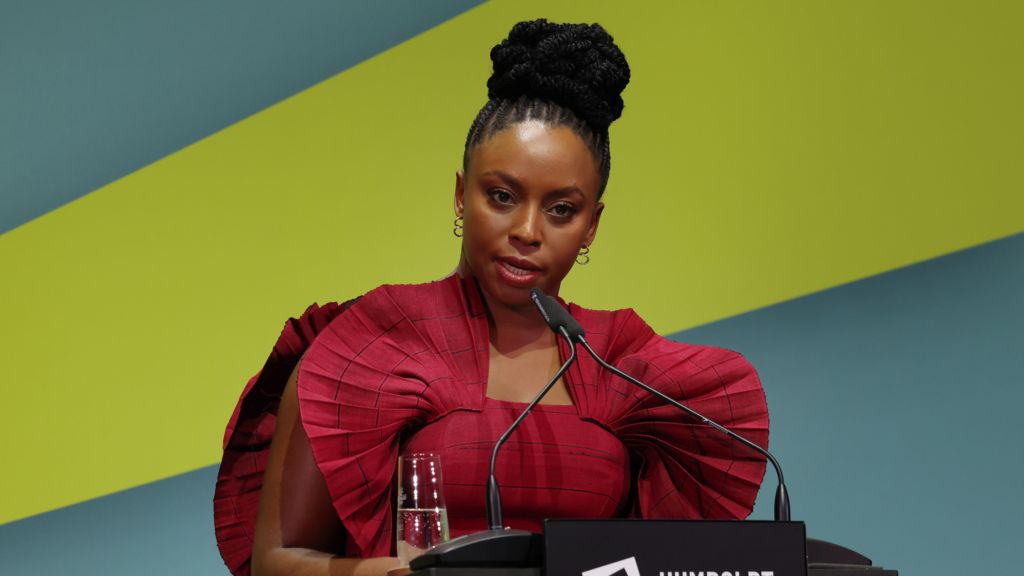
One of the world’s most decorated contemporary authors, Nigerian writer Chimamanda Ngozi Adichie, has gone public with searing accusations against a private Lagos hospital, claiming the facility has actively obstructed a mandatory coronial inquiry into the January death of her 21-month-old son, Nkanu.
Nkanu, one half of a pair of twin boys born to Adichie via surrogacy in 2024, died on January 7 at Euracare Hospital, just days after Adichie, who normally resides in the United States, had traveled to Nigeria for the 2023 Christmas holiday. The toddler had first been admitted to Atlantis Hospital, another Lagos facility, for what clinicians classified as a worsening but still mild illness. Medical teams had arranged to transfer Nkanu to the United States for specialized care at Baltimore’s world-renowned Johns Hopkins Hospital, and he was referred to Euracare solely to complete pre-transfer diagnostic checks, including an MRI and a lumbar puncture, also called a spinal tap. He died shortly after completing these procedures at Euracare.
In a dramatic break from her silence since the tragedy, Adichie published an open letter she sent to Euracare’s director back in April across her social media channels recently, laying bare her allegations and her grief. The coronial inquest into Nkanu’s death was scheduled to launch in April, but Adichie claims Euracare has spent months stalling, obscuring key details, and deliberately muddying the process of investigation. Most recently, the hospital filed a request with Nigeria’s Federal High Court to formally block the public inquiry entirely.
Adichie and her legal team have levied formal claims of medical negligence against Euracare. They allege that clinical staff at the hospital denied Nkanu sufficient oxygen and administered excessive doses of sedation, a combination that triggered the cardiac arrest that killed the toddler. Adichie also called out the hospital’s official cause of death listed on Nkanu’s death certificate — bacterial meningitis — saying there is no verifiable medical evidence to support that diagnosis. She further accuses the facility of turning over incomplete and inaccurately altered medical records, a practice she described as strikingly unprofessional for a private tertiary hospital.
In her public post accompanying the letter, Adichie opened up about the personal toll of the prolonged fight for answers. “The ultimate and utter loneliness of grief is that only you can know the true depth of your despair,” she wrote. “I long for, at least, peace to mourn, but Euracare Hospital has robbed me even of that.” She added, “If Euracare cares about the truth, then why create delays and distractions and now, finally, try to stop an inquest?”
Euracare has pushed back against all allegations of wrongdoing. The facility has issued a statement offering its deepest sympathies to Adichie and her family over the loss of Nkanu, but maintains that all clinical care provided to the toddler aligned with global medical standards. The BBC has reached out to Euracare for additional comment in response to Adichie’s recent public allegations, and has not yet received a response.
A preliminary investigation conducted by a panel convened by Nigeria’s Medical and Dental Council, the nation’s top regulatory body for medical practitioners and facilities, previously found evidence supporting a plausible claim of medical negligence against Euracare. Adichie’s legal team has submitted all evidence of the alleged negligence and obstruction to the Federal High Court as part of their response to the hospital’s motion to block the inquest. The court has not yet issued a ruling on the hospital’s request.
Adichie, whose decades-long career has earned her global acclaim, is best known for award-winning works including *Half of a Yellow Sun* (2006) and *Americanah* (2013). Beyond her literary work, she has regularly taken part in high-profile global public events, recently hosting discussions with leading global figures including former U.S. Vice President Kamala Harris and former German Chancellor Angela Merkel.