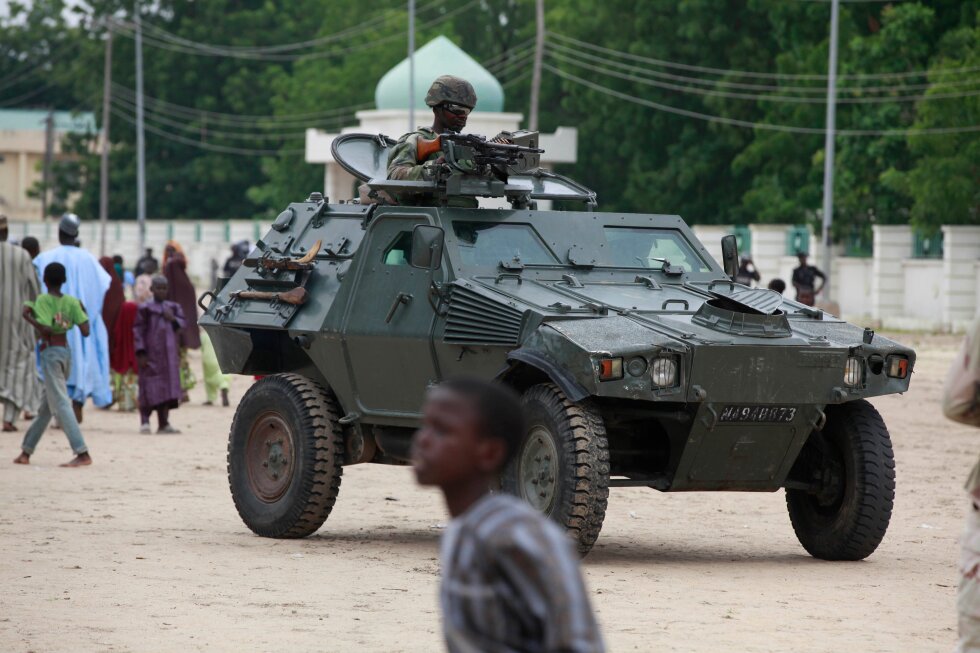
On an early Thursday morning in Nigeria’s restive northeastern Borno State, a brazen pre-dawn raid on a military installation in Benisheikh left a brigadier general and an unspecified number of service members dead, according to official Nigerian military and government statements. While the attack succeeded in killing senior military personnel, security forces successfully repelled the assault, army spokesperson Michael Onoja confirmed in an official release.
Onoja labeled the attackers “terrorists,” the standard terminology the Nigerian military uses for members of the multiple Islamic insurgent groups that have waged a decade-long campaign of violence across the country’s northern regions. Nigeria’s President Bola Tinubu later released a formal statement identifying the fallen senior officer as Brigadier General Oseni Omoh Braimah, extending his deepest condolences to the families of all troops killed in the confrontation.
In his remarks, Tinubu framed the deadly attack as a signal of growing insurgent desperation amid government military pressure. “The insurgents’ counterattack is a sign of desperation,” the president said. “I extend my condolences to the families of our gallant soldiers, led by Brigadier General Oseni Omoh Braimah, who made the ultimate sacrifice in the defense of our country today in Borno State. The government will never forget their sacrifices.”
Tinubu reaffirmed the federal government’s unwavering commitment to eradicating extremist violence across the nation, adding: “Their sacrifices will not be in vain. Because of the courage and dedication of our troops on the front line, our resolve to defeat terrorism and all forms of violence across Nigeria is stronger than ever.”
Echoing the president’s framing, Onoja emphasized that the raid came as insurgent groups have sustained heavy territorial and manpower losses from recent Nigerian military offensives, pushing them to carry out reckless, doomed attacks against fortified military outposts. “This attack is a clear indication of the desperation of terrorist elements who, having suffered significant losses in recent operations, continue to resort to futile and ill-fated offensives against well-defended military positions,” he said. “Regrettably, the encounter resulted in the loss of a few brave and gallant soldiers who paid the supreme price in the line of duty.”
The attack unfolds against the backdrop of a years-long, deteriorating security crisis across northern Nigeria. Africa’s most populous nation has struggled to contain overlapping insurgencies and militia violence for more than a decade, with the northeast being the epicenter of the conflict. Two of the most prominent active groups are the original Boko Haram insurgent organization and its breakaway faction, the Islamic State West Africa Province (ISWAP), which pledged allegiance to the Islamic State. In the country’s northwest, bordering Niger, the IS-affiliated Lakurawa network also carries out regular attacks on security forces and civilian targets, alongside widespread ransom kidnappings.
In recent years, the crisis has expanded further, with extremist groups from the neighboring Sahel region expanding their operations into Nigerian territory. Last year, Jama’at Nusrat al-Islam wal-Muslimin (JNIM), a major al-Qaeda-affiliated Sahel insurgent group, carried out its first claimed attack on Nigerian soil, marking a worrying expansion of regional insecurity.
Earlier in 2024, the United States deployed 200 U.S. troops and surveillance drones to Nigeria as part of a new security cooperation agreement to support Nigerian counter-insurgency efforts. U.S. military officials stressed that American personnel would not participate in direct combat operations, retaining no operational command authority that remains fully in the hands of Nigerian security forces. The deployment was agreed on after former U.S. President Donald Trump raised public claims that Christian communities were being disproportionately targeted in Nigeria’s ongoing violence. Most recently, U.S. forces carried out targeted airstrikes against Islamic State positions in the region on December 26.
According to United Nations data, the decade-long insurgency has claimed the lives of thousands of Nigerian civilians and security personnel. Many independent security analysts have repeatedly criticized the Nigerian federal government for failing to deploy sufficient resources and effective strategy to protect civilian populations and end the long-running conflict.