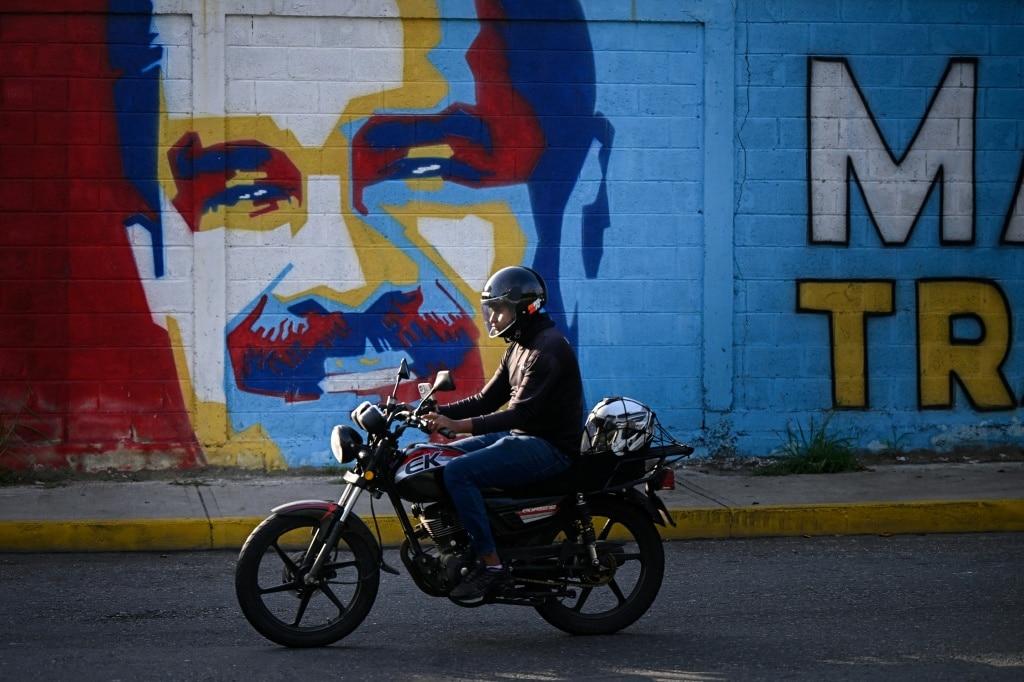
In early January 2026, a lightning special forces raid by the United States in central Caracas stunned the world: Venezuela’s long-ruling leftist former president Nicolas Maduro was taken into custody alongside his wife Cilia Flores, and immediately extradited to New York to face federal drug trafficking charges. Four months on, the once-ubiquitous face of Maduro — which for years dominated Venezuelan public life, appearing on everything from nightly state television broadcasts and street murals to public construction signage and even children’s toys — is rapidly being erased from the national landscape.
The interim government led by former Chavismo figure Delcy Rodriguez, which took power following Maduro’s ouster, has overseen this gradual removal of Maduro’s image from public spaces as it pursues a dramatic geopolitical realignment with Washington. To mark its first 100 days in office, Rodriguez’s administration adopted the unapologetic slogan “The beginning of a new chapter” — a clear signal of its break with the Maduro era.
Under intense pressure from the United States, which has threatened further military intervention if its demands are not met, Rodriguez has prioritized sweeping policy changes aligned with U.S. interests: landmark reforms opening Venezuela’s lucrative hydrocarbon and mining sectors to foreign investment, alongside a broad amnesty program that has released hundreds of political opponents imprisoned under Maduro. She has also purged dozens of Maduro-appointed senior ministers from government, systematically weakening the former leader’s remaining ties to state institutions.
Eduardo Valero Castro, a professor of political science at Venezuela’s Central University, explained the deliberate nature of this shift. “We have seen how the figure of former president Nicolas Maduro has been gradually retired from public spaces,” he told AFP. “There is a new intentionality in Venezuelan politics, fully aligned with the new geopolitical alliance frameworks between Caracas and Washington.”
Rodriguez has pushed back hard against accusations of betraying her former mentor, who she insists she remained loyal to “until the last second.” Speaking at a public event in April, she dismissed her critics’ claims as petty and irrelevant. “Those who, out of pettiness, out of irrationality, say what they say about me, I’m going to tell them something: It’s irrelevant compared to what it means to defend Venezuela,” she said.
But the shift has exposed deep internal fractures within the Chavismo movement that Maduro led. Senior former Chavismo figures have openly condemned Rodriguez’s alignment with Washington. “I communicated this internally: we have become a lowly protectorate of the United States,” former pro-Maduro lawmaker Mario Silva wrote in an open letter to Diosdado Cabello, Venezuela’s powerful interior minister and one of Maduro’s closest remaining allies. “No pressure can justify collaborating with an aggressor,” Silva added.
Cabello, who remains in his post under the interim government, recently faced public criticism on his weekly television show over what critics called a “weak campaign” to secure Maduro’s release. He reaffirmed the movement’s official stance: “Our goal from the very beginning, our main objective, is for Cilia and Nicolas to come back.”
Silva’s public critique sparked fierce pushback from other Chavismo members, who deemed his comments out of line — a clear reflection of the growing rifts between hardline pro-Maduro factions and those who have accepted the new political order. Even among rank-and-file Chavismo supporters, many are frustrated that Maduro has largely disappeared from public discourse. At a recent march calling for an end to crippling U.S. sanctions on Venezuela, 64-year-old Chavista Ana Maria Pinto told AFP: “We want people to talk about him more, because that is not happening, he is not being taken into account.”
Alquimedes Rios, a leader of a Chavismo-affiliated community council, argued that activists have continued to organize to demand Maduro’s return from U.S. custody. “Our interim president Delcy Rodriguez continues negotiating, continues talking in order for our president Nicolas Maduro to return,” he said. “Have they not done enough? That could be, but we have been fighting to make that possible.”
For many ordinary Venezuelans, the reality of the situation is more nuanced. Juan Garcia, a 21-year-old fisherman from the coastal Sucre state, acknowledged the overwhelming challenges Rodriguez faces. “They’re acting through diplomacy, because we’re not going to bring him back through force,” he said.
Political analysts say the future of Maduro’s legacy will be tied directly to the success of Rodriguez’s economic agenda. Jesus Castillo-Molleda, a Venezuelan political scientist, noted that Maduro no longer represents a unifying force of stability for the fractured Chavismo movement. The movement, he argued, “is forced to accept this reality” of cooperating with Washington to survive. If Rodriguez can deliver sustained economic improvement for Venezuelans, Castillo-Molleda said, “Maduro will be forgotten more quickly.”