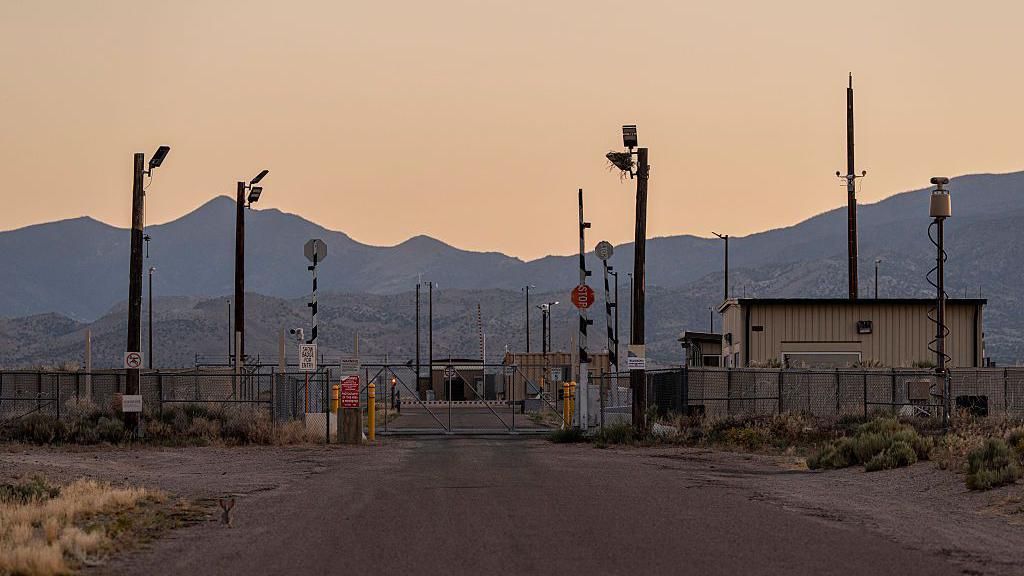
A lightning-caused wildfire burning adjacent to the United States’ most secretive military installation, Area 51 in southern Nevada, has exploded in size over nearly a week of burning, with containment efforts barely keeping pace, federal land management officials confirmed this week.
Dubbed the Quail Springs Fire, the blaze has already charred more than 13,500 acres (roughly 54.6 square kilometers) of dry, rugged terrain, and as of the latest update from the Bureau of Land Management (BLM), just 7% of the fire’s perimeter has been secured. The blaze is concentrated within the boundaries of the Nevada Test and Training Range (NTTR), a sprawling restricted military reservation closed to all unauthorized public access that sits directly adjacent to the classified Area 51 facility.
Firefighters have faced steep challenges in reining in the blaze, hampered by a combination of unforgiving terrain, triple-digit extreme heat, and gusty dry winds that have allowed the fire to jump containment lines and expand steadily. The entire region remains under an extreme heat warning through at least this coming Sunday, with forecasters predicting no significant precipitation in the near term to help douse the flames — conditions that are expected to keep fire activity high through the coming days.
As of the latest BLM update, no residential structures or public spaces are currently under immediate threat from the advancing fire. However, the small nearby community of Rachel has been placed under an official smoke advisory, warning residents of poor air quality that can pose respiratory risks for vulnerable groups.
The NTTR, where the fire is burning, has a long history as a core U.S. military testing ground, and its neighbor Area 51 carries an almost unparalleled reputation for secrecy. Originally established during the Cold War-era arms and technology race between the U.S. and the Soviet Union, Area 51 was built to develop and test cutting-edge military aircraft. Today, activities conducted within its secured boundaries remain highly classified, with the site ringed by warning signs, constant electronic surveillance, and armed patrols that bar all unauthorized entry.
This extreme secrecy has spawned decades of popular conspiracy theories, the most famous being unconfirmed claims that the U.S. government stores and studies crashed alien spacecraft and extraterrestrial remains at the site — claims federal officials have repeatedly and firmly denied.
The Quail Springs Fire is far from an isolated event this wildfire season. Across the western United States and southern Canada, dozens of large blazes are continuing to burn across millions of acres. Neighboring Oregon has already seen more than a million acres consumed by wildfire this year, while Canadian fire crews continue to battle hundreds of active blazes across the country’s western and northern regions, many of which have sent plumes of smoke across much of North America. Experts have linked the increasingly severe wildfire seasons across western North America to rising temperatures and prolonged drought driven by climate change, which create ideal conditions for large, fast-spreading blazes.