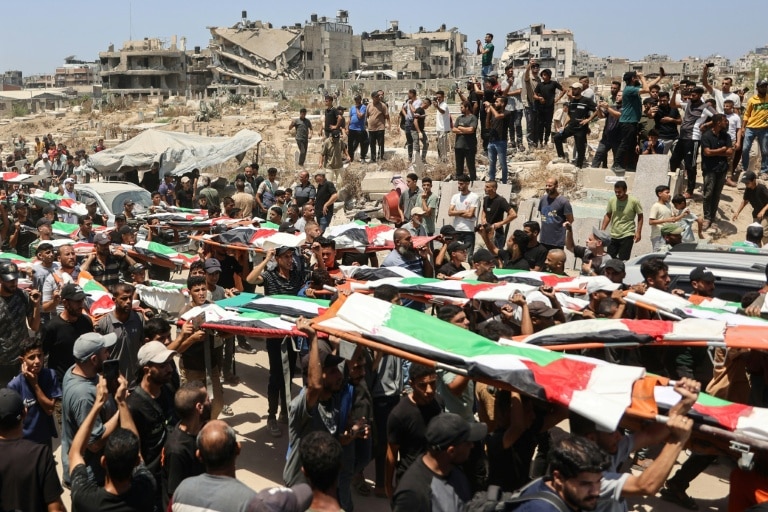
In a move that opens a clear rift between Israeli Prime Minister Benjamin Netanyahu and U.S. President Donald Trump, Netanyahu has formally rejected a 15-point U.S.-led Gaza peace plan that had already secured endorsement from Hamas, a decision driven by domestic political pressures ahead of Israel’s upcoming national elections on October 27. The first national election held since the devastating October 7, 2023 Hamas attack that ignited the ongoing Gaza war, the upcoming vote has left Netanyahu fighting to hold his position, with recent polls showing him neck-and-neck or trailing his competitors, and his right-wing political base uniformly opposed to the proposed framework. After more than a week of incremental public criticism of the plan, and even after U.S. negotiators offered assurances that Israel would not be required to begin an immediate military withdrawal from Gaza, Netanyahu bowed to pressure from his far-right coalition allies and announced his outright opposition to the deal during a Sunday cabinet meeting. “Israel rejects the 15-point document,” Netanyahu stated, referencing the proposal Hamas agreed to in late July. He added that the Israeli military “will not carry out any withdrawal until Hamas is genuinely disarmed, and will continue to thwart threats against our forces and our citizens.” While Netanyahu was careful to frame Trump, who has praised the deal as a landmark breakthrough for Middle Eastern peace, as “our greatest friend in the White House,” he made clear he had no intention of backing down from his opposition, noting that Israeli officials were formally presenting their objections to Washington. “They have ideas; some of them are acceptable to us and some are not, and we know how to stand our ground on these matters,” he said. The plan, overseen by the U.S.-created Board of Peace, is designed to prevent a repeat of the October 7 attack by establishing a phased process that begins with Hamas fully disarming, followed by an Israeli military withdrawal from the Gaza Strip. Nickolay Mladenov, the Board’s high representative for Gaza, defended the framework in an interview with Israel’s Channel 12, calling it the only viable path forward to long-term stability. “The option we are offering today is the only way forward that ensures this tragedy does not happen again,” Mladenov said. He added that the current phase of the agreement only binds the United States, Hamas, and the Board of Peace — with Israel not required to take on any obligations until Hamas surrenders all weapons, including small arms like Kalashnikov rifles — though an eventual Israeli pullout is a core requirement of the final deal. Mladenov said he remained hopeful that productive follow-up talks with Israeli officials would yield a positive outcome. The plan won Hamas’ endorsement just days after the group selected Khalil al-Hayya as its new leader, and Hamas officials are now calling on the U.S. to pressure Netanyahu to drop his opposition. “We expect the mediators and the American guarantor to pressure Netanyahu and his government to adhere to the roadmap, and not obstruct the process for internal political and electoral reasons,” Bassem Naim, a member of Hamas’ political bureau, told AFP. In an official statement, Hamas reaffirmed its ongoing commitment to the terms of the plan. The rejection marks the latest in a growing series of disagreements between Netanyahu and Trump, who has long positioned himself as the most pro-Israel U.S. president in history, including taking the unprecedented step of moving the U.S. embassy to Jerusalem. The two leaders jointly launched a military campaign against Iran in late February, but their alliance has frayed in recent months: as the conflict dragged on, dragging down Trump’s domestic approval ratings and pushing global oil prices sharply higher, Trump pushed for a ceasefire and a negotiated settlement, a position Netanyahu has resisted. Last week, just as U.S.-mediated ceasefire talks between Israel and Lebanon got underway, Netanyahu ordered new airstrikes on Lebanon in response to what Israel called a ceasefire violation by the Iran-backed militant group Hezbollah. The Gaza proposal is the next step in a U.S.-brokered ceasefire deal announced in October that has reduced the scale of Israeli military operations in Gaza but failed to end them entirely. Even with Netanyahu’s formal rejection, Israeli operations have continued at a reduced pace since the plan was announced. On the same day Netanyahu announced his opposition, Israeli gunfire wounded multiple people in Khan Yunis, including a child who was evacuated to a local hospital, according to Mahmoud Bassal, a spokesman for Gaza’s civil defense. Since the October ceasefire took effect, Israeli operations in Gaza have killed 1,258 Palestinians, according to the Gaza Health Ministry — a body administered by Hamas whose casualty figures are considered reliable by the United Nations. Five Israeli soldiers have been killed in Gaza during the same period, according to Israeli military records. On the broader issue of Iran’s nuclear program, which Netanyahu has long framed as an existential threat to Israel, the prime minister reaffirmed his hardline stance Sunday, telling his cabinet that “with an agreement or without an agreement, as long as I am prime minister, Iran will not have nuclear weapons.”