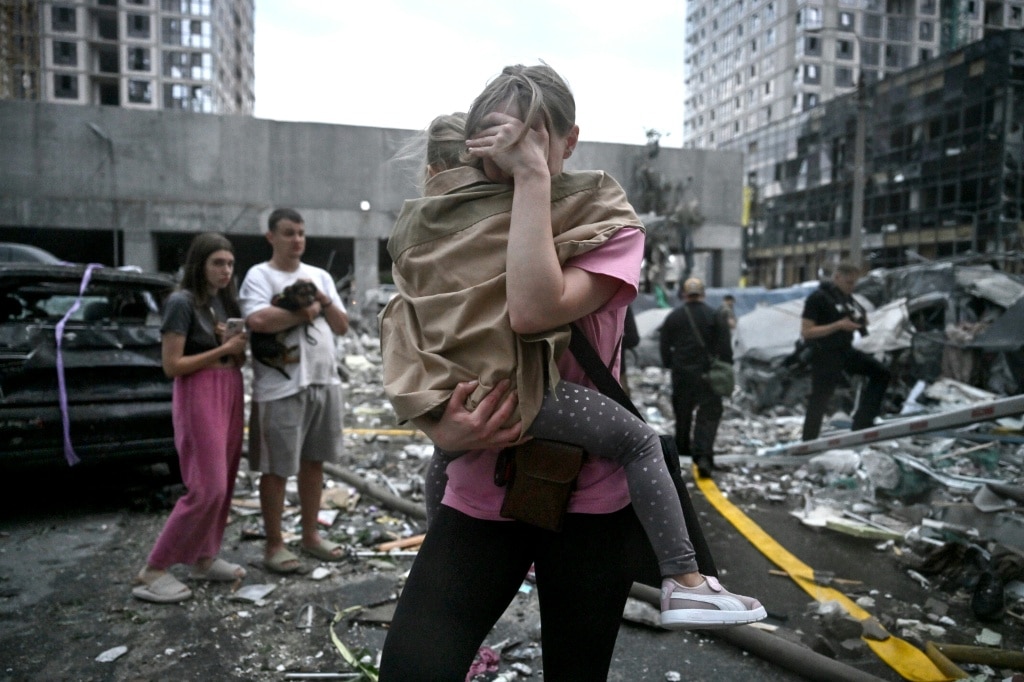
After more than four years of enduring Russia’s full-scale invasion, residents of Ukraine’s capital Kyiv are facing a sharp new spike in danger and anxiety, as Moscow escalates its missile assault with a wave of hard-to-intercept ballistic attacks that have upended the fragile daily routines civilians had built over years of conflict.
For 27-year-old student Oleksiy Virskovsky, the growing intensity of strikes pushed him to change a habit he had kept through hundreds of nights of attacks: he no longer skips trips to the neighborhood underground shelter. Speaking to Agence France-Presse, Virskovsky said Russian attacks on Kyiv have grown far more aggressive, massive, and intense in recent weeks. “It’s somehow become more frightening, and I’ve started going down to the shelter… I’ve begun to take safety more seriously than before,” he explained.
While Russia has targeted Kyiv with missile and drone strikes since the first day of its invasion, the latest wave of attacks relies heavily on ultra-fast ballistic missiles that Ukraine’s air defense systems struggle to shoot down. This new tactic has already claimed dozens of lives in July alone, with more than 50 residents killed so far this month. Two of the deadliest strikes on the capital across the entire four-year invasion occurred less than a week apart in early July.
During a large-scale assault overnight between July 5 and 6, Kyiv’s air defenses failed to intercept a single incoming ballistic missile — a troubling setback for a city long considered the best-defended in Ukraine. In another separate attack, a missile detonated over Kyiv’s skyline and jolted sleeping residents awake before the city’s air alert system could even trigger sirens. The early failure of the warning network, which normally sends multiple daily alerts via street loudspeakers, metro announcements and smartphone notifications, marked a rare and unexplained glitch that deepened public unease.
Ukrainian President Volodymyr Zelensky has publicly acknowledged the capital’s critical vulnerability: Kyiv does not have enough US-provided Patriot missile interceptors to fully shield the city from incoming strikes. At a recent NATO summit, US President Donald Trump signaled openness to allowing Ukraine to produce its own interceptors domestically, but key details of the plan remain undisclosed, and any domestically manufactured systems will take months to reach operational use.
In the gap between the rising threat and long-term solutions, Kyiv residents are scrambling to rewrite the unwritten safety rules they developed over four years of war. For years, many civilians relied on personal experience and social media tracking of incoming attacks to gauge the level of risk, allowing them to maintain a semi-normal daily routine. But ballistic missiles cut travel time to Kyiv to just a few minutes after launch, eliminating the window of time civilians previously had to react and reach safety.
The new urgency has sent thousands of residents flocking to the city’s metro network, Kyiv’s primary large-scale underground refuge, far earlier than they previously would. Many now head straight to stations immediately after finishing work, rather than waiting for an official air alert to be called. On nights when major attacks are anticipated, station platforms have become severely overcrowded, with civilians bringing pets, tents, air mattresses, baby prams and cots to settle in for the night.
Kyiv’s metro authority confirmed that more than 50,000 residents camped in the metro network during one recent major attack — the highest number of people seeking shelter there since the chaotic first months of the invasion in 2022. For Veronika Khudenko, a 22-year-old intern who has been in Kyiv for just one month from London, every night over recent weeks has been spent in the metro. “The latest attacks are very hard to bear, very nerve-wracking,” she told AFP. “It’s very hard to function during the day, because there is strong emotional pressure throughout the night.”
Not all residents can or choose to seek shelter in underground public spaces. Anna Nesterova, a 46-year-old podologist, says she prefers to remain at home during attacks, sheltering in the building’s entrance hallway, because she fears being trapped in a crowded underground space if a strike hits. “It’s more convenient for me and I feel calmer at home,” she said. Nesterova’s son joined the front lines immediately after he turned 18, so she says she feels a responsibility to stay calm for him.
Thirty-four-year-old Yulia Parkhomenko, a mother of two, also remains at home during strikes: the nearest metro station is too far from her residence, and there are no adequate private or public basements nearby. As soon as an air alert sounds, she gathers blankets and pillows, and hunkers down in the bathroom with her two children. “With each attack it’s getting more and more frightening,” she said. “And the scariest thing is for the children. My children are just very afraid.”
The escalating strikes have left the capital gripped by a new wave of chronic stress, as civilians adapt to a level of threat that has not been seen since the opening weeks of the invasion, four years ago.