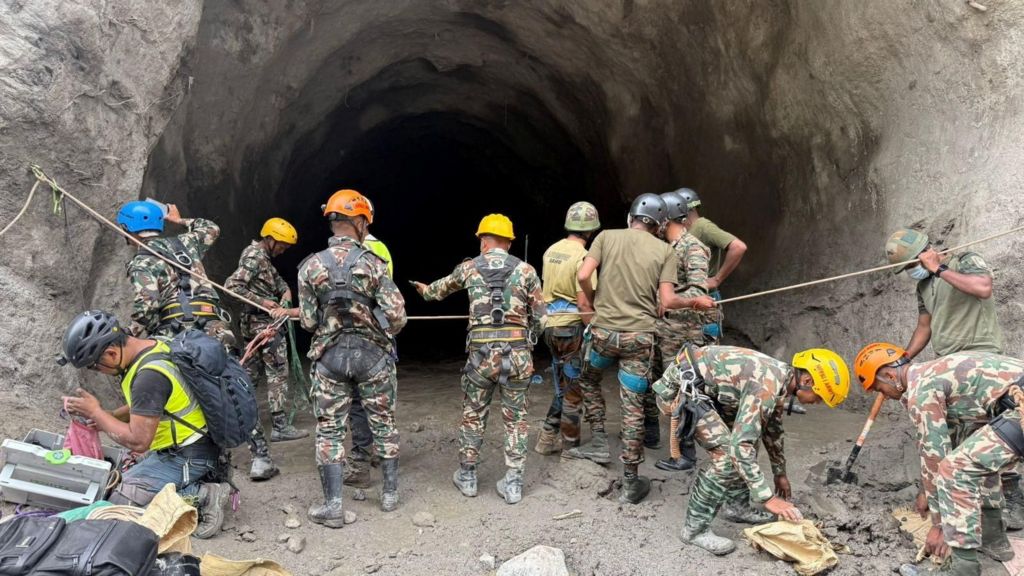
In the wake of catastrophic flash floods that swept across the Nepal-Tibet border, an urgent, multinational rescue operation is underway to reach more than 600 hydropower project workers trapped in a network of mud-choked tunnels along Nepal’s Trishuli River, as anxious families hold out fading hope that their loved ones will be pulled alive from the debris.
As of Monday, Nepalese Army teams leading the search have turned to controlled explosives to blast through rock and debris on the collapsed hillside to clear access routes to the tunnel network, after which rescue crews pump compressed air into the trapped space to sustain any possible survivors. Disaster management officials have confirmed the overall death toll from the flood disaster has climbed to 939 in Nepal, with the official count of missing people revised upward to 3,925 – 592 of whom are foreign nationals. Roughly 14% of all missing people are workers employed at the damaged hydropower projects along the river, where 279 people have already been pulled to safety, according to Nepalese Prime Minister Balendra Shah.
The massive search and recovery effort is being jointly spearheaded by Chinese and Nepalese military teams, with specialized technical experts from India, South Korea and Australia also contributing expertise to the complex underground operation. The Trishuli River basin, located in Nepal’s mountainous northern region, is home to a suite of major hydropower projects that the country, which relies heavily on hydroelectric power for its energy supply, has spent decades developing. Officials confirmed at least 11 operational and under-construction hydropower projects suffered severe damage when the floodwaters hit.
For families waiting at the operation’s perimeter, every passing minute feels like an eternity, and many have criticized the pace of the rescue for being unacceptably slow. “I still have a 50% hope that he is alive because there is an oxygen system inside,” Sita Pandey, whose husband was working in the plant when the floods hit, told Nepalese daily newspaper Kantipur. Anushila Bhandari, wife of 33-year-old missing engineer Aurus Bhandari, shared her desperate plea with BBC Nepali: “I wish we could find him. I wish he would come home.” Jiban Khadka, who has a relative trapped in the tunnel network, echoed the widespread frustration: “The longer it takes, the more our hope dies. This operation must move much faster because every second is meaningful to us. It’s a frustratingly slow operation.”
Rescue teams made limited progress on Monday, when one search team managed to advance into a tunnel leading to one of the hydropower plants, only to withdraw after finding no signs of trapped workers. Air pumping operations into accessible tunnel segments began over the weekend, but family members argue that life-saving efforts should have been launched far earlier.
Australian tunneling expert Arnold Dix, who is advising Nepalese authorities on the search remotely, explained the extraordinary challenges rescuers face in navigating the transformed landscape. “The actual signature of them has gone – everything is just missing. It looks like a lunar landscape,” Dix told BBC Radio 4’s *World at One*. The former head of the International Tunneling Association added that massive boulders, some larger than residential homes, have blocked all original access points, forcing crews to rely on controlled blasts to clear paths: “I’ve never seen that before in my life. It’s just an extraordinary operation.” Even amid the logistical hurdles, Dix remains cautiously optimistic that some survivors may be found, noting that the enclosed tunnel environment could have provided protection from the fast-moving floodwaters.
Downstream in Nepal’s Chitwan District, the tragedy has moved to the grim phase of recovering and identifying victims. Floodwaters carried nearly 300 bodies to the district’s riverbanks, overwhelming local authorities who have been forced to arrange makeshift burials for unidentified remains, as there are not enough refrigeration units to store all the corpses. Local chief district officer Ganesh Aryaal told BBC Nepali: “We don’t have enough freezers here… We had to choose this last alternative of temporary burial system. We are really overwhelmed.” Medical teams and volunteers have begun extracting DNA samples from the remains to enable future identification, so relatives can claim their loved ones once testing is complete.
Across the border in Tibet, Chinese state media reports a death toll of 16, with another 546 people listed as missing. Footage and first-hand accounts of the disaster have been heavily censored on Chinese digital platforms, and authorities have issued administrative penalties – ranging from fines and warnings to short-term detentions – for social media users who speculate that the actual casualty count is far higher than the official figure. Nepalese authorities have also taken steps to curb what they classify as misinformation, ordering the removal of social media content that spreads unconfirmed claims about the flood disaster.
To date, Prime Minister Shah confirmed that a total of 11,379 people have been rescued from flood-affected areas across Nepal, and that rescue operations have been intensified to accelerate progress for the trapped hydropower workers.