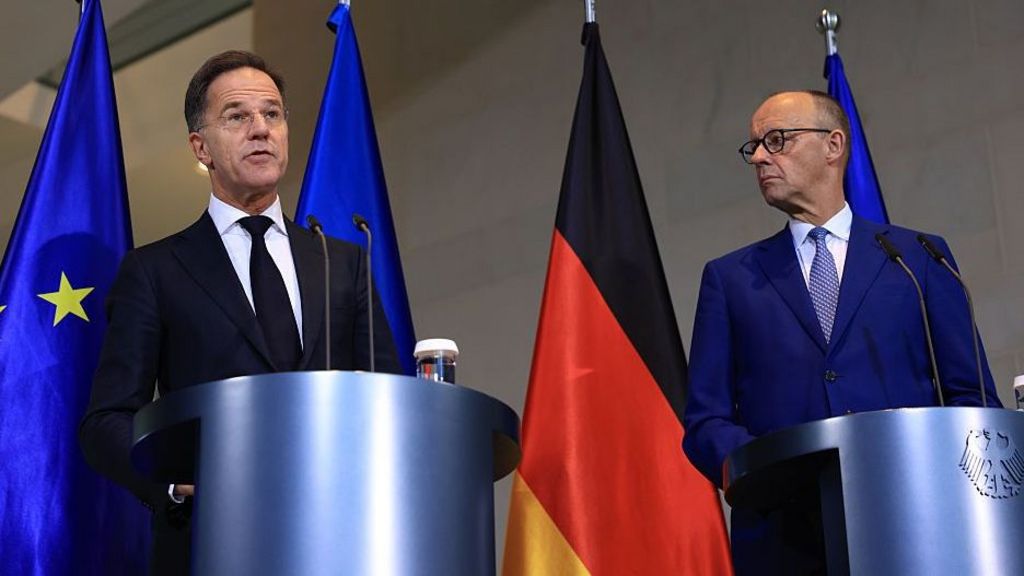
During a joint press appearance in Berlin alongside German Chancellor Friedrich Merz, NATO Secretary General Mark Rutte issued a firm public assurance that the transatlantic alliance stands fully prepared to counter any emerging threats operating in outer space, following newly surfaced intelligence reports claiming Russia is on track to deploy a nuclear-equipped satellite into orbit within the next two months. The unconfirmed intelligence findings, which were circulated among NATO member states earlier this month, were first disclosed by a consortium of leading German media outlets including public broadcasters NDR and WDR, and national daily Süddeutsche Zeitung, which cited anonymous sources within Germany’s military and intelligence apparatus. The alleged system, codenamed “Sputnik-S,” is reported to carry a nuclear warhead designed to disable or destroy critical Western orbital assets, ranging from military navigation and surveillance satellites to civilian communications infrastructure that underpins vast swathes of modern economic and public service activity. Rutte emphasized that NATO’s collective defense mandate extends to every segment of the alliance’s sovereign territory, explicitly including the space domain, and noted that military planners are continuously reviewing and updating the bloc’s deterrence and response frameworks to address evolving risks, with a full spectrum of contingency options on standby. For his part, Chancellor Merz declined to formally validate or dismiss the uncorroborated intelligence, but underscored that the unconfirmed allegations lay bare the unprecedented level of strategic escalation Moscow appears willing to pursue, adding that while rumors of Russian plans to introduce nuclear ordnance to orbit are not entirely new, they remain deeply alarming. A spokesperson for the German federal government also stated that authorities are treating the reports with the utmost seriousness, while urging the public to avoid unnecessary panic over what remains a hypothetical threat scenario. The allegations have drawn sharp pushback from Russian officials: Kremlin press secretary Dmitry Peskov dismissed the un-sourced reports as unworthy of serious consideration, while the Russian Embassy in Berlin labeled the claims entirely unfounded and framed them as part of a deliberate anti-Russia propaganda campaign. Notably, the 1967 Outer Space Treaty, which Russia is a formal signatory to, explicitly prohibits the deployment of weapons of mass destruction in orbital space, though major global powers including the United States and China have actively developed non-nuclear anti-satellite capabilities that fall outside the treaty’s explicit prohibitions. Tensions over orbital military activity have mounted steadily over the past year: in 2024, the U.S. first publicly accused Russia of developing a nuclear-powered space-based anti-satellite weapon, a claim Moscow vocally rejected, with President Vladimir Putin stating at the time that Russia maintains a consistent, categorical stance against any deployment of nuclear weapons in outer space. Even so, U.S. Air Force Secretary Troy Meink confirmed in September that the U.S. already maintains operational on-orbit space control weapons, though he declined to share technical details of the systems, a development that prompted Peskov to reaffirm Moscow’s position that outer space must remain entirely free of all weaponry. European Space Agency Director General Josef Aschbacher warned in remarks to German outlet Handelsblatt that any deployment of nuclear weapons in orbit constitutes an “ultimate nightmare scenario” for global space security, given the cascading risk of catastrophic collateral damage to the thousands of civilian and government satellites that sustain global supply chains, emergency response systems, and cross-border digital connectivity.
Nato chief vows defence against space threat after Russian nuclear satellite reports