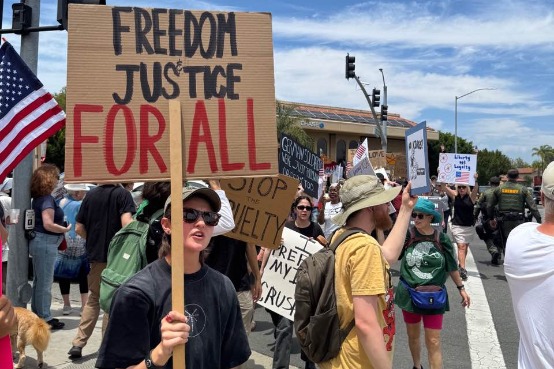
A widespread wave of coordinated demonstrations under the banner of ‘No Kings’ swept across the United States on Saturday, marking one of the most extensive grassroots mobilizations in recent political history. The movement, which expanded beyond major metropolitan centers to include suburban and rural communities, saw participation across all fifty states with over 3,100 organized events.
The protests, which also garnered international support with simultaneous events reported across several European nations including Italy, France, Germany, and Spain, represented a coalition of advocacy groups addressing diverse domestic and international concerns. Organizers from the No Kings Coalition reported unprecedented participation from traditionally less politically active demographics, with nearly two-thirds of registered attendees hailing from suburban or rural areas.
Aerial footage from Philadelphia captured substantial crowds marching through city streets, while California hosted more than 300 individual events spanning from Los Angeles to Sacramento. The demonstrations maintained a consistent emphasis on nonviolent action, with organizers providing comprehensive safety and de-escalation training to participants.
The movement emerged against a backdrop of mounting economic pressures, including rising fuel prices and living costs, combined with concerns about international conflicts and domestic policies. Civil rights leader Rev. Al Sharpton characterized the events as transcending traditional political divisions, stating at a news conference: ‘We may not all agree on some issues, but we all agree that if we do not protect the right to vote and protect democracy, it doesn’t matter where we disagree.’
The White House responded dismissively to the demonstrations, with spokesperson Abigail Jackson describing them as ‘Trump Derangement Therapy Sessions’ primarily of interest to media personnel. However, organizers pointed to the geographic diversity and scale of participation as evidence of sustained public engagement with democratic processes.
Notable gatherings included an anticipated attendance of 100,000 participants at Minnesota’s state capitol in St. Paul, building on previous protests related to federal immigration enforcement operations in the region. The coalition behind the movement includes major organizations such as Indivisible, MoveOn, the American Federation of Teachers, the American Civil Liberties Union, and the Service Employees International Union.