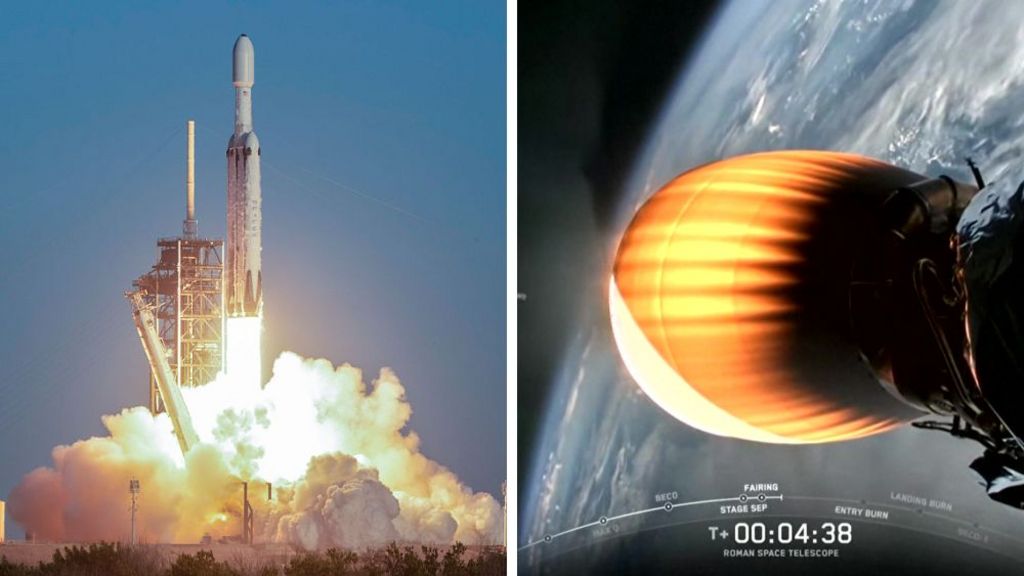
On a historic Sunday morning at Florida’s Kennedy Space Center, NASA’s revolutionary next-generation astronomical observatory, the Nancy Grace Roman Space Telescope, has successfully launched aboard a SpaceX Falcon Heavy rocket, marking the start of a mission poised to transform humanity’s understanding of the cosmos. Roughly 30 minutes after liftoff, the telescope separated cleanly from the launch vehicle and began its 100-day cruise toward its permanent observing position, a gravitationally stable orbital vantage point located approximately one million miles from Earth — the same halo orbit occupied by the 2021-launched James Webb Space Telescope.
Named for NASA’s pioneering first chief astronomer and the agency’s earliest female executive, Nancy Grace Roman (1925–2018), the observatory honors a trailblazer widely known as the “Mother of Hubble” for her critical work securing congressional approval for the iconic Hubble Space Telescope in the 1960s. Roman herself later highlighted the discovery of dark energy as Hubble’s most compelling finding, making the new next-generation telescope a fitting continuation of her legacy.
Boasting cutting-edge optical technology, the Roman Telescope features a panoramic field of view at least 100 times wider than that of the Hubble Space Telescope, which has operated in low Earth orbit roughly 300 miles above Earth’s surface since 1990. Even compared to James Webb, Roman offers far broader cosmic coverage, enabling it to capture sweeping, high-resolution surveys of the sky that were impossible with earlier observatories. The mission has a planned five-year primary science operation period, with provisions to extend operations to a full decade.
NASA officials outlined the telescope’s ambitious science objectives, which range from solving one of physics’ greatest puzzles — the nature of dark energy and dark matter — to discovering and characterizing thousands of new exoplanets orbiting stars outside our solar system. Scientists estimate that invisible dark matter and dark energy together make up roughly 95% of the total mass-energy of the universe: dark matter acts as an invisible gravitational glue holding galaxies together, while dark energy is the poorly understood repulsive force driving the accelerating expansion of the universe. Beyond cosmology, Roman will map billions of galaxies across cosmic time, study the growth and behavior of supermassive black holes, and even conduct observations of objects within our own solar system.
One of the mission’s most anticipated contributions is advancing the search for habitable worlds beyond our solar system. “One of our main goals at NASA is answering the question: are we alone in the universe?” Nicky Fox, a NASA administrator, told reporters at a post-launch news conference Sunday. “With Roman, we are going to make this giant leap forward… that is going to allow us to look at these distant, distant worlds and start to really resolve the atmosphere around them to let us know: could they be habitable?” Fox added that the mission is expected to discover tens of thousands, and potentially as many as 100,000, new exoplanets, drastically expanding the current catalog of known worlds outside our solar system.
Marking the milestone, former U.S. President Donald Trump joined the mission’s post-launch news conference via phone call to congratulate the team of scientists and engineers behind the decades-long project. “You’re the hottest in space, and we have the hottest country anywhere in the world. So let’s keep it all going. You’re a big part of it,” Trump told the assembled team.
NASA officials say that once Roman reaches its orbital vantage point and completes initial on-orbit instrument calibration, it will begin delivering its first full science data, opening an unprecedented new window into the origins and evolution of the universe. “Roman is going to change the way we look at the universe,” Fox emphasized, echoing the widespread expectation that the mission will deliver paradigm-shifting discoveries that reshape modern astronomy.
Nasa launches powerful new space telescope to explore mysteries of the Universe