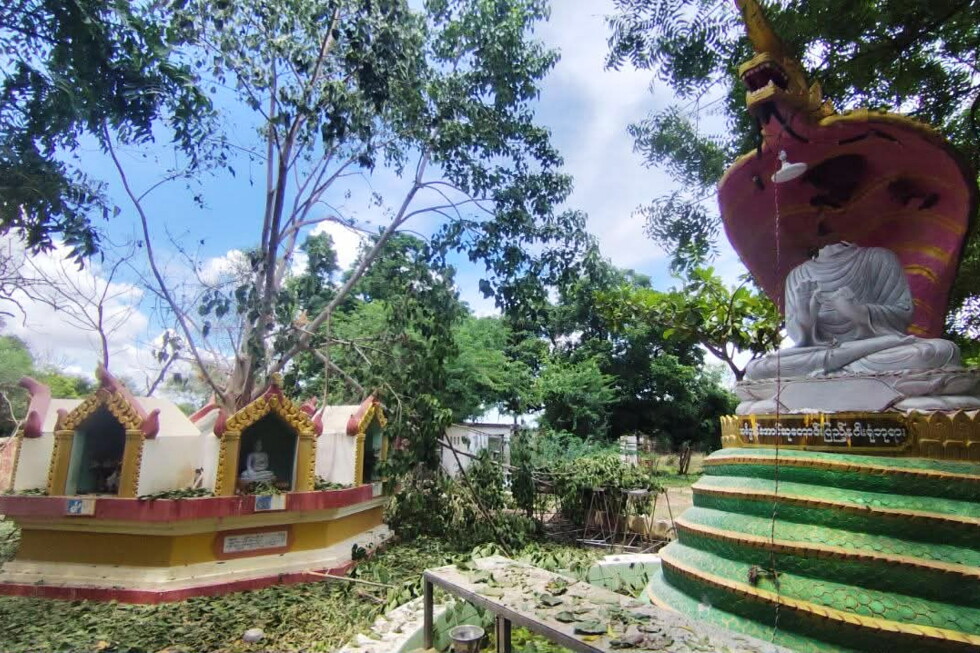
BANGKOK, Thailand – A deadly airstrike carried out Friday by Myanmar’s military against a Buddhist monastery in the country’s central Sagaing region has left 14 civilians dead, all of whom were attending a week-long meditation retreat, according to confirmation from a local opposition spokesperson and a village resident. The attack marks the latest in a sustained pattern of lethal aerial operations that have repeatedly targeted pro-democracy armed factions and ethnic armed groups across Myanmar, with civilians consistently bearing the brunt of the violence.
Details of the strike were first shared by Nway Oo, spokesperson for the Civil Defense and Security Organization of Myaung Township (CDSOM), who confirmed the attack took place in Swel Le Oh village, located roughly 75 kilometers (45 miles) west of Mandalay, Myanmar’s second-largest urban center. Nway Oo told reporters that a military fighter jet dropped an explosive directly onto the monastery’s compound, killing 14 people including three women and leaving an additional 20 people wounded.
A local villager, who requested anonymity out of fear for personal safety after the attack, corroborated the 14-person death toll in an interview with the Associated Press. The villager – whose own mother-in-law was killed in the strike – shared that the fighter jet dropped two bombs spaced 15 minutes apart. The second blast damaged a private residence adjacent to the monastery, where more than 100 people had gathered for the retreat, held during the annual Buddhist Lent observance. Following the attack, survivors cremated the bodies of the deceased before fleeing to a neighboring community for safety, the villager added.
Multiple Burmese-language media outlets, including the BBC’s Burmese service and independent local outlet Myanmar Now, have also reported on the attack, putting the confirmed death toll between 10 and 14. The outlets have published accompanying photos and video footage purporting to show the immediate aftermath of the strike, including images of deceased victims among the rubble.
As of Saturday, Myanmar’s military junta had not issued any immediate public comment on the monastery attack. In previous statements regarding its counter-opposition operations, the military has maintained that it only targets legitimate military objectives, and has labeled anti-junta resistance groups as terrorist organizations.
The attack comes against a backdrop of nearly three years of widespread civil conflict that has gripped Myanmar since the military seized control of the country from the elected government led by Aung San Suu Kyi in a February 2021 coup. After the junta violently suppressed mass peaceful protests against the takeover, opponents of military rule mobilized into an armed resistance movement, and today large swathes of the country remain mired in active fighting. Sagaing region, where the monastery attack occurred, is one of the most significant strongholds of the anti-junta armed resistance, particularly the People’s Defense Forces. The junta has increasingly relied on large-scale airstrikes to root out opposition groups in the region, and resistance factions lack any effective air defense to protect civilian populations from these attacks.
The monastery strike also comes exactly one week after the United Nations-established Independent Investigative Mechanism for Myanmar (IIMM) released a report warning of a clear escalation in junta airstrikes in the months leading up to the junta’s December-January general elections, a vote widely rejected by the international community and opposition groups. The report noted that the intensified aerial operations have continued at full pace following the election.
Just days before the monastery attack, Myanmar’s foreign ministry issued a formal rejection of the IIMM’s findings, claiming that all limited airstrikes and counterterrorism operations conducted by the junta exclusively target legitimate military objectives. The ministry stated the operations are carried out in response to insurgent and terrorist activity in line with international rules of engagement, and claimed that junta security forces exercise maximum restraint to prevent civilian casualties.