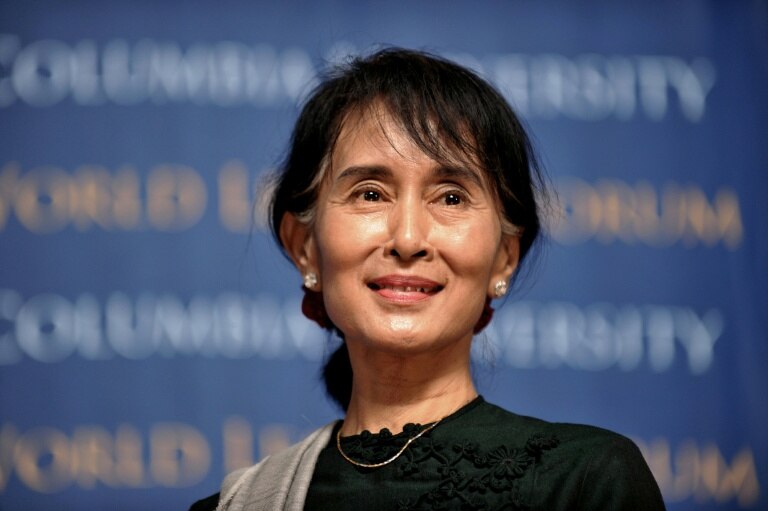
Five years after ousting Myanmar’s democratically elected government in a military coup, the junta leader who has now rebranded himself as a civilian president has ordered that deposed national leader Aung San Suu Kyi be moved from prison to house arrest.
In an official statement released Thursday, the office of Min Aung Hlaing confirmed that the 80-year-old former state counselor’s remaining prison sentence will now be served at a “designated residence” instead of a prison facility. At the time of publication, neither the exact location of the new place of detention nor the length of Suu Kyi’s remaining sentence has been disclosed to the public. A senior anonymous source from Suu Kyi’s banned National League for Democracy (NLD) party told Agence France-Presse that the ousted leader will likely be held in seclusion at a property in Myanmar’s capital Naypyidaw, but the source stressed that the precise address remains unknown.
The order marks another step in Min Aung Hlaing’s ongoing push to legitimize his rule after he was sworn in as civilian president earlier this month. The election that paved the way for his new civilian role was tightly controlled by the military, completely excluded the NLD from participation, and barred any public criticism or opposition under penalty of up to 10 years imprisonment. The vote was not even held in large swathes of the country currently controlled by anti-junta rebel forces, a detail that has led independent democracy monitors to dismiss the entire electoral process as little more than a cosmetic rebranding of military rule, which has dominated Myanmar’s political landscape for most of the country’s post-independence history.
Suu Kyi, who remains widely popular among Myanmar’s population, was first taken into custody by Min Aung Hlaing’s military forces when the 2021 coup toppled her democratically elected government. She was subsequently convicted on a series of charges that human rights organizations widely condemn as entirely fabricated, created solely to remove her permanently from Myanmar’s political scene. The coup sparked a widespread, ongoing civil conflict that has killed more than 10,000 people and displaced millions across the Southeast Asian nation, which is home to roughly 50 million people.
Along with Suu Kyi’s transfer, the junta leadership has rolled back a small number of post-coup restrictions and issued a series of prisoner amnesties. Independent analysts have described these moves as empty public relations gestures designed to improve the administration’s image globally. This skepticism is shared by Suu Kyi’s family: in a phone interview with AFP, her son Kim Aris dismissed the decision to move her to house arrest as just another of the junta’s familiar political tactics.
“[The military leadership is] trying to legitimise themselves in the eyes of the international media and governments around the world,” Aris said. He added that if the transfer is fully carried out, he hopes his mother will finally be granted permission to communicate with him, her legal team and other contacts, noting that no junta official has reached out to him with any updates about her status. Suu Kyi has been held almost completely incommunicado since the coup, and her family has repeatedly raised alarms over her declining and ailing health in recent years.
In one of his first official actions after taking office as civilian president this month, Min Aung Hlaing also granted a pardon to Win Myint, Suu Kyi’s top aide and the ceremonial president of her ousted government.