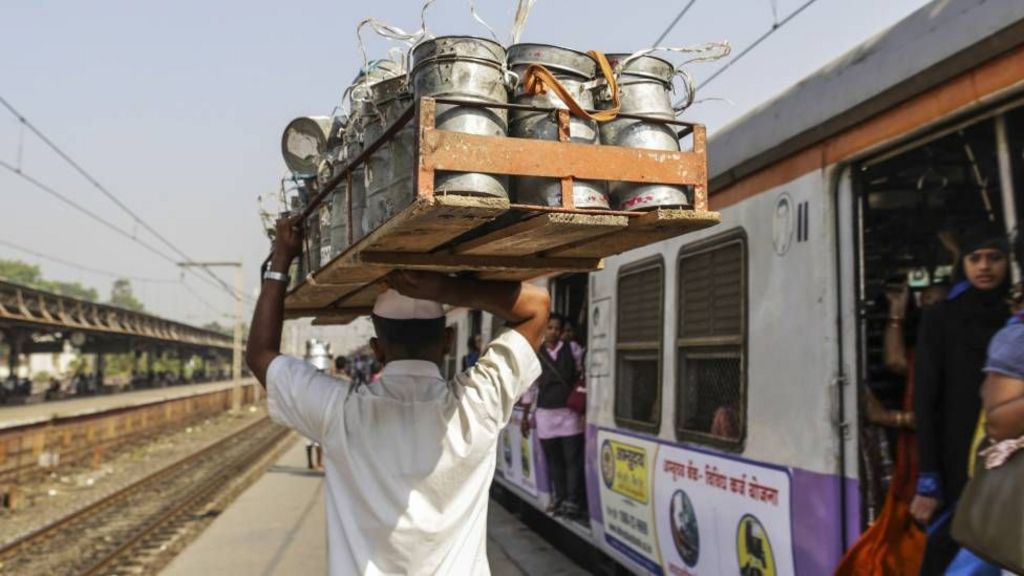
Long before food delivery apps, ride-sharing services, and on-demand urban convenience, Mumbai’s dabbawalas built a logistical legend that captured global attention. For more than 130 years, these uniformed delivery workers, recognizable by their signature white caps and shirts, have navigated the chaos of India’s financial capital to deliver thousands of hot, home-cooked lunchboxes (called dabbas) to office workers every single day. Today, however, this centuries-old tradition is on the brink of collapse, devastated by shifting work patterns and new digital competition.
Every morning, long before the city wakes to its usual frantic pace, dabbawalas cycle through Mumbai’s sprawling suburbs collecting dabbas packed with rice, lentils, curries, rotis, and fresh seasonal dishes, all cooked in family kitchens across the city. They load the stacked boxes onto suburban trains, sort them according to a simple but incredibly precise alphanumeric coding system, and deliver them on foot or by bicycle to office workers across the city by midday. After workers finish their meals, dabbawalas collect the empty boxes and reverse the route, returning them to the original homes by early afternoon. What makes this system remarkable is that it relies on no apps, no GPS, and no advanced technology – just generations of tacit knowledge of Mumbai’s streets and railways, passed down from worker to worker.
The origins of the dabbawala network stretch back to the late 19th century, when British-ruled Bombay was rapidly expanding as a commercial hub. At the time, restaurants were scarce, and cultural and religious dietary customs made home-cooked meals non-negotiable for many office workers. The model first began when a Parsi banker hired a local man to deliver his home lunch to his workplace, and the concept quickly spread. By 1890, organizer Mahadeo Bachche formalized the modern network with roughly 100 workers. Over the decades, the system grew to its peak, with nearly 4,500 registered dabbawalas delivering 50,000 lunchboxes across the city every single day.
Its legendary precision earned the dabbawala network global acclaim. Harvard Business School analyzed the system as a world-class case study in low-cost, high-efficiency logistics. Even Britain’s King Charles III, then Prince of Wales, spent time working alongside dabbawalas during a 2003 visit to Mumbai. For decades, the network became a point of civic pride for Mumbai: a reminder that amid the city’s unending noise and chaos, some core institutions still operated with unrivaled reliability.
But that reputation now offers little protection from the disruptions that have shaken the network in recent years. The turning point came with the Covid-19 pandemic, when widespread office shutdowns forced millions of Mumbai workers into remote work arrangements. Overnight, demand for daily lunchbox deliveries collapsed. Dabbawalas who once served 20 to 25 clients a day were left with just a handful of customers, or none at all. With little in the way of savings, hundreds of workers left the trade permanently.
Even after offices reopened, the shift to hybrid work models gutted demand. Many office workers now only come into the city two or three days a week, eliminating the need for daily lunch delivery. The Mumbai Tiffin Box Suppliers Association reports that registered dabbawala numbers have plummeted from roughly 4,500 in 2018 to just 1,500 today.
Competition from the digital economy has compounded the crisis. Today, major food delivery platforms such as Swiggy and Zomato offer on-demand delivery of everything from traditional biryani to fast food at competitive prices, while a booming cloud kitchen industry has expanded affordable restaurant options for city workers. Where dabbawalas once faced almost no competition for home-style lunch delivery, they now struggle to compete with the convenience of a tap on a smartphone screen.
For workers who have left the trade, the transition has been difficult. Balu Bhagu Shinde, 41, worked as a dabbawala for 20 years, earning roughly 20,000 rupees a month – enough to support his wife and three children in one of India’s most expensive cities. By the end of 2020, he was left with just two regular customers. After waiting in vain for customers to return, he switched to driving a tuktuk, where he earns just 15,000 rupees a month. “There are no customers, no money – what should we do?” Shinde said. “We are struggling to survive. I am cutting down on household expenses, but I have three children whose education matters the most. At times I have had to borrow money.”
For the dabbawalas who have stayed in the trade, survival now requires working 15-hour days across two separate jobs. Mauli Bachche, a third-generation dabbawala with 20 years of experience, completes his full morning collection, delivery, and empty box return route by 2 p.m. every day, then starts a second job collecting small daily savings deposits for a local finance company, not returning home until 10 p.m. He travels more than 100 kilometers across Mumbai every day, and still only has 15 regular customers left, down from 25 before the pandemic. “Income from dabbawala work is very low,” Bachche said. “Everyone is doing more than one job.”
Longtime workers say the biggest long-term threat is the lack of interest from younger generations. With Mumbai’s cost of living rising steadily, young people have little incentive to enter a low-wage trade with an uncertain future. “In our time, we managed to survive,” said Baban Kadam, who has worked as a dabbawala for 35 years. “But with today’s cost of living, the younger generation will not come into this work. Everyone wants a better-paying job or business.”
Industry leaders are now scrambling to implement changes to keep the network alive. The Mumbai Tiffin Box Suppliers Association is considering restructuring work into shift-based schedules, which would allow dabbawalas to take on part-time work or small side businesses alongside their delivery routes. Even with these adjustments, however, the future remains uncertain. “We are continuing for now,” said Ramdas Baban Karvande, the association’s president. “But we cannot say what will happen in the future.”
For now, the dabbawalas still load their stacks of steel dabbas onto Mumbai’s crowded suburban trains every morning, keeping alive a tradition that has long been woven into the identity of India’s most iconic city. But as the city evolves around it, this legendary logistical institution is at risk of being left behind by the very pace of change it once helped power.