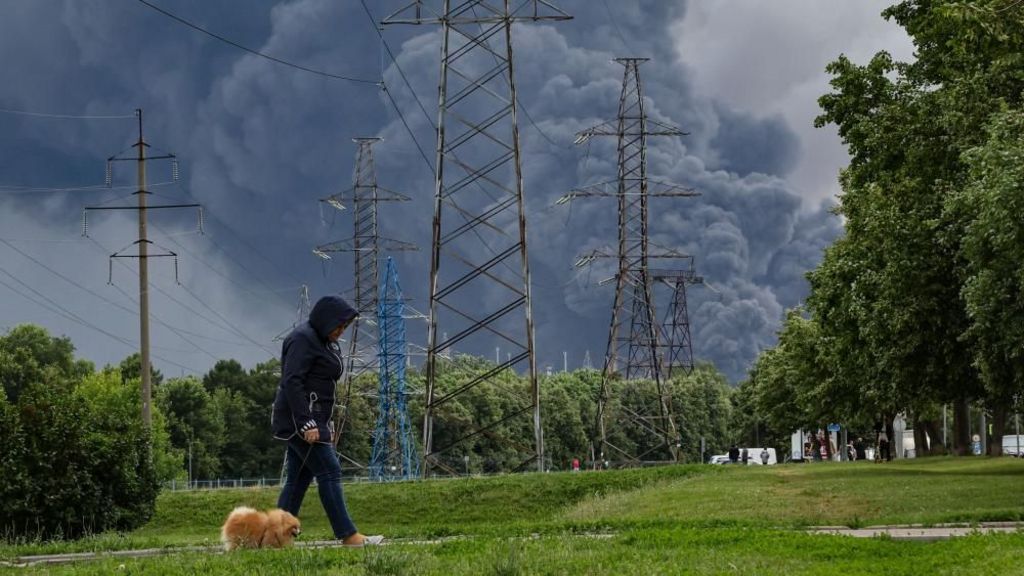
For many residents of Moscow, life has long carried a facade of normalcy even amid the ongoing full-scale conflict with Ukraine. But Thursday’s large-scale Ukrainian drone assault on the capital region shattered that quiet illusion in plain sight, leaving a stark question hanging over the city: how much longer can the war stay at arm’s length for ordinary Russians?
The attack targeted an oil refinery in southeast Moscow, sending acrid, thick black smoke billowing into the sky that turned the daytime sky dark, draping the city’s skyline in a giant, ominous shroud. Visible even from the Moscow ring road, the raging fire at the Kapotnya refinery was an undeniable, surreal sight for onlookers. Along with critical infrastructure damage, residential buildings and local shopping centres also sustained impacts, and an eight-year-old girl was killed in a fire sparked by one of the downed drones, according to the Moscow region governor.
What struck observers most, however, was the jarring contrast between the massive emergency unfolding and the mundane routines of nearby residents. An angler sat undisturbed on the bank of a nearby pond, continuing to fish with barely a glance at the massive smoke plume. Children laughed and played on swings at a playground directly opposite the facility, while shoppers moved to and from the local supermarket as if nothing out of the ordinary had interrupted their day. For the reporter on the ground, this moment drove home a sharp realization: long-held definitions of “normal” life in Moscow had already permanently shifted.
Over the 18 months leading up to this attack, the capital has slowly grown accustomed to the unthinkable. Assassinations of senior army generals, repeated drone incursions, and near-constant rumblings of conflict have crept closer to the city center, turning what once would have been unthinkable into an accepted daily reality. Thursday’s strike stands out as one of the largest aerial attacks on the Moscow region since Russia launched its full-scale invasion, making it impossible to ignore the war’s growing proximity.
Local reactions to the attack split along familiar lines, reflecting the divided perspectives of Moscow residents. “I’m not totally surprised by what happened,” explained Slava, who lives in an apartment block directly across from the refinery. “But I didn’t expect such a big attack. I heard explosions and saw lots of smoke. It’s the kind of thing you normally see in the movies. I saw it from my apartment window.” For other locals like Nadezhda, however, the strike was a shocking reminder of the conflict’s senseless prolongation. “It took us four years to win World War Two, even though our soldiers had little food and water,” she said. “Today we have all the resources we need. But this war goes on. I’m shocked.”
The Russian government and state-aligned media have offered a coordinated, consistent response to growing public unease about the war’s arrival in Moscow. Officials have long pointed the finger at the West, blaming NATO and European leaders for arming Ukraine and prolonging the conflict. Notably, President Vladimir Putin made no public mention of the strike at all during the attack, which took place while he was hosting a Russia-ASEAN summit in Kazan. Mainstream Russian television news bulletins barely covered the incident, and when national newspapers reported on the strike the following day, they all stuck to a single unified narrative for domestic audiences: Ukrainian suffering far outweighs any damage done to Russia.
Pro-Kremlin tabloid Komsomolskaya Pravda declared that Russian attacks on Ukraine have caused far greater destruction than any retaliatory strikes on Russian soil. Another popular tabloid, Moskovsky Komsomolets, echoed the claim that Russian efforts to demilitarize Ukraine are far more powerful and effective than any Ukrainian counterattacks. Government-owned Rossiyskaya Gazeta and leading business daily Kommersant repeated the same framing, emphasizing that Russian strikes on Ukrainian military and defense infrastructure deliver far more substantial results than the strikes Moscow is now forced to endure. When the Kremlin finally issued an official response, presidential spokesman Dmitry Peskov doubled down on this narrative, telling reporters to look at footage of Russian strikes on Ukrainian cities to see far greater damage, and confirming that Russian military operations will continue unabated.
There is no indication that the increasing frequency of Ukrainian long-range drone strikes on Russian territory has altered Putin’s course. Recent public statements from the Kremlin leader show he remains determined to press ahead with the invasion, confident Russia will outlast Ukraine in the ongoing war of attrition. Still, the strikes are beginning to take a measurable economic toll, particularly attacks on critical oil infrastructure like the Moscow refinery. Reports of petrol shortages and rationing have emerged in multiple regions of the country, and fuel prices have climbed steadily at pumps across Russia.
For Moscow residents, the new normal means bracing for more drone attacks to come. Moskovsky Komsomolets predicted in its coverage that Thursday’s 18 June strike will not be the last, or even one of the final attacks on the capital. Standing beneath the roiling black smoke from the refinery, one local resident summed up the resigned acceptance many residents feel: “There’s nothing we can do about this. It’s our government that must decide what to do. All we can do is watch.”