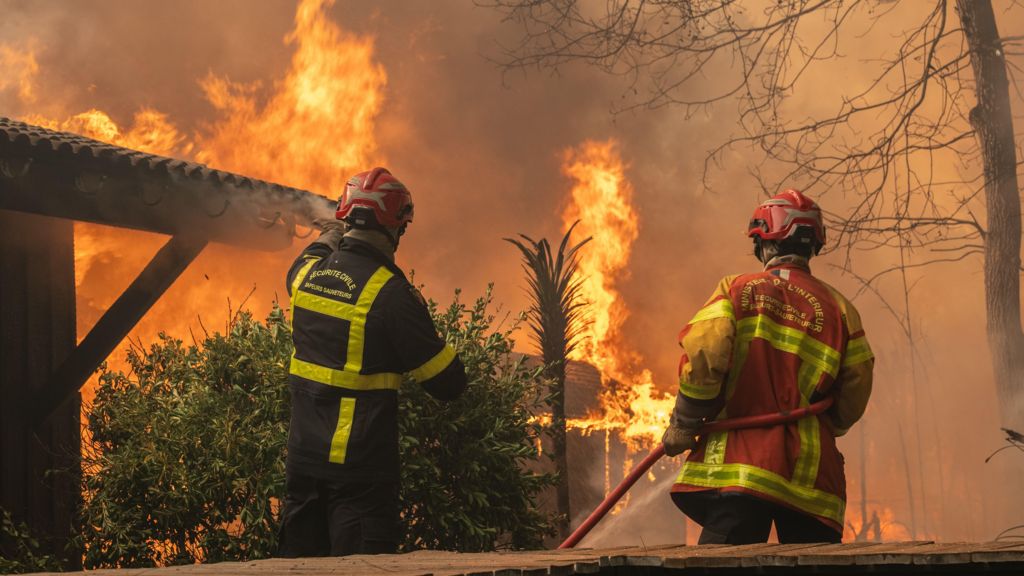
Across Southern and Western Europe, a devastating outbreak of unseasonably early and widespread wildfires is overwhelming firefighting resources, displacing hundreds of thousands of people and leaving emergency responders scrambling to contain blazes fueled by record heat and unpredictable gusty winds. The crisis has already spread from France and Spain to Italy and the United Kingdom, with regional and EU officials warning that 2026 is on track to become the worst year for European wildfire damage on record.
In southwestern France, the situation remains particularly critical, with strong winds pushing large active flames within 40 to 50 kilometers of the major city of Bordeaux. As of Saturday morning, smoke carried by prevailing winds had already reached Bordeaux, leaving a sharp acrid odor hanging over the city, even as the main blaze remained outside the urban center. One senior French official confirmed that response teams are still far from gaining full control of the fastest-spreading blazes in the Gironde and Landes regions.
To date, approximately 200,000 residents and tourists have been evacuated from high-risk areas across southwestern France, with emergency orders issued overnight for seven small communities located west of Bordeaux. Temporary emergency shelters have been constructed across the region to house displaced people, while the French government has mobilized military personnel to support overstretched local firefighters, clearing underbrush and constructing strategic fire breaks to slow the advance of flames. French Interior Minister Laurent Nuñez announced that a total of 98,000 hectares of land have already burned across the country since the start of 2026, and President Emmanuel Macron has called an emergency cabinet meeting to coordinate the national response amid an unprecedented outbreak of roughly 30 active fires across the nation.
The crisis has also disrupted major public events: organizers of the Tour de France confirmed they have shortened the race’s final Sunday leg from 133 kilometers to 89 kilometers, allowing security forces that were assigned to the route to be redeployed to wildfire-affected zones.
Many evacuees, including a large number of international tourists staying in popular coastal and regional vacation spots, have described terrifying experiences fleeing the advancing flames. Spencer Randall, a British tourist who evacuated with his family in the early hours of Saturday to a town 100 miles east of Bordeaux, told reporters his group can still smell smoke from the wildfires at their safe location. “It’s quite strong winds fanning the flames, just terrifying,” he said. Another British vacationing couple in the Bordeaux area reported that ash from the fires has coated their rental property’s swimming pool and turned their shoes black during outdoor walks, with smoke that irritates lungs almost immediately after stepping outside. Local residents described the unfolding disaster as deeply stressful, with one calling the widespread destruction a “total disaster.”
To the south, Spain is facing its own unprecedented wildfire crisis, with a national state of emergency declared. One fatality has already been confirmed: a man in his 70s was found dead in his car by responding firefighters working to extinguish a blaze in the Salt de l’Aigua ravine in Manises, in the València region, according to local media reports.
So far in 2026, more than 130,000 hectares of land have burned across Spain, which exceeds the 10-year annual average of 100,000 hectares for the country. Nearly 60,000 people have been evacuated from high-risk areas in the Madrid and Ávila regions, with more than 28,000 remaining confined to their homes to avoid exposure to smoke and fire hazards. Madrid’s regional president Isabel Díaz Ayuso called the current outbreak the “worst fire in the history of the region.”
While shifting weather conditions, including lower temperatures, higher humidity and reduced wind speeds, have created a small window of opportunity for firefighters to gain ground on blazes outside Madrid, Prime Minister Pedro Sánchez warned that major challenges remain. “It’s true that temperatures have dropped a little bit. But still the wind is making it difficult and there may be thunderstorms as well,” Sánchez told reporters from Cenicientos, south-west of Madrid, adding that the country still faces “complex times ahead.”
The wildfire crisis is not limited to France and Spain. On the Italian island of Sicily, civil protection officials confirmed that more than 350 separate fires, including 10 large major blazes, have broken out, prompting multiple evacuation orders. In Scotland, emergency services declared a major incident on Friday evening to respond to a large wildfire that has been burning uncontrolled for 10 days in the Cairngorms National Park.
EU crisis management commissioner Hadja Lahbib warned that the current season is on track to break last year’s grim record of 1 million hectares of burned land across Europe. “We are expecting to face another historical, sad record because the season has started earlier in the year,” Lahbib told the BBC, adding that forecasters predict another upcoming heatwave that could trigger additional new outbreaks across the continent.
To support overwhelmed national response efforts, the EU has activated its civil protection mechanism, with cross-border reinforcements deployed to the hardest-hit countries. France is receiving three Canadair water bombers from Croatia, two Air Tractor water aircraft from Portugal, Black Hawk helicopters from the Czech Republic and Slovakia, and a 40-person forest firefighting team from Romania. EU Commission President Ursula von der Leyen added that 11 additional aircraft and helicopters from the EU’s shared firefighting fleet have also been deployed to both France and Spain to boost response capacity.