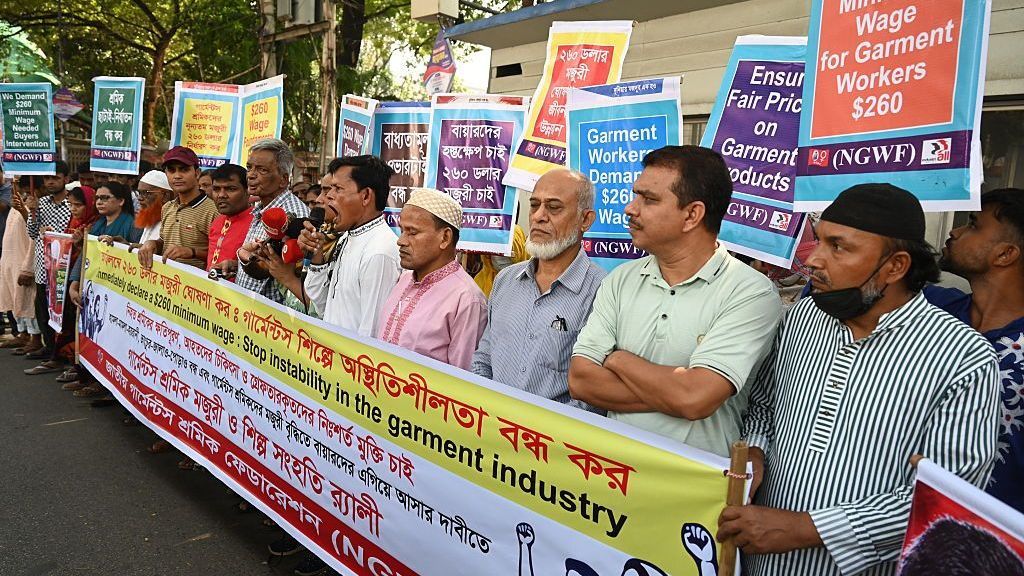
A wave of labour unrest has swept across Bangladesh’s core garment manufacturing regions this weekend, as tens of thousands of industry workers stage coordinated strikes to demand a sharp increase to the national minimum wage, prompting widespread factory shutdowns across the Savar, Ashulia and Gazipur industrial hubs on the outskirts of Dhaka. The unrest first erupted Friday when demonstrators took to the streets of the capital to voice their demands for a monthly minimum pay threshold of 30,000 taka, equivalent to roughly £182, a figure they say is critical to navigating the country’s deepening cost of living crisis. The current statutory minimum wage for garment workers stands at just 12,500 taka per month, a level employees argue no longer covers basic household expenses including food, rent and utilities amid sustained inflationary pressure. Tensions escalated Sunday morning when thousands of striking workers gathered on the busy Dhaka-Tangail highway in Gazipur to stage a road blockade, bringing all vehicular traffic to a halt for approximately one hour before law enforcement officials intervened to clear the roadway. Mohammad Amjad Hossain, Superintendent of Gazipur Police, confirmed to reporters that authorities oversaw the closure of 13 factories overnight Saturday, followed by 16 additional facilities during Sunday’s early morning unrest, bringing the total number of shuttered production sites to nearly 150 across the three key textile hubs. Under existing Bangladeshi labour regulations, a “No Work No Pay” clause grants factory owners the authority to suspend operations and withhold employee wages whenever industrial action disrupts regular production schedules, a provision manufacturers are now leveraging in response to the walkouts. Bangladesh’s $40 billion annual ready-made garment export sector is the backbone of the national economy, accounting for 10% of total GDP and providing formal employment to an estimated four million workers who produce apparel for global retail giants including H&M, Primark and Zara. As the world’s second-largest exporter of mass-market clothing behind China, the country’s supply chain stability is closely monitored by international buyers, with industry analysts warning that prolonged unrest could trigger cascading disruptions to holiday and upcoming seasonal order fulfillment for global fashion brands. The two leading national apparel trade bodies, the Bangladesh Garment Manufacturers and Exporters Association (BGMEA) and the Bangladesh Knitwear Manufacturers and Exporters Association (BKMEA), have issued urgent calls for government intervention to protect factory premises from vandalism and operational disruption. BGMEA President Mahmud Hasan Khan stated that the two associations are questioning the viability of continuing to participate in ongoing minimum wage board negotiations without formal guarantees of safety for manufacturing facilities, adding that all factories unable to resume normal operations due to the ongoing unrest will be placed under indefinite shutdown starting the following day, in full compliance with national labour law. The government had formally established a tripartite minimum wage board on November 1, led by a senior district judge, with an explicit mandate to finalize a revised, updated pay recommendation by the end of the month, slated to go into official effect as of December 1.