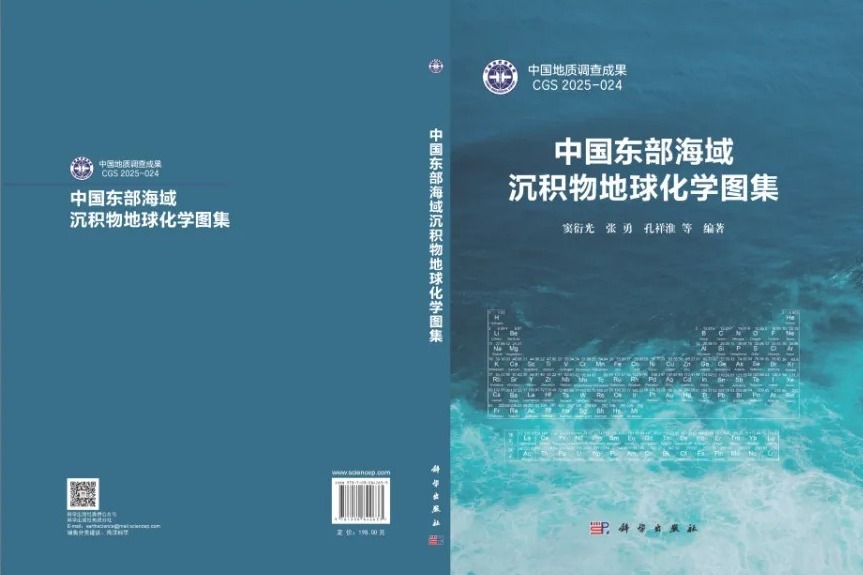
After nearly 20 years of sustained field investigation and cutting-edge data analysis, a team of Chinese marine geologists has completed the most comprehensive systematic survey of seabed sediment geochemistry in China’s eastern waters to date, generating unprecedented high-precision data that will advance regional resource development, ecological conservation, and Earth science research. The groundbreaking findings were officially released recently by the China Geological Survey.
Encompassing the Bohai Sea, Yellow Sea, and East China Sea, China’s eastern waters represent a geologically critical junction between the Eurasian continent and the Pacific Ocean, shaped by millions of years of sediment deposition, tectonic activity, and climate shifts. Drawing on decades of on-site marine expeditions, the research team assembled the largest, most complete, and most reliable geochemical dataset ever compiled for this region. To overcome the challenge of incomplete data across sparse survey areas, the team integrated field measurements from more than 10,000 sampling stations and leveraged machine learning algorithms to improve simulation accuracy. This innovative approach allowed them to produce detailed maps documenting the location, concentration, and spatial distribution of dozens of key chemical elements, including iron, manganese, copper, and a range of rare earth minerals.
Dou Yanguang, a lead researcher at the China Geological Survey’s Qingdao Institute of Marine Geology, described the new element distribution dataset as a foundational “navigation chart” for balancing development and conservation efforts across China’s eastern marine territories. “With this clear map of element distributions, we can rapidly pinpoint contaminated zones and ecologically sensitive areas, demarcate marine ecological protection red lines, more effectively manage marine pollution and environmental risks, and accurately target potential seabed mineral deposits to eliminate costly blind exploration,” Dou explained.
Beyond practical coastal management and resource applications, the survey also delivers profound insights into Earth’s geological and climatic history. Layers of seabed mud and accumulated biological remains act as a “thick marine diary,” preserving millions of years of records of continental drift, long-term climate change, and shifting river courses. The new geochemical data gives scientists a far clearer tool to decode this history and reconstruct the evolution of the western Pacific margin.
As part of their analysis, the research team compared sediment geochemistry from major river systems including the Yellow River, Yangtze River, and coastal rivers running through Zhejiang, Fujian, and Taiwan. The comparison confirmed a clear latitudinal pattern: moving southward into warmer, wetter climatic zones, chemical weathering breaks down bedrock and minerals far more completely, a pattern reflected in the composition of seabed sediments. The team also identified multiple secondary factors shaping element distributions, including seabed sediment grain size, the erosive scouring effect of ocean currents, and localized hydrothermal activity near tectonic plate boundaries and volcanic zones.
The China Geological Survey emphasized that this project fills a long-standing critical gap in systematic marine geochemical research in China, addressing the absence of a complete seabed sediment element map for the country’s eastern waters. The foundational dataset is expected to support ongoing work to advance China’s marine science capacity and advance the development of a modern maritime power.