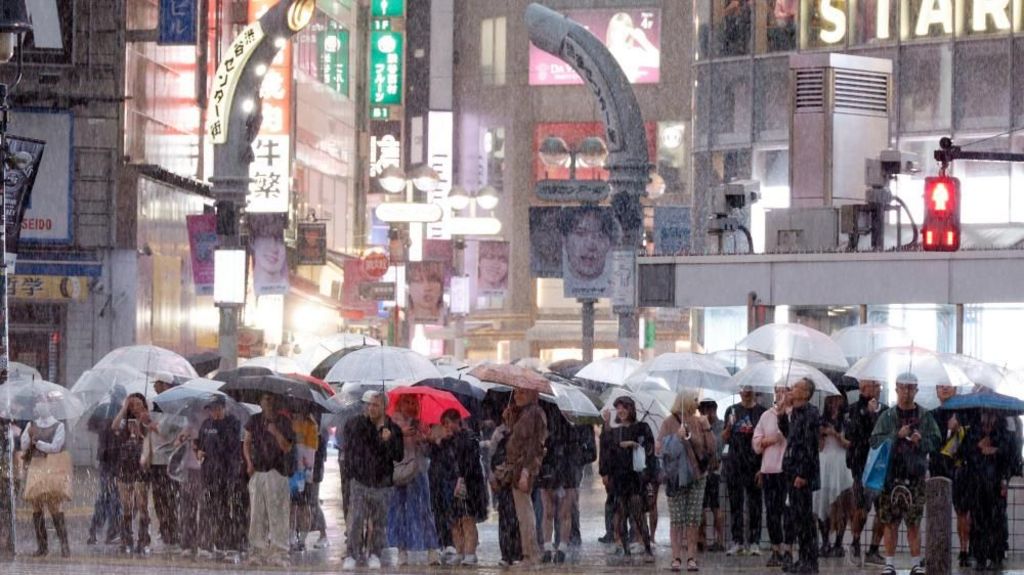
As Typhoon Dujuan makes landfall across multiple Japanese prefectures, nearly 2 million residents have been ordered to evacuate their homes, in what has become the country’s 25th typhoon of an unusually active storm season. The Japan Meteorological Agency (JMA) initially issued an urgent warning of “imminent threat to life” across wide swathes of the country, though most severe alerts have since been downgraded. Only a small number of high-risk areas retain the most serious life danger warnings, including Oshima Town, Shinagawa Ward, Toshima Village, and Niijima Village, where level four landslide warnings remain in effect. Authorities continue to urge the public to stay vigilant and monitor updated weather advisories closely.
Packing sustained wind speeds of 130 kilometers per hour (80.8 miles per hour) with gusts reaching up to 194 km/h, the storm has already caused widespread disruption to infrastructure and daily life. More than 50,000 households across the affected regions have been left without power, while hundreds of domestic and international flights have been grounded, and all regional rail services have been suspended for safety.
The typhoon’s arrival overlapped with Japan’s five-day national holiday, forcing the cancellation of dozens of scheduled public and private events. High-profile cancellations include all Monday performances at the popular Rock in Japan music festival and the full day’s programming at the Tokyo Game Show, one of the world’s largest annual video game industry conventions. In a notable political disruption, Japanese Prime Minister Sanae Takaichi has delayed a high-profile trip to the United States, where she was set to meet U.S. President Donald Trump and address the United Nations General Assembly in New York this week, to stay in Tokyo and oversee the government’s typhoon response.
Local emergency services have reported multiple incidents of storm-related harm. In Kanagawa Prefecture, the Yokosuka City Fire Department confirmed a woman in her 60s is missing after being swept away by floodwaters and is presumed buried by a landslide that hit her home. In neighboring Chiba Prefecture, a 50-year-old worker was rescued after being trapped while clearing debris at a landslide site. The worker fell into a dense bamboo thicket alongside heavy machinery before being extracted and transported to a local hospital for treatment. Emergency responders also received a report of a separate home in Kanagawa that was completely crushed by a landslide, though no further details on casualties have been released.
Climate scientists point to two key factors driving the intensity of this year’s Pacific storm season. This year’s powerful super El Niño event, a natural climate pattern that raises ocean surface temperatures across parts of the tropical Pacific, has created ideal conditions for storm formation and intensification. While El Niño does not have a consistent impact on the total number of typhoons that form each season, researchers note it can shift storm tracks, alter strength, and increase the likelihood of stronger storms making landfall in Japan. Beyond natural climate variability, long-term climate trends are also increasing the risk of severe storm impacts: while global climate change is not projected to increase the total number of storms globally, and may even reduce storm frequency in some regions, rising global temperatures do amplify the intensity of the typhoons that do form. Warmer ocean waters allow developing storms to absorb more energy, boosting wind speeds, while a warmer atmosphere holds more moisture, leading to far heavier rainfall and increased flood and landslide risk.
As of the latest updates, Typhoon Dujuan continues to track northward along Japan’s Pacific coast. Emergency officials say full assessments of the total damage across affected regions are not expected to be completed until Tuesday, as response teams work to reach cut-off communities and clear blocked infrastructure.