For years, 44-year-old Old Delhi businessman Sameen Ud Din has cast his ballot at his longstanding Nizam Ud Din residence, including in the 2025 Delhi state elections. But when the Election Commission of India (ECI) released the draft voter list for the ongoing Special Intensive Revision (SIR) process, he discovered his name had been erased from the rolls entirely, with no prior official notification explaining the removal. “It is a bitter irony that I, a regular voter, was never contacted by the ECI before my name was struck off,” Din shared with Middle East Eye. “Now I am being pressured to submit Form 6 to re-register as a new voter, which requires me to make a false declaration that I have never been enrolled before – a move that carries serious legal penalties.” Din is far from an isolated case. Thousands of Muslim and Dalit voters across India have reported identical, unprompted removals from the draft SIR lists, as official data shows roughly 133 million names have been flagged for elimination from national electoral rolls.
Critics argue the deletions are not neutral administrative housekeeping, but a targeted campaign that disproportionately impacts marginalized communities. A 2025 investigation by Indian news outlet The Wire found that in West Bengal, 1.8 million of the 2.75 million names marked for removal – nearly 70% of the total – belonged to Muslim residents, even though Muslims make up only 25% of the state’s total electorate. In some local districts, Muslim names accounted for more than 90% of all proposed deletions, a staggering statistical gap that has sparked widespread public anger and mass street demonstrations across the country.
Leading the charge against the SIR process is the Cockroach Janta Party (CJP), a grassroots movement that originated as a satirical online campaign in May 2026, initially formed to demand the resignation of BJP Education Minister Dharmendra Pradhan following a massive leak of India’s national medical entrance exam, the NEET. What began as a digital protest has rapidly evolved into a formidable street mobilization force, organizing nationwide demonstrations under the slogan “Lehra Do Tiranga” (Wave the Tricolour). At a mid-October rally in central Delhi, the Congress Party estimated turnout reached 250,000 people, with tens of thousands more participating in parallel protests in cities across India. Demonstrators waving Indian national flags marched from Connaught Place through central Delhi, chanting slogans demanding the resignation of Chief Election Commissioner Gyanesh Kumar, condemning heavy-handed police tactics, and accusing the ruling Modi administration of attempting to rig electoral demographics.
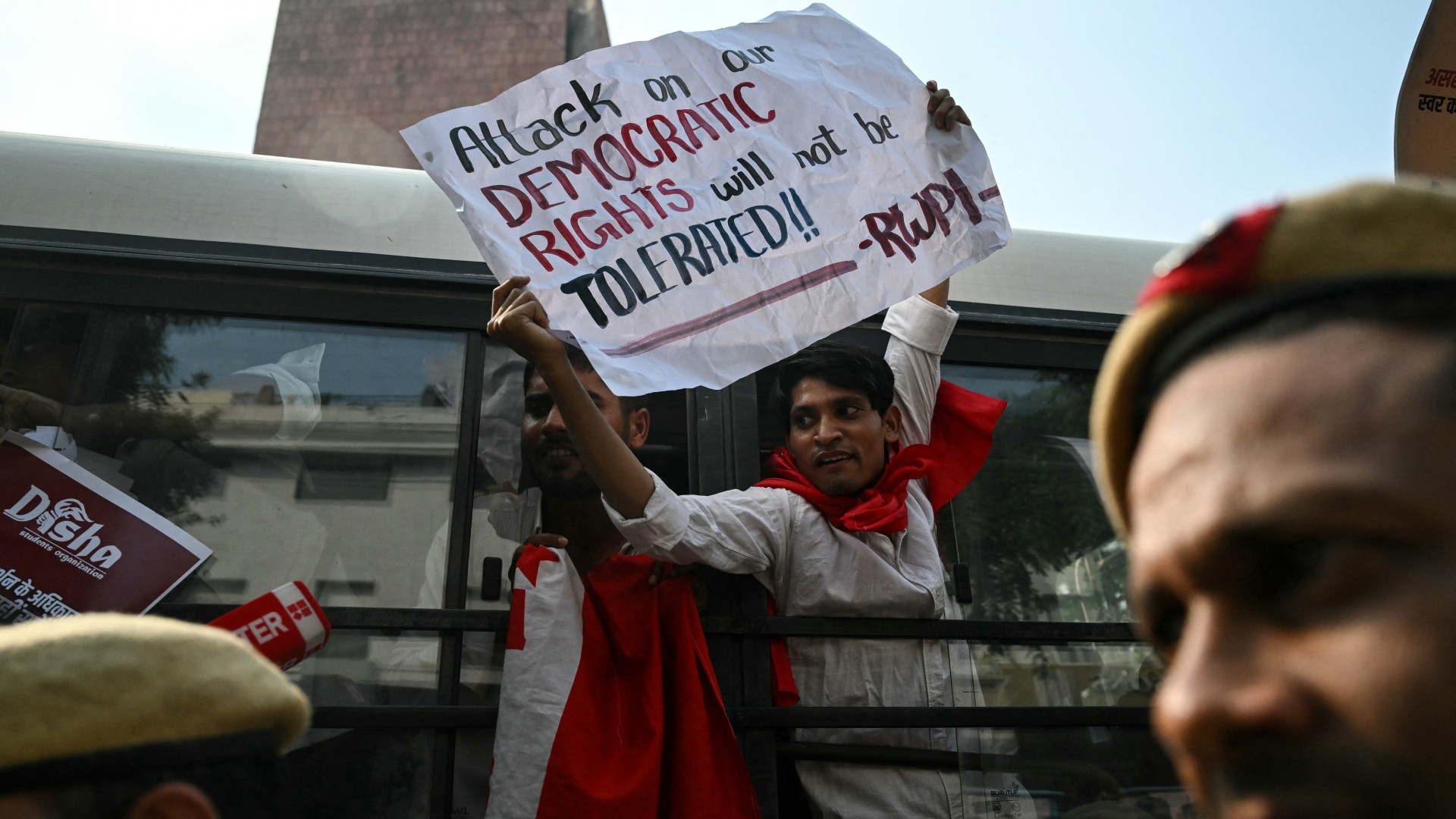
Authorities led by the BJP-controlled Delhi government attempted to quash the unrest by imposing prohibitory orders banning gatherings of four or more people in large swathes of the capital, just days after Delhi Police removed the iconic, decades-old protest site at Jantar Mantar from its list of approved demonstration locations, re-routing permitted events to far-flung, underused grounds on the city’s outskirts. Despite these restrictions, thousands of demonstrators defied the bans, leading to widespread detentions. “We are out on the streets to defend Indian democracy, and we are not engaging in any violence – yet the police are still arbitrarily arresting people,” protester Vishnu told Middle East Eye from a police transport vehicle holding detained demonstrators. “These illegal detentions are the hallmark of a fascist state. Our demand is non-negotiable: scrap the SIR entirely, because it is nothing more than a state tool to reengineer this country’s voting demographics. They have already successfully pulled this trick in dozens of locations, and we are calling on every citizen to join us to fight this oppressive government.”
Among those detained during the marches were CJP founder and digital strategist Abhijeet Dipke, and All India Students Association president Neha Bora. Bora was released without charges on Saturday morning, while Dipke was released after appearing before a Special Executive Magistrate and signing a personal bond. Delhi Police has filed at least two formal cases against the movement for violating public assembly restrictions.
The ECI and ruling BJP have defended the SIR process, framing the roughly 130 million proposed deletions as a routine, good-faith administrative effort to purge dead, duplicate, and otherwise ineligible voters from the rolls to clean up electoral integrity. But a September 23 investigation by *The Indian Express* uncovered deep internal rifts within the Election Commission, revealing that two sitting Election Commissioners, Sukhbir Singh Sandhu and Vivek Joshi, had filed formal written objections at least 14 times over a 10-month period to major decisions that were enacted without their knowledge, consultation, or approval. Their documented concerns included unvetted mass additions and deletions of voters, unauthorized changes to Form 6 protocols, unrestricted access to the central national voter database, and unregulated modifications to the commission’s core electoral technology systems. The ECI has publicly dismissed the reports of internal dissent, claiming the documents cited were merely informal suggestions, and that every decision related to the SIR process was reached with full, unanimous agreement among all commissioners.
Political analysts argue the stakes of the SIR process extend far beyond administrative procedure, posing a fundamental threat to the fairness of India’s upcoming 2029 general national elections. Ajay Gudavarthy, an associate professor of political studies at Jawaharlal Nehru University, explains that the disproportionate removal of Muslim and Dalit voters appears to be a deliberate, calculated political strategy by the BJP to consolidate electoral support among upper-caste and Other Backward Class (OBC) communities. “The overwhelming majority of deleted names belong to Muslim voters, and that deliberate targeting is why there has been no broader cross-caste mass outrage against the SIR,” Gudavarthy noted. “The BJP’s larger design is not just to erase Muslim votes, but to socially polarize the entire electorate along religious lines through these deletions. Removing large numbers of Dalit voters alongside Muslim voters serves to trigger reverse consolidation of upper-caste and OBC voters behind the BJP, entrenching their hold on power.”
In Odisha’s Cuttack district, the experience of Sayed Rashad Ikmal’s family illustrates how the flawed SIR system operates at the grassroots level. The names of Ikmal’s aunt and uncle – a retired Indian Railways finance department employee – were both struck from the draft voter list, even though they had been registered voters for decades. The family later discovered an unauthorized Form 7 petition (the official document used to request a name’s removal from voter rolls) had been filed against their names, with no knowledge or consent from the couple. Only after they appealed directly to their local Block Development Officer (BDO) was the fraudulent deletion request cancelled, and their names restored to the rolls. Ikmal notes that local communities across his district are increasingly reporting that Muslim residents are being disproportionately targeted for deletion, a trend that has coincided with the spread of the Hindu right-wing “Go to Bangladesh” narrative that frames Indian Muslim citizens as illegal foreign infiltrators. “This repeated threat of being labelled an illegal Bangladeshi migrant is one of the most terrifying narratives being weaponized against Muslim communities,” Ikmal said. “It has been used repeatedly to divide voters along religious lines ahead of state elections, and to galvanize support for the BJP.”
Gudavarthy warns that the ongoing SIR controversy exposes a dangerous erosion of institutional autonomy in the world’s largest democracy. “The only way to restore accountability to our electoral system is through sustained mass public protest and greater decentralization of electoral governance away from unaccountable central authorities,” he said. “This crisis is a critical lesson for Indian democracy: even longstanding, supposedly independent institutions can be easily subverted when the executive branch is allowed to overreach its authority without pushback.”