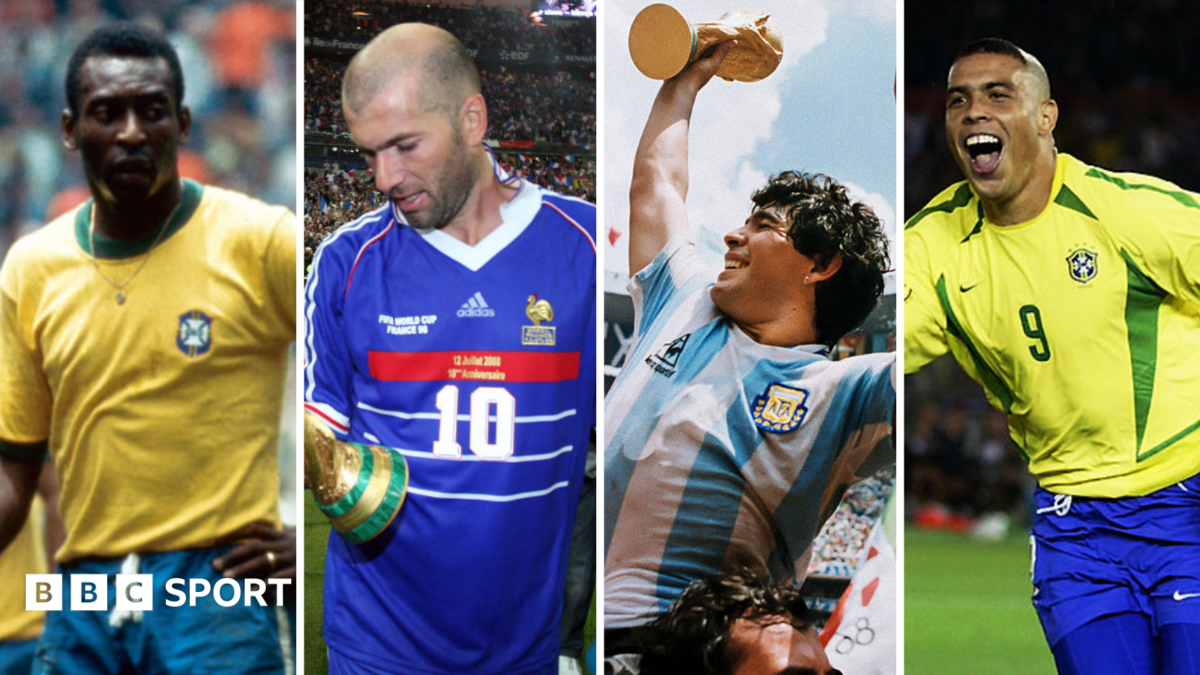
Narrowing down thousands of elite players across 22 men’s FIFA World Cup tournaments spanning nearly 120 years to a final list of just 10 all-time greats is no small feat, according to senior BBC Sport journalist Alex Bysouth. While Bysouth notes the top six or seven selections are largely undisputed, debate will inevitably rage over the final spots on the ranking, with many iconic players forced to miss out.
Among the standout omissions is Miroslav Klose, the men’s World Cup’s all-time leading goalscorer, who lands just outside the top 10 at 11th. Also left off the final list are Brazilian dribbling legend Garrincha, Italian icon Roberto Baggio, 1958 single-tournament 13-goal record holder Just Fontaine, Dutch revolutionary Johan Cruyff, Portuguese powerhouse Eusébio, German clinical finisher Gerd Müller, and no individual from Spain’s universally celebrated 2010 World Cup-winning squad, whose collective strength left no single player standing out enough to claim a spot. With that context, here is Bysouth’s ranking of the 10 greatest World Cup legends in history:
10. Sir Geoff Hurst, England (1966 Winner)
England’s 1966 home World Cup final was meant to see star striker Jimmy Greaves return from a group stage injury to start, but manager Alf Ramsey opted to retain Hurst — a player who had made his international debut just months earlier. That decision went down in football folklore: the West Ham forward scored the only hat-trick in a men’s World Cup final for 56 years, leading England to their first and to date only World Cup title. Hurst was not the most naturally gifted player in that England squad, but his historic final feat — only matched 56 years later by Kylian Mbappé in Qatar, who finished on the losing side — cements his place in World Cup history. Without Hurst, there would be no iconic “they think it’s all over” commentary, nor the decades of national longing that have followed England’s 1966 triumph.
9. Cafu, Brazil (1994 & 2002 Winner)
The only player in history to feature in three consecutive World Cup finals, Cafu’s legacy stretches from the favelas of São Paulo to the world’s biggest football stages. He came off the bench to claim his first winners’ medal when Brazil beat Italy on penalties in the 1994 Rose Bowl final, finished as a runner-up in 1998 on home soil for France, and lifted the trophy as captain in the 2002 co-hosted tournament in Japan and South Korea. Across four tournaments, Cafu notched 16 World Cup wins — a total only topped by the omitted Miroslav Klose. Before lifting the 2002 trophy, he wrote “100% Jardim Irene” on his Brazil shirt, a tribute to the working-class favela where he grew up, cementing his status as both a World Cup great and a grounded icon of the game.
8. Paolo Rossi, Italy (1982 Winner)
Rossi’s 1982 World Cup run remains one of the greatest fairytale redemption stories in tournament history. Returning to international football just months after a two-year ban over match-fixing allegations he always denied, Rossi rose to the occasion in one of the most iconic World Cup matches of all time: Italy’s second-round clash with tournament favorites Brazil at Barcelona. Expected to rely on their solid defense to grind out a result, Italy found their match-winning hero in Rossi, who scored a hat-trick — including the game-winner — to knock out the Seleção. He went one step further, bagging a brace against Poland in the semi-final, and scoring the opening goal of Italy’s 3-1 final victory over West Germany at the Santiago Bernabéu, securing Italy’s first World Cup title since 1938. His six tournament goals earned him the Golden Boot, Golden Ball, and FIFA World Player of the Year honors.
7. Zinedine Zidane, France (1998 Winner)
A second-generation Algerian immigrant raised in the public housing towers of northern Marseille, Zidane became the face of France’s multicultural 1998 World Cup-winning squad, a team that united the nation behind the tournament hosted on home soil. After a red card against Saudi Arabia in the group stage sidelined him for two matches, Zidane returned in the knockout stage to lead France past Italy and Croatia, before delivering a masterclass in the final against favorites Brazil. He scored two trademark header goals from corner kicks, sparking mass celebrations across Paris that saw a million fans pack the Champs-Élysées, with chants of “Zidane for president” ringing out around the Arc de Triomphe. Zidane’s World Cup legacy is equal parts brilliance and controversy: he is also remembered for a red card after headbutting Marco Materazzi in the 2006 final, which France lost to Italy, but that moment does not overshadow his status as one of the tournament’s greatest ever players.
6. Kylian Mbappé, France (2018 Winner)
Mbappé’s World Cup legend is still being written at just 27 years old, with potentially two or three more tournaments left in his career before he retires. As a 19-year-old at the 2018 Russia World Cup, he became France’s youngest ever World Cup goalscorer, the first teenager to score twice in a knockout round match since Pele in 1958 (in a last-16 win over Argentina), and the first teen to score in a World Cup final since Pele, as France lifted the trophy against Croatia. Despite his prolific club success at Paris Saint-Germain and now Real Madrid, Mbappé has yet to win a UEFA Champions League title — his greatest performances have consistently come on the World Cup’s biggest stage. His sensational hat-trick in the 2022 Qatar final against Argentina, including a stunning volley, was a performance worthy of a second title, even if he ultimately ended on the losing side against Lionel Messi.
5. Franz Beckenbauer, West Germany (1974 Winner as Captain, 1990 Winner as Manager)
Nicknamed Der Kaiser, Beckenbauer is one of only a handful of people to win the World Cup both as a player and as a manager. After finishing runner-up in 1966 and third in 1970, he captained host West Germany to the 1974 title against the heavily favored Dutch side led by Johan Cruyff. Despite falling behind to a second-minute penalty before the German side had even touched the ball, the elegant ball-playing defender led his team to a comeback victory over Cruyff’s revolutionary Total Football side, a style that had influenced Beckenbauer’s own approach to the game. After retiring as a player, he moved to the dugout, leading West Germany to the 1986 final (a loss to Argentina) before securing revenge and the 1990 title in Italy, cementing his unique multi-decade World Cup legacy.
4. Lionel Messi, Argentina (2022 Winner)
For years, it looked like World Cup glory would elude Messi, one of the greatest players of his generation and of all time. As he entered his mid-30s, Messi had never lifted the trophy, even after leading Argentina to the 2014 final. His fifth tournament in Qatar got off to a disastrous start, with a shocking opening defeat to Saudi Arabia that left Argentina facing early elimination. But Messi turned the tournament around single-handedly: he notched a goal and an assist in a critical win over Mexico, scored against Australia in the last 16, converted a penalty against the Netherlands in the quarter-final, and scored another spot kick against Croatia in the semi-final to send Argentina to the final. In a classic final against France, Messi scored twice to bring his tournament total to seven goals, and converted his penalty in the shootout to secure Argentina’s first World Cup title since Diego Maradona’s 1986 triumph, finally completing his legacy.
3. Ronaldo (Brazil, 1994 & 2002 Winner)
Ronaldo’s 2002 World Cup triumph remains the sport’s most iconic redemption arc. Like Cafu, the teenage Ronaldo was part of Brazil’s 1994 World Cup squad but did not make an appearance. By 1998, he was the best player on the planet, a dynamic combination of blistering pace, technical skill and ruthless finishing, and carried Brazil to the final, scoring four goals en route. But a pre-match seizure left him disoriented for the final, and Brazil fell to France, leaving the star with a painful legacy he carried for four years. Years of serious knee injury kept him out of club and international football for long stretches ahead of 2002, leaving his place in the squad in doubt. But in Japan and South Korea, the Brazilian legend reclaimed his status, scoring eight goals — including two in the final win over Germany — to erase the memory of 1998, and brought his total World Cup goal tally to 15, a record that stood for years.
2. Diego Maradona, Argentina (1986 Winner)
No player in World Cup history brought more drama, star power and iconic moments than Maradona, who claims the second spot on this list. Left out of Argentina’s 1978 home World Cup win at 17, he made his tournament debut in 1982, where he was sent off for retaliation in a fiery knockout clash with Brazil. His defining tournament came in 1986 in Mexico, where he delivered what many still consider the greatest individual performance in World Cup history. His quarter-final clash with England produced two of the most famous goals in history: the controversial “Hand of God” opening goal, followed by a moment of pure genius, where he dribbled from inside his own half past six England players to score one of the greatest goals the tournament has ever seen. He scored twice more against Belgium in the semi-final, and captained Argentina to a final win over West Germany, finishing the tournament with five goals and five assists. Maradona’s World Cup career ended as dramatically as it played out: he led Argentina to the 1990 final, where they lost, and was sent home from the 1994 tournament after failing a doping test.
1. Pele, Brazil (1958, 1962 & 1970 Winner)
There was never any question who would top this list: Pele remains the only player in men’s World Cup history to win three titles, across three different decades, and for generations, he was the most iconic name in global football. As a 17-year-old in 1958, he fulfilled a promise he made to his father after Brazil’s devastating 1950 Maracana final defeat to Uruguay, scoring a semi-final hat-trick against France and two more in the final win over Sweden to claim his first title. He was part of the 1962 Brazilian squad that retained the trophy, though he missed most of the tournament through injury after scoring in the opening match. A series of brutal tackles in the 1966 tournament led him to vow he would never play in the World Cup again, but he returned in 1970, leading what many consider the greatest World Cup squad of all time to victory in Mexico, scoring in the 4-1 final thumping of Italy and setting up two more goals. Across four World Cups, Pele scored 12 goals in 14 matches and left an unmatched legacy as the greatest World Cup star of all time.
Bysouth has invited football fans to share their own takes on the ranking in public comments, opening the debate up to the global football community.