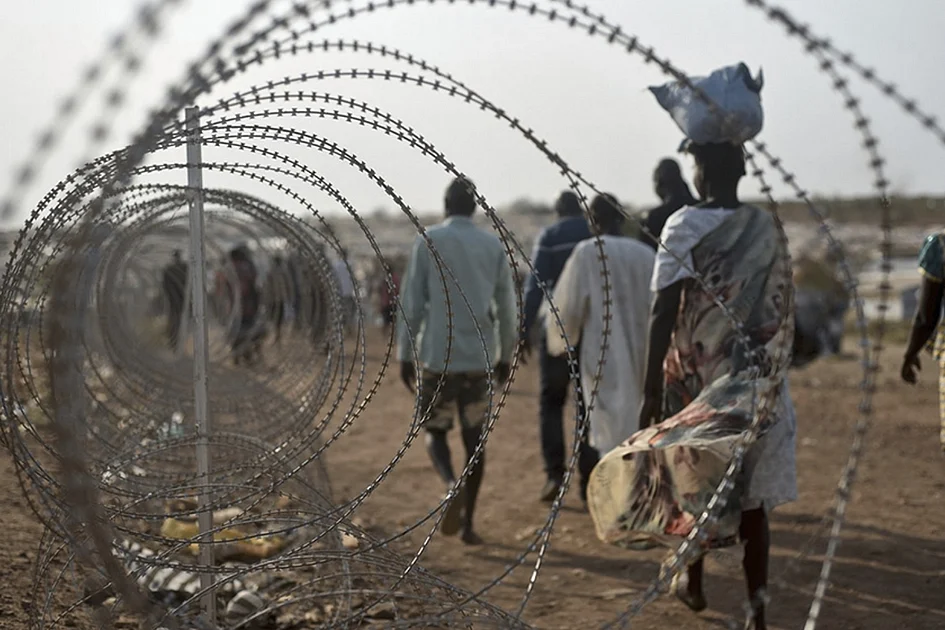
South Sudan, the world’s youngest nation, faces a catastrophic resurgence of violence that has displaced approximately 180,000 civilians and triggered alarming humanitarian concerns. The renewed conflict, concentrated in Jonglei state north of the capital Juba, marks the effective collapse of the 2018 power-sharing agreement between President Salva Kiir and his former vice-president Riek Machar.
Eyewitness accounts describe indiscriminate aerial bombardments utilizing barrel bombs, with civilians fleeing into swamps for safety. Daniel Deng, a 35-year-old displaced resident of Duk County, reported approximately 300 combatant fatalities during recent clashes, though these figures remain unverified. ‘I am stuck, and if worse comes, the only safe place for me to go is the swamps,’ Deng told AFP via telephone.
The political crisis deepened significantly when Machar was arrested in March 2025 and now faces trial for alleged crimes against humanity. This development effectively terminated the fragile coalition government that had maintained relative stability since the civil war that claimed 400,000 lives following the country’s 2011 independence.
Humanitarian organizations report catastrophic conditions for displaced populations. The UN Office for the Coordination of Humanitarian Affairs (OCHA) confirms widespread looting and burning of homes and medical facilities across four Jonglei counties. Médecins Sans Frontières operations manager Gul Badshah warned from Nairobi that supply shortages have reached critical levels, stating bluntly: ‘We don’t have the supplies… Kids will die; it’s as simple as that.’
The violence has created extensive ‘red zones’ where humanitarian access remains completely blocked. Bol Deng Bol, a local civil society leader, reported continuous civilian movement toward Bor, the state capital, as military mobilization suggests imminent escalation. The UN Commission on Human Rights in South Sudan member Barney Afako characterized the situation as ‘a dangerous escalation which could put the country into another dangerous spiral of violence.’
Despite substantial oil reserves, systemic corruption has left South Sudan among the world’s poorest nations. World Food Programme data indicates approximately 7.7 million of its 12 million citizens faced food insecurity as of April 2025, a situation now dramatically worsened by the current conflict.