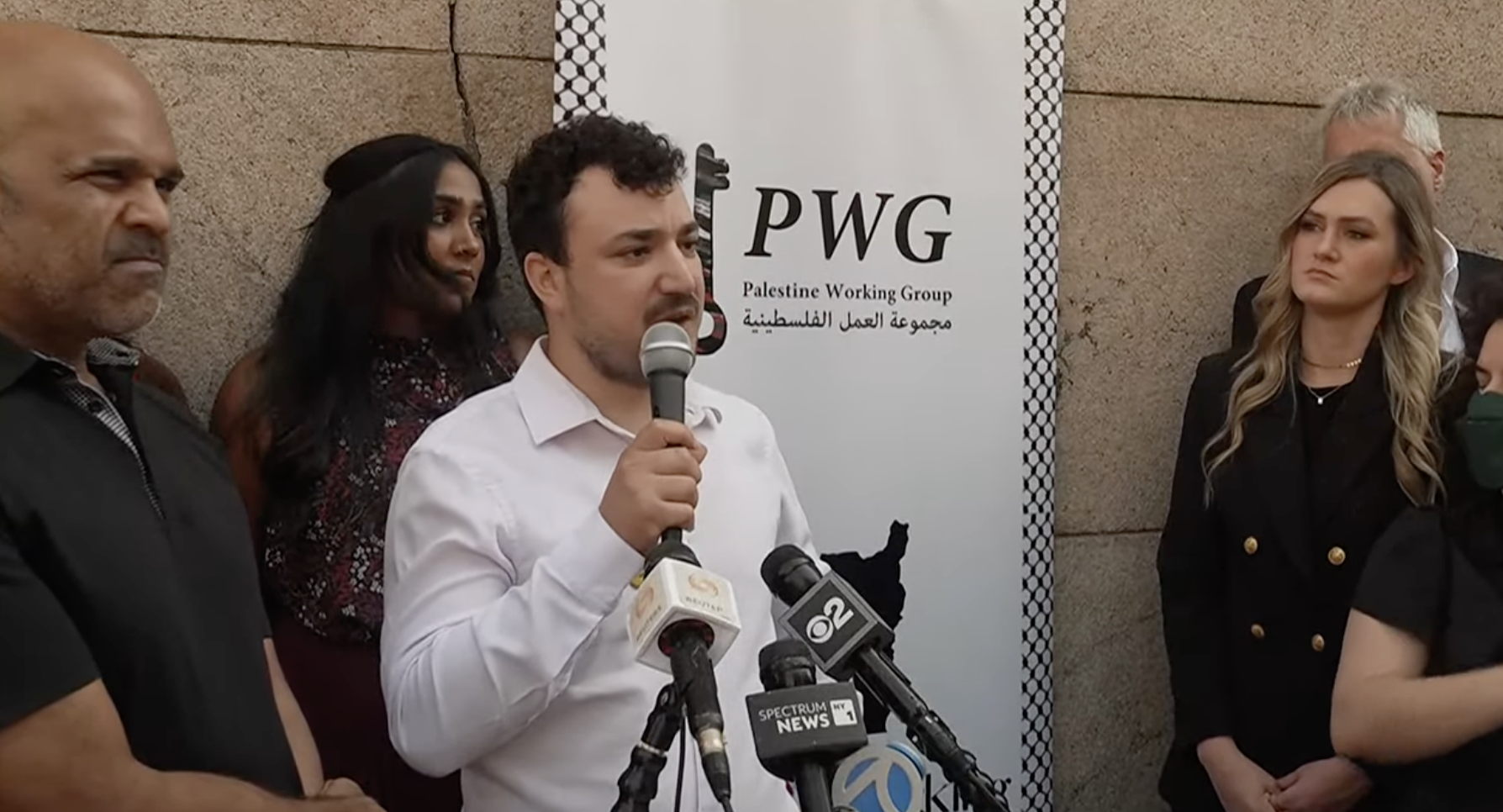
On a Monday press conference in New York City, former Columbia University student Mahmoud Khalil, alongside a campus pro-Palestine student group and its leader, launched a new federal lawsuit against the elite Ivy League institution, accusing it of enabling systemic discrimination that directly cleared the path for his 2025 arrest by U.S. Immigration and Customs Enforcement (ICE).
Joining Khalil as co-plaintiffs are the Palestine Working Group (PWG)—a student organization based at Columbia’s School of International and Public Affairs (SIPA)—and PWG president Mohammed Ibrahim Zubairi. Named as defendants in the suit are Columbia’s Board of Trustees and SIPA Dean Keren Yarhi-Milo. The legal filing outlines that the university displayed deliberate indifference to repeated reports of severe, sustained, coordinated harassment targeting the plaintiffs, singling them out because of their pro-Palestine advocacy, their Arab and Muslim identities, their national origins, and their status as non-U.S. citizens. Court documents identify Khalil as a Palestinian Muslim holding Algerian citizenship, and Zubairi as a Pakistani Muslim with Pakistani citizenship.
Khalil, a former U.S. green card holder married to a U.S. citizen, was taken into ICE custody in March 2025 as part of the Trump administration’s campaign targeting non-citizens deemed to hold anti-Israel rhetoric. Plainclothes agents revoked his student visa and green card during the arrest, and he remained detained in an ICE facility for 104 days—a period that forced him to miss the birth of his first child. He was ultimately released on a federal court order pending the outcome of federal proceedings against him, and his case quickly garnered international public attention.
In remarks to reporters Monday, Khalil emphasized the lawsuit does not blame the university for ICE’s actions directly, but for creating conditions that made his detention possible. “If only I had legal support [from the university] before my detention, I don’t think ICE would have came and kidnapped me,” he said. “That’s why I’m not suing Columbia for what ICE did. I’m suing them for all the groundwork that they did before my abduction to make my abduction possible. Because without Columbia’s intentional disregard to my safety, I don’t think ICE would have came after me.”
The legal complaint details that in the five months after mass pro-Palestine protests erupted across Columbia’s campus in 2024 in response to Israel’s military campaign in Gaza, Khalil, Zubairi, and other PWG members repeatedly reported harassment and doxxing targeting pro-Palestine students to university administrators, including directly to SIPA’s dean. According to the suit, school officials failed to intervene to stop the ongoing, pervasive harassment, and instead retaliated against PWG: university leaders repeatedly labeled the group’s events as security threats, unreasonably disrupting its ability to operate as a recognized student organization. Khalil added that he had met repeatedly with university leadership in the months before his arrest to plead for protection for the campus Palestinian community, but his requests were ignored. He also noted that the university ultimately banned two leading pro-Palestine student groups, Students for Justice in Palestine and Jewish Voice for Peace, after the protests began.
“Our safety and well-being did not serve the ideological project [Columbia’s] Board of Trustees was protecting, so they traded us away,” Khalil told reporters.
In a statement provided to Middle East Eye in response to the new lawsuit, a Columbia spokesperson reaffirmed the university’s stated commitment to campus safety. “Creating a campus environment where every member of our community feels welcome, supported, and safe is fundamental to who we are as a University,” the emailed statement read. “It is also a responsibility we take seriously. Columbia is committed to protecting our community from discrimination and harassment, and responding promptly and appropriately when concerns arise.”
Monday’s lawsuit marks the second major legal action against Columbia over alleged anti-Palestine discrimination in as many months. Last month, a separate group of current and former Palestinian students and staff filed suit in New York State Supreme Court, seeking monetary damages under New York City’s Human Rights Law, which bans discrimination based on race and national origin, among other protected characteristics. That complaint alleges that Columbia has subjected Palestinian students, faculty, and staff to unequal treatment in the period following the October 7, 2023 Hamas attacks and the subsequent Israeli military campaign in Gaza. Plaintiffs in that case accuse the university of actively amplifying racially, ethnically, and politically motivated targeting of Palestinians, failing to protect Palestinian community members from harassment, and subjecting pro-Palestine activists to biased, unfair disciplinary proceedings. One key allegation in that suit notes that Columbia hired private investigators to surveil students who participated in a March 2024 campus event called “Resistance 101,” after which six students were suspended and removed from university housing.
Both legal actions come after more than two years of ongoing controversy surrounding Columbia’s handling of campus protests against Israel’s war in Gaza. In July 2025, Columbia reached a settlement agreement with the Trump administration to end federal investigations into alleged violations of anti-discrimination law and restore frozen federal research funding. Under the terms of that deal, the university agreed to pay $200 million to the U.S. government and an additional $21 million to resolve an Equal Employment Opportunity Commission investigation into antisemitism claims from Jewish employees. Columbia did not admit any wrongdoing nor accept the federal government’s finding that it had violated Title VI of the Civil Rights Act. The university also settled a separate lawsuit brought by Jewish plaintiffs in February 2026, which alleged Columbia had failed to protect Jewish and Israeli students from antisemitism on campus.
Palestinian student activists and free speech advocates have for years repeatedly accused Columbia of disproportionately disciplining students and faculty who voice opposition to Israeli policy, a pattern that the new federal lawsuit brings to federal court.
This report is from Middle East Eye, an independent media outlet focused on coverage of the Middle East, North Africa and global affairs related to the region.