The widening geopolitical fallout from the US-Israeli war on Iran has sent shockwaves through India’s energy supply chain, triggering the most severe cooking gas shortage in 10 years and pushing hundreds of thousands of low-income internal migrant workers to abandon urban livelihoods and return to their rural hometowns. The crisis traces its roots to Iran’s recent decision to close the Strait of Hormuz, the strategic maritime chokepoint that carries roughly 20% of the world’s daily crude oil shipments. As one of the world’s largest LPG importers, India relies heavily on Middle Eastern energy exports: approximately 60% of the country’s total LPG comes from Qatar, the United Arab Emirates and Saudi Arabia, and 90% of those shipments pass through the Strait of Hormuz. This dependence has left India uniquely exposed to the disruptions sparked by ongoing regional conflict.
For millions of Indian households, LPG – a blend of propane and butane – is the primary cooking fuel, making consistent access a non-negotiable requirement for daily life. For low-wage migrant workers, who make up the backbone of India’s urban industrial and service sectors, the supply crunch and subsequent price spike has proven catastrophic. Thirty-year-old Raj Kumar, a daily-wage laborer who spent 15 years working at a New Delhi bathware factory earning less than $7 a day, is one of hundreds of thousands of workers forced to leave the capital. For weeks, Kumar attempted to secure LPG to cook for his wife and two children, but skyrocketing prices and persistent shortages made staying impossible. The factory where he worked, one of thousands of small businesses affected by fuel shortages, shut down entirely, leaving Kumar and all 40 of his co-workers unemployed. Left with no other options, Kumar loaded his family’s belongings and traveled 650 kilometers back to his hometown in Mahua, Uttar Pradesh. “It is hard to stay here anymore. We were struggling to eat properly. Seeing my children and wife suffering for the past few days was painful,” Kumar told reporters.
Stories like Kumar’s are not isolated. Across major Indian industrial hubs including New Delhi, Mumbai and Gujarat, thousands of small and medium enterprises – from textile and ceramic manufacturing units to food processing facilities, local eateries and street food vendors – have scaled back operations or shut down completely as fuel supplies dried up. Migrant workers, who move from rural areas to cities in search of scarce, low-paying work, have borne the brunt of the crisis, a pattern that mirrors the widespread displacement seen during India’s 2020 COVID-19 lockdown.
Twenty-two-year-old Chandan, who works at a motorcycle spare parts factory in Bhiwandi, Rajasthan, spent all of his wedding savings trying to refill his small 5-kilogram LPG cylinder before being forced to head home to Balia village, also in Uttar Pradesh. After exhausting his savings, Chandan switched to eating at roadside eateries, but found that tripled commercial gas prices had pushed food prices up threefold as well. “Before the unforeseen gas crisis, I would buy a plate of rice for 50 rupees (around half a dollar), but all the eateries have tripled the price for the same plate, claiming an equal rise in commercial gas in the grey markets. I earn around 500 rupees a day ($6), and I cannot purchase a kilo of gas for 400 rupees ($4),” Chandan explained. With no government relief in sight, he joined the wave of reverse migration back to rural Uttar Pradesh.
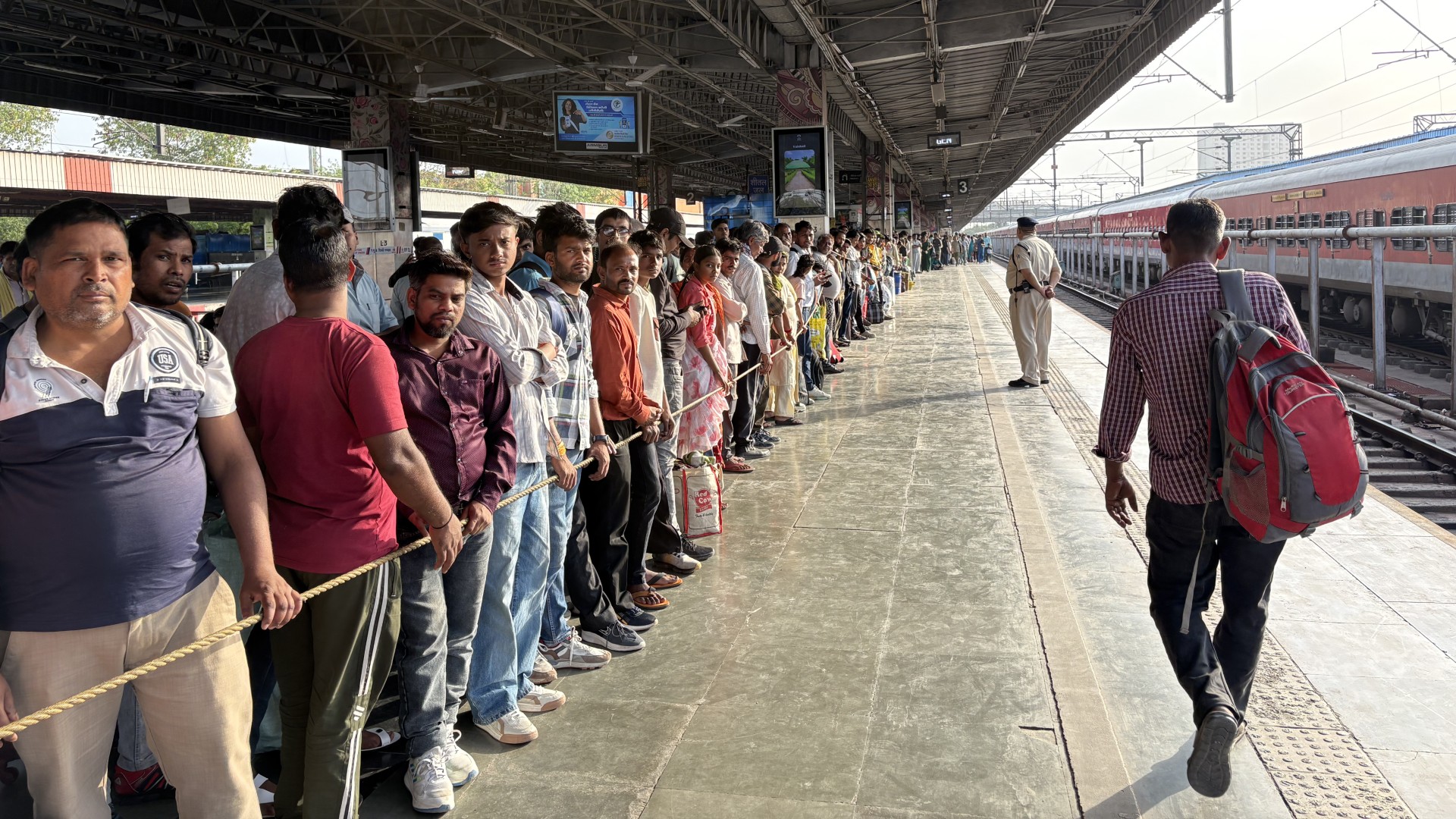
Government data and official statements have painted a conflicting picture of the crisis. India’s federal energy ministry has claimed that it maintains uninterrupted domestic LPG supplies and that no large-scale worker outmigration from major cities is occurring, despite long queues of workers seeking tickets home at railway stations across the country. However, during a March 12 parliamentary address, junior petroleum and natural gas minister Suresh Gopi admitted that India holds only five days of strategic crude oil reserves, and just 20 days of LPG reserves to cover unexpected supply disruptions.
Compounding the crisis for migrant workers are long-standing regulatory barriers that limit their ability to purchase LPG in urban areas. Under current government rules, each household is only eligible for one subsidized LPG connection, which is almost always registered to the worker’s home village. In cities, migrants are only permitted to purchase small 5-kilogram cylinders, a process hampered by heavy bureaucratic restrictions. As a result, most migrants are forced to buy LPG on the unregulated black market, where prices are often multiple times the subsidized rate. In response to growing public pressure, the government announced on April 7 that it would ease these restrictions and double the national allocation of 5-kilogram cylinders, a move analysts say is too little too late.
The reverse migration trend has experts warning of long-term social and economic damage that mirrors and exceeds the fallout from past crises. Sunil Kumar Aledia, executive director of the Centre for Holistic Development and a prominent social activist, argues that the Indian government has failed to take proactive steps to mitigate the crisis, leaving vulnerable migrant communities to fend for themselves. “They are facing the burden of the LPG crisis. Although it seems the impact is gradual, the government has not offered any help,” Aledia said, warning that the government’s slow response could allow the crisis to escalate into a larger humanitarian catastrophe in the coming months.
Professor S Irudaya Rajan, chairman of the International Institute of Migration and Development in Kerala, compared the current crisis to the displacement seen during the 2020 COVID-19 pandemic and the 2008 global recession, noting that the long-term damage is likely to be far more severe this time around. Rajan added that the crisis will be compounded by an additional wave of reverse migration from Gulf nations, where thousands of Indian expat workers are employed. “Not only India, but people from several other countries in Southeast Asia earn a significant percentage of remittances from the Gulf nations that outweigh the earnings from domestic labour engagement. As the people start migrating from the war-hit countries, the impact of internal migration would be aggravated by this international reverse migration,” Rajan explained.
Dr Adfer Shah, a New Delhi-based sociologist and South Asia analyst, described reverse migration as an existential threat to India’s most economically and socially marginalized communities. “Reverse migration places enormous pressure on village economies and rural livelihoods that are structurally not equipped to reabsorb the returning workforce. Such a shock affects their whole life, even their children’s education. It curtails all freedoms and opportunities that urban proximity offers them,” Shah said, noting that the influx of returning workers will push down rural wages, increase joblessness, and destabilize already fragile village economies.
At major railway hubs across New Delhi, thousands of workers are scrambling to secure tickets home, often paying double or triple the official fare because of overwhelming demand. Twenty-one-year-old Sintu Kumar Bhagat, who has been out of work for more than a month, waited at New Delhi Railway Station to board a train to his home village in Purnia, Bihar, after scraping together enough money to buy overpriced tickets for himself and his brother. “I got the tickets for double the price with difficulty. Booking has to be done a day or two in advance as everyone is leaving for home,” Bhagat said.
Twenty-seven-year-old Ashok Kumar Chaudhary, who traveled 1,000 kilometers from his Jharkhand village to work in Delhi’s iron manufacturing industry to support a family of five, echoed the despair shared by many returning workers. “I had travelled 1,000 kms from my village in Jharkhand to Delhi to support my family of five, now going back home empty-handed feels like a curse,” Chaudhary said as he waited to board his train at Anand Vihar Railway Station.
For workers like Raj Kumar, who waited with his wife and newborn child for a train back to Uttar Pradesh, the only hope is that the crisis will end quickly, allowing them to return to the urban jobs that offer their children a better future. “At home, we have firewood to cook and feed ourselves. I will work on farms until the end of the crisis, and I hope the situation here improves soon. We don’t have any option but to return so that we earn better and make a good future for our kids,” Kumar said. With India’s domestic energy reserves stretched thin and geopolitical tensions in the Middle East showing no sign of easing, that future remains increasingly uncertain for hundreds of thousands of the country’s most vulnerable workers.