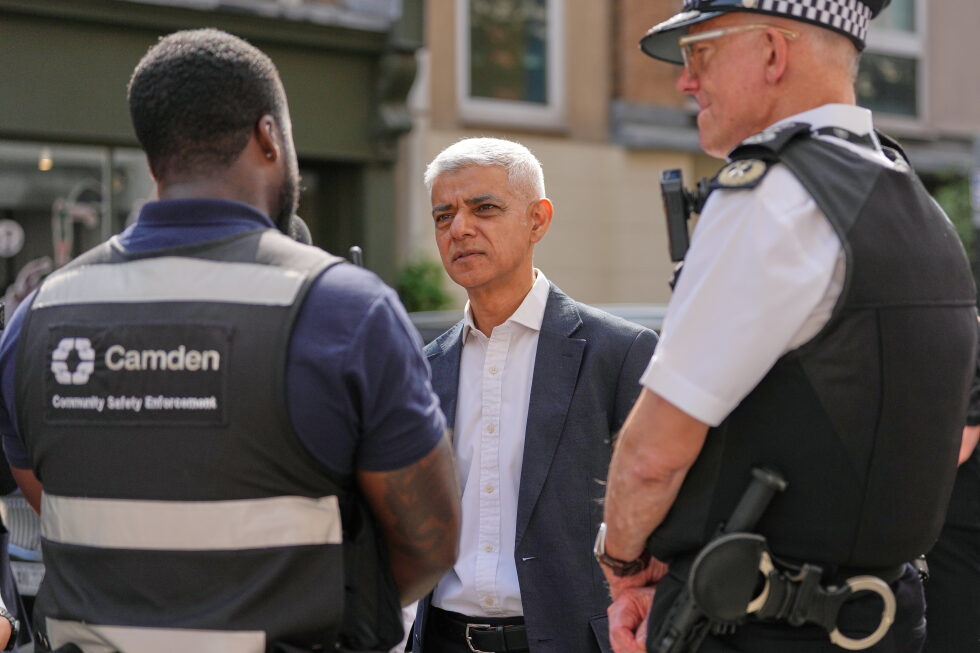
LONDON – Fresh crime data showing a sharp drop in common street offenses has given London’s top city officials a platform to push back against a widespread, politically charged online narrative that frames the British capital as a lawless, unsafe destination for visitors and residents alike. Mayor Sadiq Khan and Metropolitan Police Commissioner Mark Rowley outlined the new figures during a press briefing Thursday, arguing that viral negative claims about London’s crime crisis are amplified by bad actors seeking to undermine the city’s progressive, multicultural identity.
According to data released by the Metropolitan Police, neighborhood crime – a broad category covering phone theft, pickpocketing, residential burglary and motor vehicle offenses – fell 14% across the capital in the 12-month period ending in June. In two of London’s most visited tourist areas, the declines were even steeper: the crime category dropped more than 33% in Westminster, which hosts major attractions including the Houses of Parliament, Soho and Leicester Square, and fell 25% in neighboring Camden, another popular destination for international visitors.
Despite these measurable improvements, Khan noted that negative claims about London’s safety have exploded across social media platforms over the past two years. He reported a 200% jump in social media posts claiming London is in “decline” or overrun by danger, with many of these claims pushed by right-wing politicians and tied to anti-immigrant and anti-Muslim rhetoric. As London’s first Muslim mayor, who has held office since 2016, Khan has himself been a frequent target of these attacks: he has been publicly insulted by X owner Elon Musk and former U.S. President Donald Trump, who has repeatedly labeled Khan a “terrible” mayor and a “stone-cold loser.”
Khan blames this coordinated negative campaign on what he calls an online “outrage economy,” where content creators and bad actors monetize fear and negativity to drive engagement and profit. “We know there are bot farms making money from negative stories about London,” Khan told the Associated Press in an interview. “We know that there are state actors in Russia and China and MAGA-backed influencers in the USA who want to do London down. Why? Because we’re liberal, we’re progressive, we are multicultural and we’re incredibly successful.” Khan added that if social media platforms fail to crack down on coordinated misinformation, new regulation will be necessary to curb the spread of harmful false content.
Broader crime trends support officials’ claims that London is far safer than viral narratives suggest. Like most major urban centers across Europe and North America, London has seen a steady decline in violent crime in recent years. The city recorded 97 homicides in 2023, the lowest annual total since 2014, and its homicide rate per capita is lower than that of Paris, Berlin, or New York City. Even so, Khan acknowledged that London still faces pressing public safety challenges: he specifically highlighted a worrying rise in hate crimes targeting Muslim and Jewish communities, a surge fueled in large part by ongoing geopolitical conflicts in the Middle East. “We’ve got to make sure we give these communities the confidence to report these crimes,” Khan said. “We’ve also got to be sure we support them to make their places of worship safer, so nobody’s scared to practice their faith.”
The Metropolitan Police has focused on cracking down on non-violent but quality-of-life eroding offenses, such as phone snatching, shoplifting and subway fare evasion – crimes that many Londoners report encountering in their daily lives. Police leaders credit the recent drop in these offenses to a multi-pronged strategy that combines increased high-visibility patrols in high-risk tourist and residential areas, intelligence-driven operations targeting repeat offenders, and integration of new technology into policing work.
Rowley, who took over as commissioner in 2022, highlighted the force’s controversial but “innovative and creative” use of facial recognition technology as one tool driving recent progress. “There’s classic police work, officers on the streets, supported by the best of 21st century technology that’s making a difference,” he said. Rowley’s leadership has come as the Met works to rebuild public trust after a string of high-profile scandals, which culminated in an independent public review that found the force was deeply institutionalized with sexism, homophobia and racism. The force also faces separate criticism from right-wing groups that claim it practices a “two-tier” policing model biased against white people. Rowley pushed back against that narrative, saying the force is committed to impartial policing that serves all communities equally. “We’re routinely invited to join either side of the culture wars. We’re politely declining those invites,” Rowley said. “We operate under the law without fear or favor. We’re here to protect every citizen and we do that with equal vigor.”
Many visitors and long-term residents echo officials’ reassurances about London’s safety. Julianne Sweeten, a 21-year-old American university student studying abroad in London from Chesapeake, Virginia, said the capital “feels a lot safer than the U.S.,” noting that the near absence of gun violence eliminates a major source of fear, and she has not experienced the phone theft that many online warnings warn about. Vicky Hawkins, a 78-year-old artist who has lived in London her entire life, said she sees little change in overall crime levels from decades past. “I know people feel more unsafe, I think, these days. But I don’t,” she said. “But I know not to push my luck.”