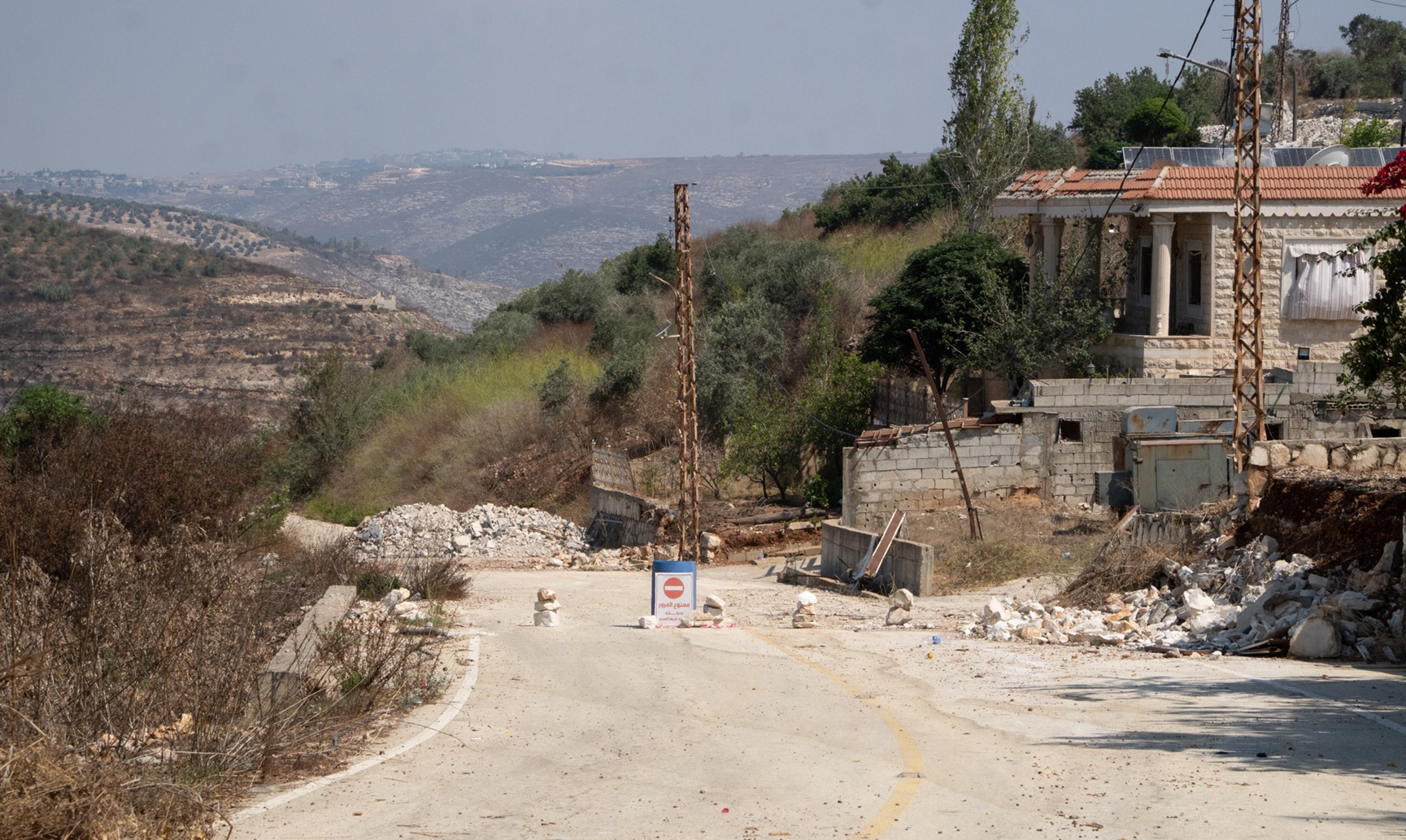
Perched on a strategic hilltop just outside Israel’s self-declared Yellow Line in south Lebanon, the small village of Ghandouriyeh bears the brutal, visible scars of months of cross-border conflict. Most of its residential buildings stand as hollowed rubble or flattened heaps of concrete, the result of Israeli strikes earlier this year that turned once-lived-in homes into uninhabitable wreckage. It is here that 66-year-old Mariam Ismail Ballout waited on August 28 at the entrance of a Medecins Sans Frontieres (MSF) mobile medical clinic, desperate to collect medication and escape the chaos that has upended her life.
“All our houses are ruined, all our houses are on the ground, demolished,” Ballout told Middle East Eye, her voice cracking before tears overtook her. She lost everything when her home burned to the ground: no refrigerator, no washing machine, no access to gas for cooking—every basic necessity of daily life gone overnight.
Ghandouriyeh sits just south of Froun, one of Lebanon’s designated “pilot zones” in the Nabatieh governorate, a region that has remained on edge despite a US-brokered ceasefire announced in June. A rolling green valley called Wadi al-Hujeir blocks direct sightlines to Israeli military positions on the other side of the border, but little else shields residents from the constant threat of violence. A large plastic bin marked with an Arabic warning of “enemy” territory beyond is the only barrier between the village outskirts and roads now closed to all travel.
Against all advice, roughly 228 families have returned to Ghandouriyeh in recent months, even though the village has no access to running water or electricity. Village mayor Mohammed Ali Nader told Middle East Eye that most returnees have no other option: they cannot afford to rent housing elsewhere, forcing them to cram into damaged, partially standing homes and share space with neighbors who have also lost everything. While Nader confirmed the village has not suffered a direct strike in months, residents live in a permanent state of high alert—a chronic stress that medical experts say is fueling a growing, underreported mental health crisis across the region.
MSF, which operates daily mobile medical units across hard-to-reach parts of south Lebanon, has become a critical lifeline for communities cut off from regular healthcare access. Almas Al Andary, a 33-year-old MSF counselor and clinical psychologist working out of the Ghandouriyeh clinic, says the conflict has triggered new mental health disorders among people who never experienced symptoms before. “We definitely see a lot of people having acute stress disorders. And these symptoms we can’t formally diagnose because the crisis is still ongoing,” Al Andary explained. Intense, persistent responses to daily triggers—including the constant buzzing of Israeli drones that hover over the village nearly every day—are the most common complaints: widespread tension, hypervigilance, crippling fear, and constant anxiety about the next strike.
MSF’s internal records reflect the scale of the growing need: since the war resumed on March 2, the organization’s counselors have conducted 1,326 individual mental health sessions across southern Lebanon, and requests for psychological support have climbed steadily month over month. On the day of Middle East Eye’s visit to Ghandouriyeh, the persistent hum of an Israeli drone hung over the village. Only three patients came to the clinic that day—an unusually low number, which Al Andary attributed to overnight air strikes that sent most residents fleeing to the relative safety of the valley overnight. Of the three patients that did show up, two were first-time visitors seeking mental health support.
The crisis extends far beyond Ghandouriyeh. Earlier this year, Embrace, a leading Lebanese mental health non-profit that runs the country’s National Lifeline, reported that call volume during the 2026 conflict was 55 percent higher than during the 2024 cross-border war. Despite this surge, little public data exists to document the full scope of mental health harm in southern Lebanon under the fragile, nominally ceasefire conditions. On the ground, frontline medics say the reality is stark. Farah Kerbaj, a community health educator, told Middle East Eye that widespread sleep disorders are rampant, forcing many residents to rely on sleep and mental health medications just to get through the day. Reem Farhat, an MSF midwife working in the region, added that most patients she sees are in a state of constant agitation, their nerves frayed by months of uncertainty.
Stigma around mental health treatment and the chaos of tracking care for displaced families have only compounded the crisis, medics say. For Ghandouriyeh, the most urgent immediate need is access to clean water—without it, residents cannot grow crops to feed their families, the mayor says. But even the most basic calm remains out of reach: most families keep their bags packed, ready to flee at a moment’s notice, a constant state of readiness that aligns with the hypervigilance Al Andary documents in her patients.
“We’re fed up, honestly. We’re fed up with wars; we’ve had enough wars,” said Mohammed Gannem, a local resident who returned to Ghandouriyeh with his family in June, relieved to find his home still standing but still unable to sleep through the night. Gannem says he is particularly worried about the impact of constant conflict on his two young daughters; his youngest, nearly two years old, now flinches in terror at the sound of incoming shelling, a fear she never had before this year’s war.
Medics say the steady rise in demand for mental health support has two overlapping causes: a growing willingness among Lebanese people to seek help for mental health struggles, as historical stigma slowly fades, and a parallel rise in desperation as the ceasefire holds in name only. Israel continues to carry out strikes beyond the Yellow Line in Nabatieh, Tyre, and other southern districts, which have claimed dozens of lives since the June truce. The Lebanese Army confirmed last week it has ramped up operations in southern non-occupied areas amid growing signs of escalating tensions.
Georges Jreij, an MSF counselor based at another mobile clinic in Beirut’s southern suburbs, says mental health distress often rises in waves following the outbreak of conflict, with a predictable surge around the six-month mark— a threshold the war will hit this month. “It’s usually the time it takes for the brain to really realise the situation, to be able to think about the stuff that people are going through,” Jreij explained. “And the central nervous system sort of calms down in these periods, so other sides of the brain are reactivated.”
As the MSF clinic’s day in Ghandouriyeh drew to a close, a brief, unexpected sound cut through the constant drone buzz: the playful jingle of a pale pink ice cream van, its windscreen cracked from past strikes, slowly winding past the piles of ruined homes. For a moment, the sound offered a faint, fleeting echo of normal life in the hilltop village. But as the jingle faded into the distance, the menacing buzz of surveillance drones returned, a constant reminder that for the residents of south Lebanon, the crisis is far from over.