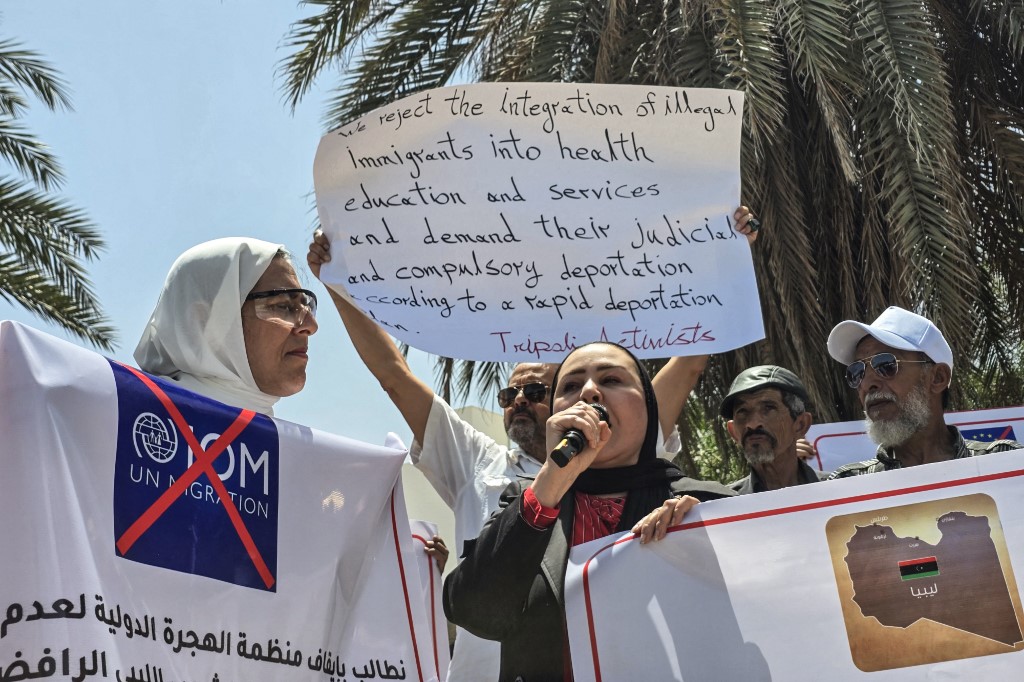
In early October, a planned mass xenophobic demonstration targeting foreign migrants in Tripoli that had been weeks in the making failed to materialize at scale, overshadowed by a large-scale teachers’ strike demanding unpaid wages from the internationally recognized Government of National Unity (GNU) that controls western Libya. But the failed protest did little to ease the rising tide of anti-migrant sentiment that has been building in the Libyan capital since spring 2025, leaving hundreds of thousands of vulnerable people facing growing threats of violence, discrimination, and exclusion. In the lead-up to the 1 October deadline for protests, dozens of social media groups and pages flooded platforms with openly xenophobic content, replete with racist slurs targeting Sub-Saharan African, Arab, and Asian migrants, in a coordinated campaign to push Libyans into the streets. Migrant rights organization Refugees in Libya even confirmed it received a handwritten threat targeting “black people” that included a bullet just days before the planned demonstration. While the 1 October protests drew barely any turnout, small factions of demonstrators did gather in Tripoli’s Martyrs’ Square on 2 and 9 October, chanting slogans including “Libya for Libyans” and “No to resettlement.” These small actions are part of a steady string of similar demonstrations that have taken place multiple times per month in central Tripoli since April, slowly amplifying hostility toward the large migrant population concentrated in the capital. Today, Tripoli is home to nearly 700,000 Sub-Saharan African migrants and refugees, including 335,000 Sudanese people who fled the ongoing war in their home country. For years, the Libyan capital has served as a key transit hub for migrants seeking to cross the Mediterranean to reach Europe. Data from the first eight months of 2025 shows that roughly 80% of all migrants arriving in Italy via the Mediterranean departed from Libyan territory, with over 90% of those departures launching from western Libya’s coastline between Tripoli and Zuwara, a longstanding major departure point for migrant smuggling networks. Long before the recent wave of public anti-migrant protests, migrants in Libya already faced systemic abuse that the United Nations has labeled widespread and systematic human rights violations. These abuses include exploitation by smuggling networks, arbitrary detention, kidnapping, torture, enslavement, and violent interception by Libyan authorities at sea. But the rising tide of public hostility has added new layers of risk, with migrants facing growing threats in their homes, workplaces, and public spaces that did not exist at the same scale just a year ago. “I feel that Libyans are increasingly allowed to do whatever they want to us, without obligation to abide by the law,” explained Albert G, a 37-year-old migrant from Sierra Leone who resides in eastern Tripoli, in an interview with Middle East Eye. “Not only will torture and imprisonment continue to be a reality for migrants, which is already a well-known problem, but it also adds more common difficulties when there is no way for us to enter the public places or look for work to survive.” Albert told reporters that anti-migrant sentiment began growing after the first wave of public protests in spring, and became genuinely frightening by the start of summer. The first large, coordinated anti-migrant protest took place in June, when hundreds of demonstrators gathered to oppose what they claimed was a secret UN-backed “resettlement plan” to keep migrants in Libya permanently, rather than allowing them to continue their journey to Europe. Despite immediate and firm denials from both the International Organization for Migration (IOM) and the UN High Commissioner for Refugees (UNHCR), protesters blocked the UNHCR headquarters in Tripoli on 4 June, accusing international aid agencies of seeking to alter Libya’s demographic makeup. The June protests were followed by widespread anti-migrant violence across multiple western Libyan cities, with police and armed factions aligned with the Libyan interior ministry launching waves of arrests targeting Sub-Saharan African people. Many members of the migrant community stayed locked inside their homes for days to avoid violence, as unrest spread. While large-scale unrest died down over the summer, small anti-migrant gatherings and sporadic violent incidents continued. Tensions flared again on 7 September, when a group of Libyan protesters stormed an IOM Migrants’ Response Centre in western Tripoli. While no one was killed or injured in the attack, the incident sent shockwaves through Tripoli’s Sub-Saharan African community. “If the authorities can allow an IOM camp to be attacked, many lives will be impacted because there will be no safe place for migrants,” Albert said. After the attack on the response centre, the GNU released a statement acknowledging that “the right to peaceful protest can never justify assault, vandalism or threats to life,” and warned that perpetrators would face legal consequences. But when Middle East Eye asked the Libyan interior ministry what concrete steps it had taken to hold attackers accountable or prevent future incidents, the ministry failed to respond. Meanwhile, the large social media pages and groups that launched the anti-migrant campaign earlier this year remain active on Facebook and X (formerly Twitter), continuing to spread hate speech and call for future mobilization. Groups including “Libyan News – No to the Resettlement In Libya,” which boasts 76,000 members, and “The Tripoli Activists Movement,” with 39,000 members, publish hateful content targeting migrants on a daily basis. To date, the full extent of coordination behind the movement and its original origins remain unclear. An August investigation by the BBC found that the June large-scale protests were primarily fueled by unfounded online rumors spread to stoke public anger. On the ground, a small number of public Libyan figures including lawyer Thuraya al-Tuwaibi and journalist Salma al-Shaab have repeatedly led the protests, which they describe as “peaceful,” and have kept the movement’s momentum going. “These campaigns are still ongoing, even though they are based on false and misleading information,” said Ahmed Hamza, a Libyan human rights activist, in an interview with Middle East Eye. “The actions of those advocating for or coordinating this criminal movement constitute criminal acts punishable under the Libyan Penal Code.” Hamza pointed to a “state of complacency, complicity, and suspicious silence from the interior ministry and other authorities” that has allowed the anti-migrant movement to grow unimpeded. Migrants themselves echo this criticism, noting that while the GNU officially allows migrants to live and work in Libya – and even employs some in low-wage roles – it has never taken meaningful steps to guarantee the safety of migrant communities in Tripoli. Kingsley, a pseudonym for a Cameroonian refugee who has lived in Tripoli for four years, told reporters he has “never felt safe in Libya.” The 29-year-old was arrested twice by Libyan security forces in 2024 and 2025, and says he was only released after paying ransom to what he describes as his “kidnappers.” Human rights groups have repeatedly documented that armed groups affiliated with official Libyan state institutions, alongside independent criminal gangs, routinely hold migrant civilians for ransom. “Now, I see the vast majority of Libyans as a threat,” Kingsley said. While Sub-Saharan African people remain the primary target of online and offline anti-migrant hate, the movement’s rhetoric has also expanded to target Palestinian, Syrian, and Bangladeshi communities – groups that have long had a large presence in eastern Libya and are increasingly visible in Tripoli. Migrants report that even minor, everyday interactions with locals are now marked by increased disrespect and rights violations, even in incidents that are not directly tied to the anti-resettlement movement. “Last week, I worked at a construction site for two days and received no money. I had to go home on an empty stomach,” Albert said. While no new large anti-migrant protest dates have been announced publicly, tensions across Tripoli remain high, and human rights advocates warn the situation could escalate into widespread violence at any time. “Authorities must assume their responsibilities. Matters could escalate and get out of control,” Hamza warned. To date, the rising hostile climate has not forced large numbers of migrants to flee Tripoli, but many are now considering leaving for neighboring countries in search of safety. The IOM runs voluntary return programs for migrants, which assisted around 16,000 people in 2025, while Libyan official authorities deported more than 37,000 migrants last year. “Even if the situation is terrible there too, I would rather be in Tunisia, or Algeria,” Albert said. “I don’t know what the coming months have in store for us here.”