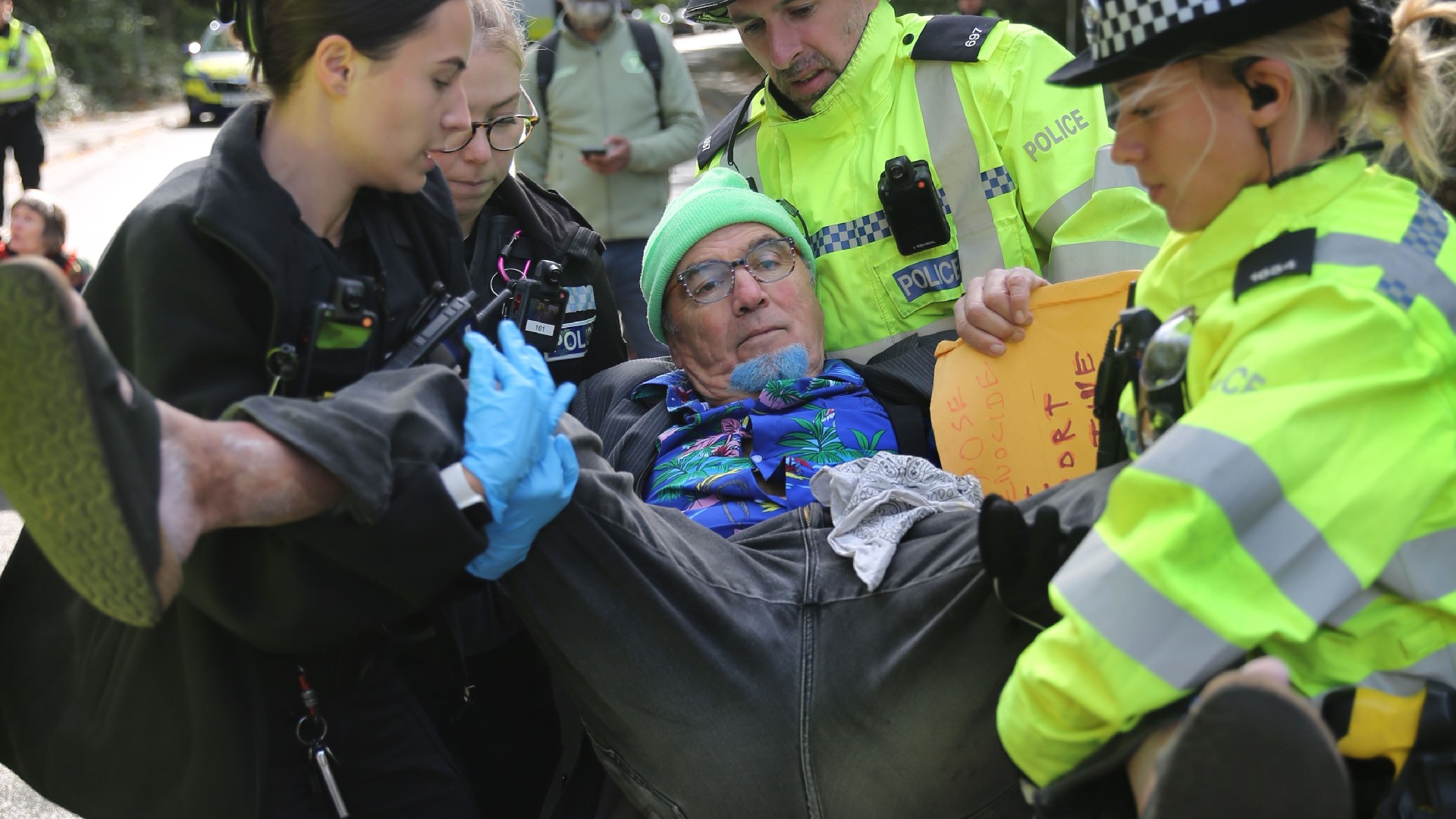
On October 8, a peaceful demonstration targeting an Israeli-owned drone manufacturing facility in Leicester ended in widespread detentions, with at least five working journalists swept up in mass arrests under the UK’s Terrorism Act – an incident that has sparked fierce debate over police overreach and press freedom. The protest was held outside UAV Tactical Systems, a UK-based subsidiary of Israeli arms manufacturer Elbit Systems, and drew participants backing Palestine Action, a direct action group proscribed under British law. Under Section 13 of the Terrorism Act, public expression of support for a proscribed organization is a criminal offense, a provision that police leveraged to order mass detentions of everyone inside a cordoned protest zone.
The arrested journalists included two full-time reporters from the local *Leicester Gazette* and two union-accredited freelance journalists who were on site specifically to cover the demonstration, according to *Leicester Gazette* editor Emma Guy. In comments to Middle East Eye, Guy confirmed that all five journalists had explicitly identified themselves as press to multiple officers before their arrest, ruling out any case of mistaken identity. The reporters were held in detention for three hours before being de-arrested only after turning over full personal information to officers. “A decision was made by Leicestershire Police to blanket arrest journalists and then de-arrest them on a case by case basis,” Guy explained.
Two freelance journalists who spoke to Middle East Eye on condition of anonymity (using the pseudonyms Matt and Barold) detailed the chaotic turn of events that led to their detentions. They confirmed the protest had been organized to end peacefully at midday, and that activists had already reached an agreement with police to disperse by that time. But instead of allowing the crowd to leave, officers deployed in large numbers formed a rigid police cordon – colloquially known as a kettle – around the entire protest site. An announcement over a police megaphone confirmed that every person inside the cordon would be arrested.
Matt, a veteran freelance photographer with 40 years of experience covering demonstrations, said he had repeatedly shown his official press card to officers to move through the cordon throughout the morning, with no pushback. But when he attempted to exit the cordon for a final time, he was stopped and placed under arrest. “I didn’t think that necessarily would apply to press. I mean, it never does, press is always the exception,” he said. Both freelance journalists confirmed that even after they presented their officially verified press cards – which include secure PIN codes that allow police to confirm identity on the spot – officers refused to verify their credentials and instead demanded private personal information as a condition for release. Matt called the action “incredibly heavy-handed”, noting “They just arrested anybody that was in there. People that were just standing round holding banners, and people that had done nothing at all.”
Barold, a freelance video journalist, added that arresting officers refused to communicate with his National Union of Journalists (NUJ) representative, and that an officer explicitly confirmed the mass arrests were intended primarily to collect identifying information on all attendees. For the *Leicester Gazette* team, which has covered regular protests at the Elbit Systems site for five years without any incident, the arrests mark a dramatic escalation. “This is concerning for us as a small newsroom. Like many others, we don’t go to work thinking that we’ll be arrested under the Terrorism Act. It sets a worrying precedent that journalists are being arrested for doing their jobs,” Guy said.
Legal observers have harshly condemned the police tactic of mass arrest followed by conditional de-arrest in exchange for personal information. Tim Crosland, a former government lawyer and spokesperson for campaign group Defend Our Juries, called the practice legally baseless and fundamentally incompatible with British policing norms. “There is no legal basis for police to demand members of the public provide them with personal information generally, and definitely not as a pre-condition for ‘de-arrest’,” he said. “Such oppressive and intimidatory police conduct is characteristic of a police state, not policing by consent.”
Guy added that the arrests were carried out under a recent expansion of the Terrorism Act that expands criminal liability to include livestreaming or photographing material that could be interpreted as supporting a proscribed organization. In its official response to requests for comment, a Leicestershire Police spokesperson defended the mass detentions, saying “To affect a thorough investigation, due to the circumstances and number of people at the scene, everyone was placed under arrest and told to remain in the area. Once these individuals had been spoken to, details provided to officers and it was established that no offences had been committed, they were de-arrested.” The spokesperson confirmed a total of 35 people were arrested under Section 13, with one additional arrest on suspicion of racially aggravated public order, and all 35 have since been released on conditional bail. None of the journalists were taken into formal custody beyond their initial detention.
The NUJ, which represents working journalists across the UK, has formally raised the incident with the National Police Chiefs’ Council over concerns about systemic police overreach. NUJ General Secretary Laura Davison noted that the union has repeatedly emphasized that simply covering Palestine Action protests and documenting placards or statements does not constitute criminal support for the group. Defend Our Juries confirmed that despite widespread filming and livestreaming of previous protests at the site, no journalist or attendee has ever been arrested for this activity prior to the October 8 demonstration.
For Matt, the incident is only the latest in a pattern of aggressive targeting of journalists who cover pro-Palestine protests at arms manufacturing sites tied to Israel. He said he has now been arrested five times in the last three years, all while covering Palestine Action demonstrations, and that the persistent targeting has created a constant climate of fear for working reporters. “As a journalist, you don’t feel entirely safe. You’re made to feel that you shouldn’t really be there,” he said. “It seems to be particularly difficult at Elbit Systems sites. It’s becoming almost impossible. You can’t relax. You don’t really know if you’re ever gonna come home. It acts as a deterrent.”
In April 2025, Matt was arrested while covering a Palestine Action protest at a Lockheed Martin site in Ampthill, on suspicion of conspiracy to commit burglary. Police alleged he had fired fireworks from his vehicle, but he was in fact photographing the protest from outside the main gate. He was held for 20 hours, and police seized his car and all journalistic equipment. He ultimately won a financial settlement from Bedfordshire Police over the unlawful arrest, though the force maintained it acted with reasonable grounds and settled the claim without admitting liability. A month after that arrest, Matt was detained again on suspicion of a hate crime while photographing the aftermath of a Palestine Action protest at a London site tied to Elbit Systems, and was later released without any further action.