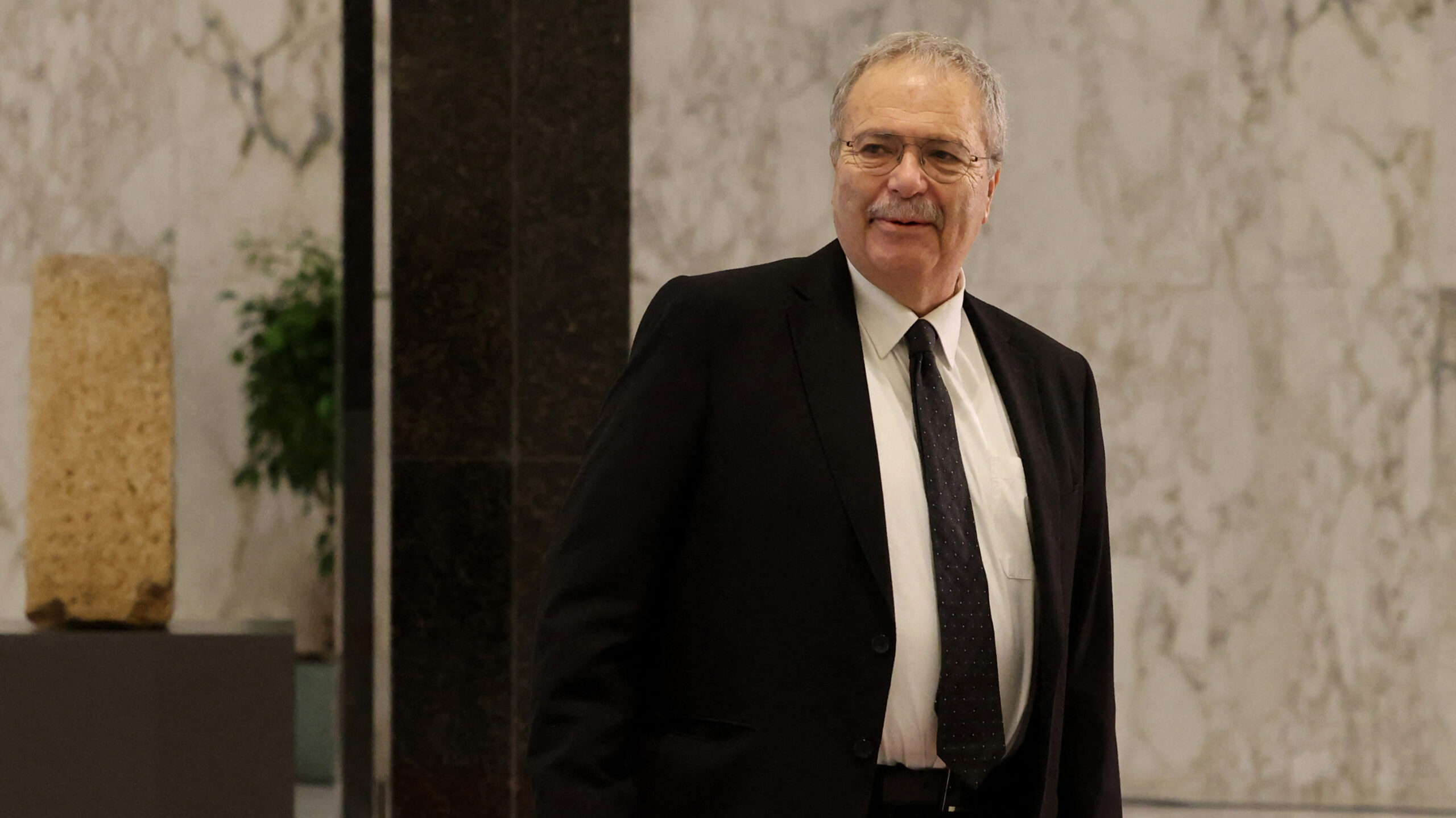
BEIRUT – Lebanon’s Deputy Prime Minister Tarek Mitri has stated in an exclusive interview with Middle East Eye that the current U.S.-brokered framework between Israel and Lebanon to end hostilities between Israel and Hezbollah is unworkable in its existing form, and cannot gain the status of a legally binding agreement without formal approval from Lebanon’s full Council of Ministers.
Mitri clarified the distinct constitutional roles of Lebanon’s presidency and cabinet in international negotiation processes, noting that while the president holds the constitutional authority to negotiate on Lebanon’s behalf, all final agreements must receive cabinet approval before they take legal effect. To date, that step has not been completed, meaning the text agreed to by both parties in Washington on June 26 remains a non-binding starting point rather than a finalized deal.
“The word agreement is nowhere to be seen in this text,” Mitri confirmed during the interview at his Beirut office.
The U.S.-mediated framework, designed to map a path toward ending months of open conflict between Israel and the Lebanese armed group Hezbollah, has sparked widespread public and political opposition across Lebanon since it was signed. Critics have raised urgent questions about Lebanese national sovereignty, accountability for war crimes, and the framework’s structure that places Lebanon’s obligations ahead of Israel’s formal commitments.
Hezbollah has publicly condemned the deal for failing to guarantee a full Israeli withdrawal from the roughly 6 percent of Lebanese territory that Israel continues to occupy, and for not securing the return of hundreds of thousands of displaced Lebanese residents to their homes in southern Lebanon.
Mitri acknowledged that the current proposal does not meet all of Lebanon’s core demands, but framed it as an opening for future negotiation rather than a final settlement. “This is not the last word… It doesn’t meet all the desires and aspirations of the Lebanese. But this is a beginning,” he said, repeating that the text remains “not a solid, well-structured, final binding agreement.”
He also conceded deep internal political divisions over the framework, noting that significant domestic outreach and negotiation will be required before any final deal can secure broad cross-political support within Lebanon. “You need to make sure that at the domestic level, although there might be disagreement, [a deal] should not exacerbate divisions and should not deepen already existing divisions,” he said.
Mitri pointed to immediate public statements from Israeli leaders following the framework’s release as clear evidence of its weaknesses, demonstrating that Israel also does not view itself as bound by the text. “Twenty-four hours after the trilateral framework was made public… Netanyahu, the foreign minister, the defence minister said, ‘We’re staying in southern Lebanon. We’re not withdrawing,’” he recalled. Israel’s refusal to publicly commit to a full withdrawal from southern Lebanon directly contradicts Lebanon’s non-negotiable core demands, which also include the return of displaced residents and the release of Lebanese prisoners held by Israel, he added.
The current conflict, which opened when Hezbollah launched rocket strikes on Israel on March 2 following the U.S.-Israeli killing of Iran’s Supreme Leader Ali Khamenei, has evolved into “a war that Lebanon did not want, did not seek,” Mitri said, emphasizing that what began as a confrontation between Israel and Hezbollah has become a full-scale war on the Lebanese state and people.
Lebanese authorities confirm that Israeli airstrikes and ground operations have killed more than 4,300 people since the war began in March. A recent assessment from the United Nations Development Program found that more than 11,000 buildings across southern Lebanon have been completely destroyed by Israeli attacks, with a further 2,200 structures partially damaged. “When the war started in Lebanon, it looked like a battleground between Israel and Hezbollah. But Israel has made a war on Lebanon,” Mitri said. “And there are many parts of Lebanon where Hezbollah had no military activity that were severely affected.”
Addressing widespread criticism of Article 13 of the framework – a provision that suspends mutual legal and political action between the two sides during ongoing negotiations, which Lebanese human rights and legal experts warn could shield Israel from accountability for alleged war crimes – Mitri pushed back against concerns that the article would permanently end Lebanon’s efforts to document and pursue legal action for Israeli attacks.
As chair of Lebanon’s National Commission on International Humanitarian Law, Mitri confirmed that the state’s ongoing work to document war crimes has not stopped, and “cannot be stopped” by the provisions of Article 13. He noted that Lebanon has never brought formal proceedings against Israel before an international court for a range of historical reasons, pointing out that neither country is a signatory to the Rome Statute that governs the International Criminal Court. Even so, evidence collected by the commission remains available for Lebanese citizens seeking to bring cases against Israel before foreign courts that exercise universal jurisdiction, he said.
Mitri added that Lebanese officials have received formal assurances that Article 13 does not permanently end legal action against Israel. “We were told that although the word ‘cessation’ is used… it only means suspension,” he said, noting that pausing legal proceedings during active negotiations is a common practice in international peace processes, including the post-apartheid settlement in South Africa and the Algerian peace process.
One of the most sensitive political issues facing the Lebanese government in the wake of any ceasefire will be the question of disarming Hezbollah and extending full state control over all weapons and territory across the country. Shortly after Hezbollah opened hostilities in March, the Lebanese government banned the group from conducting any independent military activities. Last year, the cabinet instructed the Lebanese army to draft plans for Hezbollah’s disarmament, a move that sparked fears of domestic armed conflict even as top officials including the president and prime minister emphasized they do not seek a military confrontation with the group. Earlier this year, Middle East Eye reported deep tensions between Prime Minister Nawaf Salam and army chief Rodolphe Haykal over disagreements on how to implement the disarmament ban, with unconfirmed sources indicating Salam considered sacking Haykal for refusing to confront Hezbollah during the ongoing war.
Mitri argued that disarming Hezbollah is fundamentally a political issue, not a military one, rejecting calls for the Lebanese army to confront the group by force to establish state authority. “Disarming Hezbollah is not a technical question,” he said. “It’s not about the military balance of power between the army and Hezbollah’s military structure – it’s first and foremost political.” He noted that there has been little substantive discussion of the issue over the past several months, as open war makes domestic dialogue extremely difficult, but added that negotiations on the question are inevitable, and it must remain an internal Lebanese affair. When asked whether Israel is intentionally seeking to provoke a confrontation between the Lebanese army and Hezbollah, Mitri said: “Possibly the Israelis would be happy if that happens. But I think neither the army nor Hezbollah are willing to fall into the trap of fighting each other.” He noted that the pilot deployment zones outlined in the current framework can serve as a “litmus test” for the army to expand state authority gradually, while allowing Hezbollah to step back without triggering internal armed conflict.
The current conflict marks the third major confrontation between Israel and Hezbollah since the 33-day 2006 war, which ended with a UN-brokered ceasefire that kept the border largely calm for nearly 18 years. Comparing the current diplomatic context to the 2006 negotiations, Mitri noted that Lebanon is now operating in a drastically shifted global landscape, where the UN Security Council and multilateral diplomacy have been sidelined. “The only party that can mediate, or at least allow for mediation under its auspices, is the United States of America,” he said.
This reality has left Beirut with little choice but to engage with Washington, despite decades of deep mutual distrust, Mitri explained. Lebanon has long been “a footnote” in U.S. regional policy, he said, but Lebanese officials see a current “window of attention” that they are determined to leverage. He added that some political observers see recent comments from U.S. Vice President JD Vance – who suggested that Washington’s unconditional support for Israel should not be taken for granted – as a potential sign of a gradual shift in U.S. policy toward the region. “The main reason why the Lebanese look towards the United States is… that the US is the only country that has leverage over Israel and can help in resolving the present difficult issues we face,” he said.
Mitri also emphasized that Israel’s strategic objectives have grown far more ambitious since the 2006 war, pointing to repeated public statements from Israeli leaders outlining a new military doctrine focused on “reclaiming deterrence” by establishing permanent security buffer zones in Gaza, Lebanon and Syria. “Now we are in a totally different, more difficult situation,” he said. “We’re left with very few options.”
Looking beyond the immediate conflict, Mitri noted growing regional interest in building a new architecture of coordination and strategic alignment among regional states including Syria, Saudi Arabia, Qatar and Turkey, extending beyond narrow security arrangements. He pointed to Turkish President Recep Tayyip Erdogan’s long-held view that regional security is deeply interconnected, with Turkey’s security tied to Syria’s, and Syria’s security tied to Lebanon’s.
Mitri stressed that Syria is far more than just a neighbor and ally to Lebanon; the two countries’ futures are “inextricably intertwined.” Addressing recent reports that U.S. President Donald Trump asked Syrian President Ahmed al-Sharaa to intervene militarily against Hezbollah, Mitri said Syria’s new leadership has shown no interest in reviving the decades of interference in Lebanese affairs that marked the former Assad regime. Al-Sharaa has publicly denied any plans to take military action against Hezbollah, and Mitri confirmed: “We know that with the present Syrian government, there is no hegemonic design over Lebanon.” Damascus is willing to support Lebanon through diplomatic and political means instead, he added.
Mitri also rejected claims that Lebanese President Joseph Aoun holds reservations about Syria’s new leadership, despite the fact that neither president has yet conducted an official visit to the other’s capital. “I have not sensed any major reason why the visits… did not take place,” he said, explaining that trust is still being rebuilt after decades of mutual suspicion and Syrian political dominance over Lebanon. “This is all changing and it takes time for the population of both countries to realise that we’re in a totally different dispensation.”
Despite years of catastrophic economic collapse, persistent political turmoil, and repeated cycles of war, Mitri said he does not believe Lebanon’s national unity and sovereignty face an imminent existential threat. He did acknowledge that deep-rooted sectarian loyalties and communal tensions remain present across the country, creating a widespread sense of social estrangement. While he warned that Lebanon’s future as a unified state depends on successfully resolving the current crisis, he stopped short of ruling out all risk of fragmentation. “Lebanon’s unity is always in the making,” he said, adding that fragmentation will only occur “unless we were unable to manage the present crisis and dissipate the present fears.”