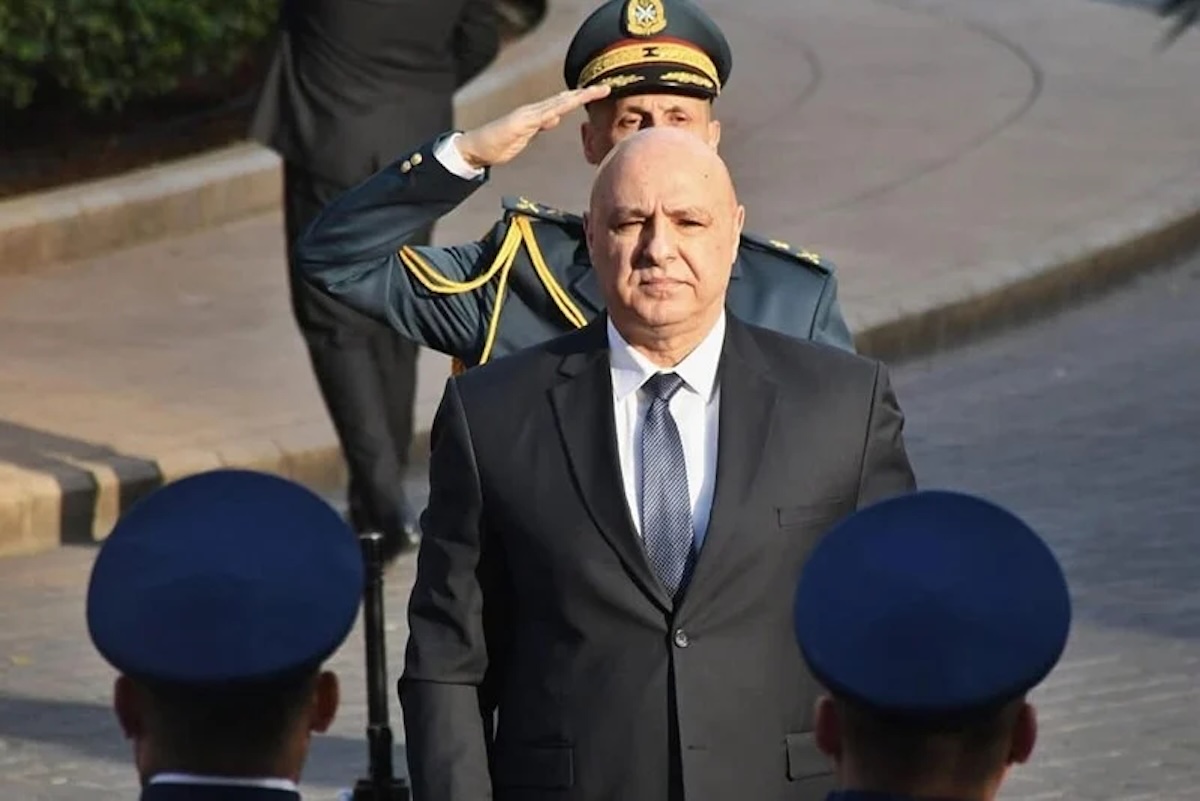
Against the backdrop of ongoing high-stakes Middle East peace negotiations, Lebanese President Joseph Aoun is mounting a urgent campaign to center his nation’s interests, pushing back against the tendency of global and regional powers to treat Lebanon as a secondary bargaining chip in their broader conflicts. For weeks, Aoun has grown increasingly frustrated as both Iran and the United States frame Lebanon as a peripheral theater in their escalating geopolitical rivalry, leaving the country’s sovereignty and security hanging in the balance. For Iran, backing its proxy ally Hezbollah through military aid and diplomatic protection serves as a core pillar of its claim to regional power status. Mohammad Bagher Ghalibaf, speaker of Iran’s parliament, recently reinforced this position, declaring that “the efforts of Lebanon’s brave fighters and the powerful diplomacy of Iran will guarantee the sovereignty and territorial integrity of beloved Lebanon.”
On the U.S. side, the Trump administration has shown clear dismissal of Lebanon’s specific national concerns. While former President Donald Trump has expressed casual unease over Israeli airstrikes on Lebanese territory, he has done little to advance Lebanon’s demands for Israeli withdrawal. Most recently, Vice President J.D. Vance, who is leading U.S. peace talks with Iran, publicly chided Israel last Sunday amid continued bombing runs, arguing that the country “can’t just kill your way out of solving every single national security problem” but stopped short of endorsing Lebanon’s core demands.
This sidelining of Lebanon has spurred Aoun to deliver a blunt, unapologetic rebuke to both foreign powers. He has openly demanded that Iran end its military intervention in Lebanon through its support for Hezbollah, stating sharply: “It is not your country, it is our country. You are not trying to help us. It is the Lebanese who are paying the price for your own interests, and our interests do not coincide with yours. We are tired and we want to live in peace.” After receiving a weekend phone call from Vance updating him on planned U.S.-Iran negotiations, Aoun pushed back against the idea of external powers cutting deals over Lebanon’s head, noting: “We welcome any assistance to end the war, but we distinguish between assistance and interference in internal affairs. We are a sovereign country and no one negotiates on our behalf.”
This week, Aoun is moving forward with a new round of diplomatic engagement: Lebanese envoys are set to travel to Washington on June 22 for direct talks with Israeli representatives, with two non-negotiable priorities: the full disarmament of Hezbollah and a complete Israeli withdrawal from Lebanese territory. But the proposal has already met a hard rejection from Israeli Prime Minister Benjamin Netanyahu, who announced on Monday that his government has given the Israel Defense Forces (IDF) full autonomy to operate in southern Lebanon. “Our fighters in southern Lebanon have full freedom of action to thwart any direct or emerging threat to them or to the residents of the North [of Israel],” Netanyahu said. “The IDF has no restrictions in this regard.”
These talks mark the fourth round of negotiations ordered by the Trump administration this year. Israel has put forward its own proposal, calling on the Lebanese army to disarm Hezbollah, with the IDF retaining an indefinite military presence in southern Lebanon to enforce the deal if Hezbollah resists. Aoun has decried this framework as deeply unrealistic, arguing that the Lebanese military is severely under-trained and under-equipped to take on the well-armed militant group. Compounding this challenge is the country’s sectarian demographics: roughly 40% of Lebanese army personnel are Shiite, and Aoun warns it is highly unlikely they would take up arms against the Shiite-aligned Hezbollah. “Any controversial domestic issue in Lebanon can only be approached through conciliatory, non-confrontational dialogue and communication. If not, we will lead Lebanon to ruin,” Aoun warned. “We can’t let the country descend into another civil war.”
These fears are rooted in decades of unresolved conflict and failed attempts to rein in Hezbollah’s power. In the early 1980s, a government order to the military to crack down on Muslim militias led to mass desertions and refusals to obey commands from Shiite service members. In 2008, the government attempted to dismantle a secret Hezbollah communications network in southern Lebanon and block the group’s use of Beirut International Airport as a covert weapons transit point from Iran. In response, Hezbollah and its allied militias seized control of majority-Sunni downtown West Beirut, forcing the government to fully back down.
Hezbollah leaders have already issued sharp threats in response to Aoun’s current push. Senior Hezbollah figure Mahmoud Qamati warned that “a confrontation with the political authority is inevitable after the war” and vowed that Lebanese officials engaging with Israel “would pay the price for their betrayal.” Current Hezbollah leader Naim Qassem added that any effort to disarm the group would trigger a “serious crisis” that would leave “no life in Lebanon.”
Lebanon’s long-running sectarian power-sharing system, established under Ottoman and French colonial rule and retained after independence in 1945, has amplified these internal tensions. The system allocates the presidency to a Christian, the prime minister role to a Sunni Muslim, and the parliamentary speaker position to a Shiite Muslim, with all bureaucratic posts and parliamentary representation divided along confessional lines, including guaranteed representation for the 6% Druze minority. While designed to reduce sectarian conflict, the system has instead entrenched religious-political rivalries that have repeatedly erupted into violence over decades.
Foreign intervention has further destabilized the country. In 1982, Israel invaded Lebanon to expel the Palestine Liberation Organization, which had its headquarters in Beirut, and to install Christian leader Bashir Gemayel as president in the hopes he would sign a permanent peace treaty with Israel. That plan collapsed after Syria organized Gemayel’s assassination, and guerrilla forces pushed Israeli troops back into southern Lebanon, where they remained for 18 years of occupation.
It was in this occupied southern Lebanon, the heartland of Lebanon’s Shiite population, that Hezbollah emerged with backing from Iran and Syria. After 18 years of failed efforts to subdue the group, Israel withdrew from southern Lebanon in 2000. Rather than disbanding, Hezbollah reframed its mission around “liberating” the small contested Sheba Farms territory on the edge of the Golan Heights, which Israel seized from Syria in the 1967 Six-Day War, after Syria asserted Lebanon had a legitimate claim to the area.
Since 2000, frequent border clashes and periodic full-scale wars have broken out between Israel and Hezbollah. Iran has since elevated the group’s role as the vanguard of its “axis of resistance,” a regional coalition that also includes Hamas in Gaza and the Houthis in Yemen, positioning Hezbollah as the “forward defense” of Iran’s regional interests. As the U.S. moves forward with planned negotiations with Iran, the core question hanging over Lebanon’s future remains: can any U.S.-Iran deal resolve the Hezbollah issue, and finally deliver the sovereign peace Aoun and the Lebanese people have long demanded?