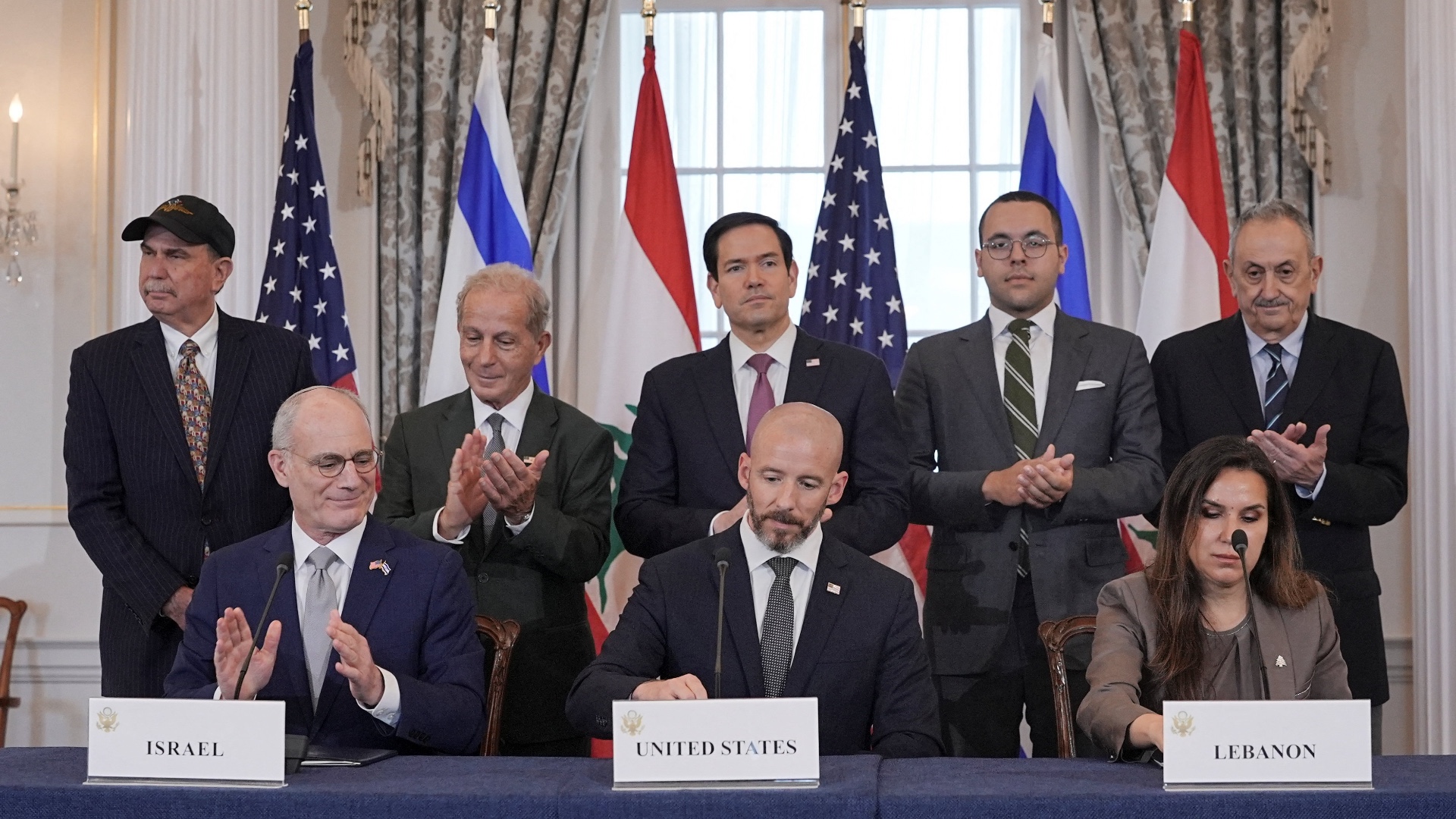
After five rounds of negotiations mediated by the Trump administration, Lebanon and Israel have finalized a landmark agreement under a US-led trilateral framework, with the official signing ceremony held in Washington on Friday. While full terms of the deal have not yet been released to the public, top US officials have framed the agreement as an opening breakthrough for long-stalled regional peace efforts.
Speaking to reporters shortly before the signing, US Secretary of State Marco Rubio called the deal “the beginning of the beginning” of a process to resolve decades of cross-border tension. Rubio emphasized that the Israeli public deserves to live free from security threats, noting that repeated cross-border attacks targeting northern Israel originated from Lebanese territory – not from the Lebanese government or people, but from the Iran-backed militant group Hezbollah, which did not send representatives to the negotiating table.
Lebanon’s ambassador to the United States, Nada Hamadeh Moawad, characterized the negotiations as “long and difficult”, but framed Friday’s agreement as a critical first step toward reclaiming full Lebanese sovereignty and territorial integrity. She outlined the core goals of the deal for her country: securing a permanent, full end to hostilities, allowing displaced Lebanese civilians to return to their homes, and creating conditions for all Lebanese residents to build peaceful, prosperous lives.
Yechiel Leiter, Israel’s ambassador to Washington, praised Moawad’s tenacity during negotiations, saying she “fought for her country like a lioness”. He emphasized that the deal paves the way for a new future: “Iran is out, Hezbollah is out and the road to peace between Israel [and] Lebanon is in,” he told reporters.
Israeli Prime Minister Benjamin Netanyahu, in a video address posted to X on Friday, highlighted a key Israeli priority preserved in the agreement: Israeli forces will maintain their presence in a security zone in southern Lebanon, a position he called “a major achievement” that will stand until Hezbollah completes full disarmament. Netanyahu added that Israeli authorities will roll out two pilot security zones in the southern region: one located south of the Litani River, and a second north of the critical waterway.
The Litani River is Lebanon’s most important natural water resource, but Israeli officials have pushed to establish a buffer zone extending to the river to protect northern Israeli border communities from potential militant attacks. To date, Israeli military advances have left Israel in control of roughly one-fifth of Lebanon’s internationally recognized territory.
Friday’s signing comes the same week that the United States and Iran reached a separate 14-point agreement to end the US-Israeli military campaign against Iran that launched on February 28. Even after a November 2024 ceasefire between Israel and Lebanon brokered by former US President Joe Biden’s administration, Israel ramped up military operations in Lebanon following the outbreak of the Iran conflict.
According to Lebanon’s Ministry of Public Health, more than 4,200 Lebanese people have been killed by Israeli actions in Lebanon since March 2. Key stakeholders remain divided on core outstanding issues: Hezbollah has repeatedly stated it will not disarm as long as Israel maintains territorial claims and poses a military threat to Lebanon, while senior Israeli officials have openly discussed expanding Israeli borders northward into Lebanese territory.
This is an ongoing, developing story that will be updated as new details emerge. This report is compiled from independent on-the-ground and diplomatic reporting from Middle East Eye, a news organization specializing in original coverage of the Middle East, North Africa and global affairs.