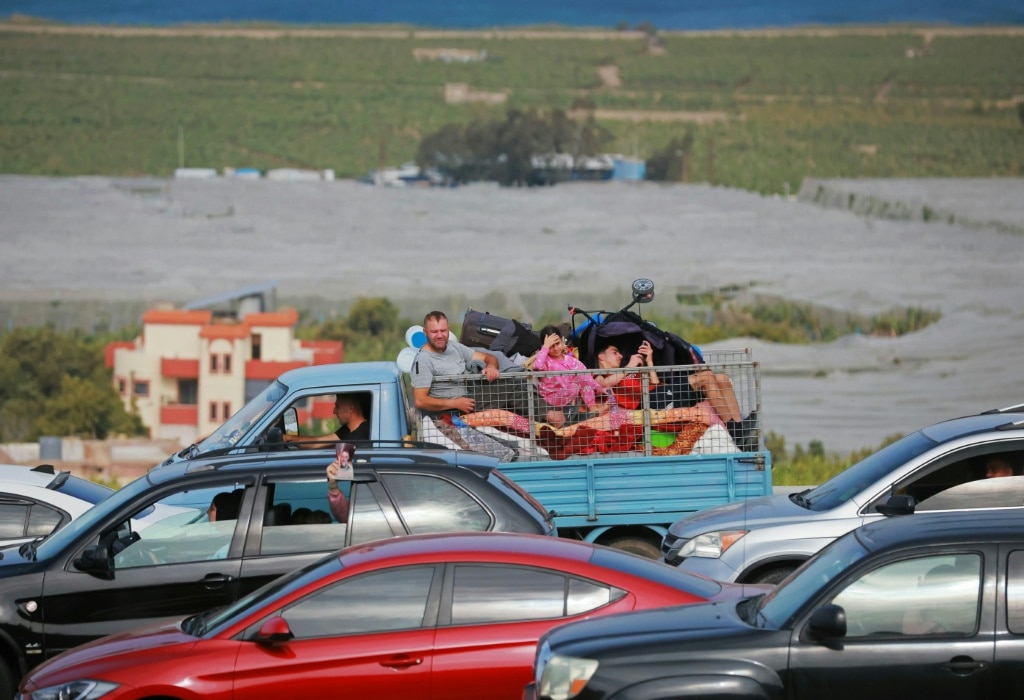
A fragile 10-day ceasefire between Israel and Iran-backed Hezbollah has come into force along the Lebanon-Israel border, opening the door for thousands of displaced Lebanese civilians to rush toward their war-ravaged homes in southern Lebanon and southern Beirut. Despite official warnings from the Lebanese military against returning to areas heavily damaged by weeks of Israeli targeting of Hezbollah positions, crowds of families have already gathered at destroyed crossing points, waiting for infrastructure repairs to be completed so they can begin their journey home.
At the bombed-out Qasmiyeh bridge near the southern Lebanese city of Tyre, AFP journalists documented long lines of vehicles packed with belongings and anxious residents, many of whom had been displaced for weeks amid the escalating cross-border conflict. For many of these returnees the temporary truce, negotiated through U.S. diplomatic pressure led by President Donald Trump, has brought a long-awaited glimmer of hope after months of violence. “Our feelings are indescribable, pride and victory,” 37-year-old returnee Amani Atrash told AFP from her car while waiting in the queue, adding that she held out hope the 10-day truce would be extended into a longer lasting ceasefire.
Across the international border in northern Israel, civilian movement restrictions remain in place for vulnerable border communities ordered by the Israeli military’s home front command. Even so, some Israeli civilians are already daring to hope for a return to everyday normalcy after weeks of sheltering from rocket attacks. “I’ve got a three-year-old girl and a two-month-old baby, and the whole time we’ve just not left the house because you never know when there’ll be a rocket attack,” 31-year-old Ofir Ben Aris Lev told AFP. “It’s been crazy, but I think things will be quiet now and I’ll be able to take my daughter to the park”, he added.
Hezbollah, which has sustained heavy damage from Israeli airstrikes and deployed ground fighters in southern Lebanon, has confirmed it will respect the truce so long as Israeli attacks on Lebanese territory cease, but remains on high alert for any violations. “The fighters will keep their finger on the trigger because they are wary of the enemy’s treachery,” the movement said in an official statement. Hezbollah lawmaker Ibrahim al-Moussawi told AFP the group would “cautiously adhere” to the truce if Israeli attacks stopped, and thanked Iran for applying diplomatic pressure in support of Lebanon.
The ceasefire marks a critical milestone in U.S.-led efforts to broker a broader peace deal between Washington and Tehran, after Iran made an end to the Lebanon-based fighting a non-negotiable precondition for any final agreement. Pakistan has led behind-the-scenes diplomatic efforts to restart direct face-to-face negotiations between Tehran and Washington, and President Trump has said the two sides are “very close” to reaching a final agreement.
The conflict in Lebanon erupted on March 2, when Hezbollah launched a barrage of rockets into Israel just days after the start of the broader regional Middle East war, in retaliation for the killing of Iran’s supreme leader Ali Khamenei. As the ceasefire officially took effect, the Israeli military confirmed it had struck more than 380 targets linked to the “Hezbollah terror organisation” across southern Lebanon during the conflict, and said it remains on “high alert” to resume military operations if the truce is broken.
President Trump confirmed he held separate calls with Israeli Prime Minister Benjamin Netanyahu and Lebanese President Joseph Aoun in the lead-up to the truce, saying both leaders had agreed to the pause in fighting “in order to achieve PEACE between their Countries”. He added that he expects both Netanyahu and Aoun to visit the White House for talks “over the next four or five days” to continue peace negotiations.
A high-level in-person meeting between Israeli and Lebanese leadership would mark a watershed moment for the long-turbulent region, though it remains unclear whether the meeting will actually go ahead. An anonymous official source told AFP that Lebanese President Aoun has already rejected Trump’s request for a direct call with Netanyahu, a sign of lingering tensions between the two governments.
Netanyahu said the truce opens an opportunity for a “historic peace agreement” with Beirut, but reiterated that the full disarmament of Hezbollah remains a non-negotiable precondition for any long-term deal. Lebanese Prime Minister Nawaf Salam welcomed the ceasefire announcement, calling it a “key Lebanese demand that we have pursued since the very first day of the war”.
President Trump called the developing diplomatic progress “very exciting” during a press interaction with AFP at the White House, noting “Today they’re going to be having a ceasefire, and that’ll include Hezbollah.” For Iranian officials, the truce was framed as a victory for Tehran’s diplomatic positioning and Hezbollah’s armed resistance. Iranian state television portrayed the ceasefire as the result of Tehran’s “insistence” alongside Hezbollah’s “resistance” against Israeli aggression.
Netanyahu confirmed Israel agreed to the 10-day truce but will maintain a 10-kilometre (six-mile) “security zone” along the border inside southern Lebanon for the duration of the ceasefire. Violence continued right up to the minute the truce went into effect: Lebanon’s health ministry confirmed that at least seven people were killed and more than 30 wounded in a late Israeli airstrike on the town of Ghazieh on Thursday, just hours before the ceasefire took hold.