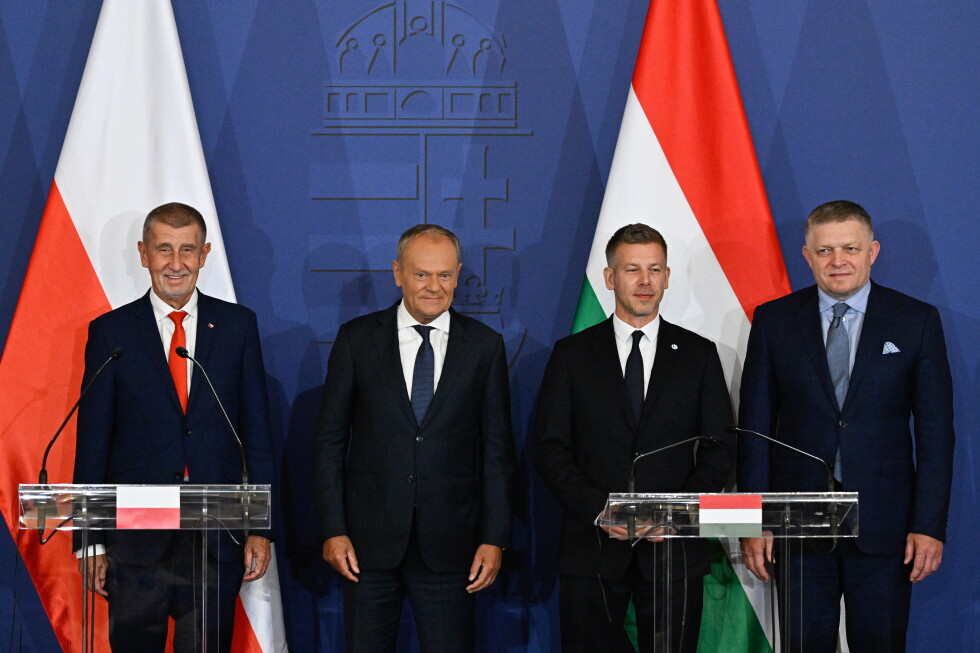
In a landmark gathering held outside Budapest on Tuesday, the prime ministers of the Czech Republic, Hungary, Poland, and Slovakia formally relaunched the Visegrád Four (V4), a key Central European regional alliance, ending more than two years of stalemate triggered by deep divisions over former Hungarian Prime Minister Viktor Orbán’s pro-Russian stance amid the war in Ukraine.
The summit, hosted by Hungary’s new Prime Minister Péter Magyar at the historic Grassalkovich Castle in the Budapest suburb of Gödöllő, marked the first full leaders’ meeting of the informal bloc since 2022. The alliance had fractured after Orbán’s soft approach to Russia’s invasion of Ukraine created irreconcilable fault lines, most notably between Hungary and Poland, which has been a staunch supporter of Kyiv.
Magyar, who took office in May following a landslide election victory that gave his center-right Tisza party a two-thirds parliamentary majority, has made reviving the V4 a core foreign policy priority. Since succeeding Orbán, he has already broken with his predecessor’s obstructionist stance within the European Union, shifting Hungary toward a policy of constructive cooperation while retaining a focus on defending national interests.
Following a closed-door one-hour working session with his three counterparts, Magyar announced that the bloc was officially active again. “The V4 is back,” he told reporters after the meeting. “The heart of Europe is beating in Central Europe today.” He outlined an ambitious agenda for the renewed alliance, including a proposal to develop a cross-border high-speed rail network connecting the capitals of all four member states. Leaders also reached preliminary agreement to pursue common policy frameworks on three pressing regional challenges: energy security, agricultural cooperation, and managing illegal immigration.
Magyar added that he aims to expand V4 cooperation to include additional regional partners over time, with the goal of building a stronger, more influential bloc that can shape EU policy from a unified Central European perspective. “We want a Visegrád Four that is strong and which has a credible voice in European decision-making,” he said.
Polish Prime Minister Donald Tusk echoed this vision, noting that coordinated V4 positioning ahead of European Council meetings would allow the bloc to advance shared regional interests more effectively. Tusk framed the revived alliance as a “beacon of hope” that can bring Central European priorities to the forefront of EU governance.
A notable shift under Magyar’s leadership has been a complete reversal of Hungary’s approach to Ukraine’s European integration. Within weeks of taking office, Magyar’s government brokered a deal with Kyiv to restore a full suite of rights for the ethnic Hungarian minority in western Ukraine. In exchange, Hungary lifted its long-held veto on the launch of Ukraine’s EU membership accession talks — a major break from Orbán’s policy of blocking Kyiv’s path to the bloc.
The summit also made clear that the V4 retains internal diversity when it comes to policy on Ukraine. Czech Prime Minister Andrej Babis and Slovak Prime Minister Robert Fico remain political allies of Orbán, and have followed his lead in cutting or reducing military and financial aid to Ukraine as it defends itself against Russia’s full-scale invasion. Even so, both leaders expressed full support for the revival of the bloc. Babis struck an optimistic tone, confirming that the alliance is “once again fully operational” and asserting that “these four countries are the future of Europe.”
Hungary has held the rotating V4 presidency since the start of the year, and will hand over the role to Slovakia at the end of this month. Tuesday’s summit comes amid broader shifts across Central Europe, as new leadership in Budapest opens the door for greater regional alignment and more cohesive engagement with EU institutions after years of division.