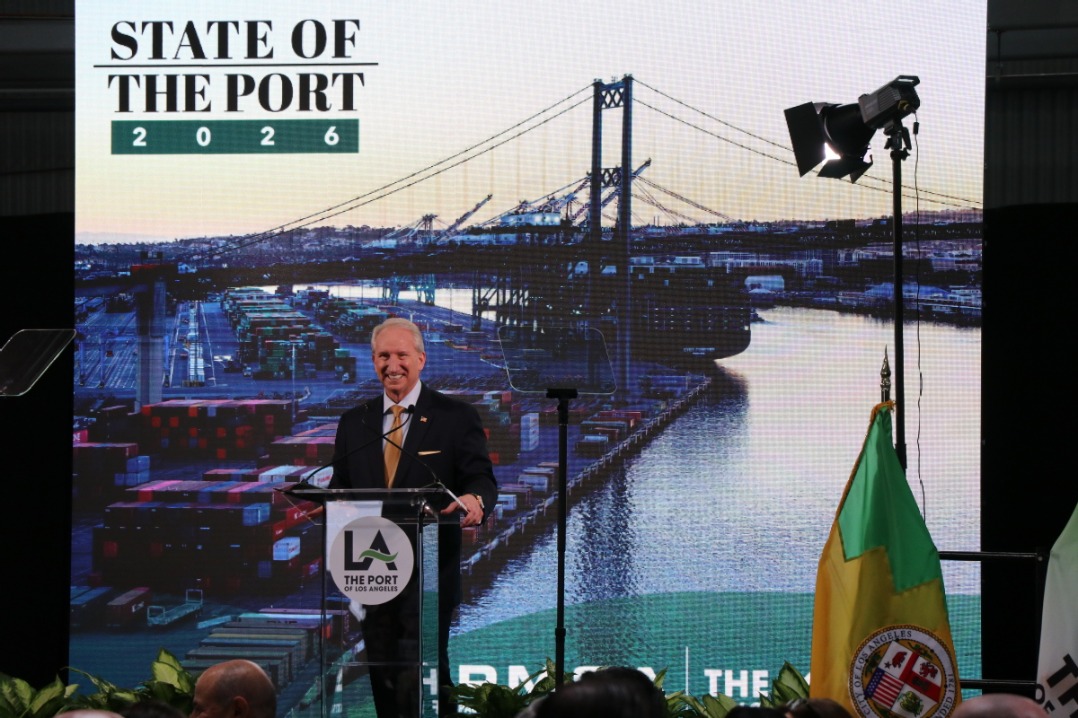
The Port of Los Angeles, maintaining its position as America’s busiest container port for 26 consecutive years, is intensifying efforts to enhance sustainable shipping practices and deepen its crucial trade partnership with China. Executive Director Gene Seroka revealed these strategic priorities during his annual address, emphasizing that China accounts for approximately 40% of the port’s business—more than double that of any other trading partner.
Seroka highlighted the indispensable nature of trans-Pacific supply chains, noting that there is no faster route for Chinese goods to reach US markets than through Los Angeles. His multiple visits to China throughout the previous year reinforced relationships with government agencies, state-owned enterprises, and private companies, underscoring the mutual economic dependency between the nations.
The port’s environmental initiatives have achieved significant milestones, particularly through the Los Angeles-Long Beach-Shanghai Green Shipping Corridor. This pioneering partnership has successfully completed all Phase 1 objectives, including expanded use of shoreside electricity for docked vessels, advancement of cleaner vessel technologies, and foundational work for future bunkering of low-carbon marine fuels.
Infrastructure development remains central to the port’s ‘Building Bigger and Building Smarter’ strategy. Ambitious projects include the proposed Pier 500 Marine Terminal, designed for next-generation, zero-emission operations. Los Angeles currently boasts the lowest emissions per TEU of any major global port, demonstrating its environmental leadership.
Local officials, including LA City Councilmember Tim McOsker and Mayor Karen Bass, echoed the importance of stable US-China economic relations for regional logistics and manufacturing sectors. The San Pedro Bay port complex handles approximately 40% of all US containerized imports, with substantial volumes originating from Chinese export hubs like Shanghai, Ningbo-Zhoushan, and Yantian.
As global supply chains evolve, analysts emphasize that US-China cooperation in decarbonization, digital logistics, and green shipping corridors will become increasingly critical for maintaining trans-Pacific trade efficiency and resilience.