In a groundbreaking shift for decades-long U.S. policy toward the Palestinian militant group, White House envoy Jared Kushner, who is also Donald Trump’s son-in-law, sat down for direct talks with Hamas’s newly appointed leader Khalil al-Hayya in the Egyptian Mediterranean city of El-Alamein Sunday. The high-stakes meeting, coordinated alongside regional mediators and members of the Trump administration’s Middle East peace board, marks a major push to breathe new life into a Gaza peace initiative that Israeli Prime Minister Benjamin Netanyahu has already rejected.
This encounter comes two weeks after Hamas formally endorsed the latest phase of the Trump administration’s plan, committing to transfer its weapons stockpiles to a newly formed independent governing committee. For Kushner and the U.S. negotiating team, the core priority of Sunday’s discussions was pressing Hamas to agree to concrete, internationally verifiable disarmament measures — a non-negotiable demand that Netanyahu has repeatedly emphasized as a condition for any deal. A anonymous source familiar with the closed-door talks, who spoke on condition of anonymity due to the issue’s sensitivity, shared that Kushner made clear to the Hamas delegation that Gaza can never again be permitted to operate as a base for terrorist activity targeting Israel.
Sunday’s meeting marked al-Hayya’s first international trip since he took the helm of Hamas in July, and shortly after assuming leadership, the group threw its support behind the disarmament roadmap. Many regional observers have characterized this move as a tactical gambit, predicated on the expectation that Netanyahu would reject the plan outright regardless of Hamas’s concessions. Despite that analysis, a second source confirmed that Hamas reaffirmed its public commitment to the framework during negotiations with Kushner. Following the talks, Hamas issued a statement calling on international mediators and the Trump administration’s Board of Peace to pressure Israel to approve the roadmap and immediately begin drafting a clear implementation timeline.
While host Egypt did not release any public imagery of al-Hayya at the negotiating table, photos confirmed Kushner was joined by other participants, including former British Prime Minister Tony Blair, a senior member of the Board of Peace. Qatar and Turkey, two key regional mediators that have long maintained ties with Hamas, also joined the talks alongside Egypt.
This direct engagement between a senior U.S. envoy and Hamas represents a dramatic reversal of longstanding U.S. policy. For years, Washington officially refused any direct contact with the group, which it designates as a terrorist organization. Hamas was responsible for the October 7, 2023, attack on southern Israel that killed roughly 1,200 people and took roughly 250 hostages, triggering the ongoing devastating Gaza war. But the Trump administration has increasingly embraced direct talks in pursuit of a permanent end to the conflict, and previously negotiated the October 2025 ceasefire that secured the release of all remaining Israeli hostages held in Gaza.
Following the Egypt talks, Kushner is set to travel to Israel Monday to meet with Netanyahu, who is currently locked in a competitive re-election campaign ahead of October’s national vote. Netanyahu, a longtime hawk on Palestinian issues, has already rejected the U.S.-backed plan outright, even after the Board of Peace revised its terms to accommodate Israeli demands. Originally, the framework called for a phased Israeli troop withdrawal from Gaza to proceed in lockstep with Hamas’s disarmament. But Board of Peace High Representative for Gaza Nickolay Mladenov assured Netanyahu that Israel would not be required to pull its forces out of the war-ravaged territory until full disarmament is completed — a concession that still failed to win Israeli support.
The rejection of the plan has sparked widespread pushback from regional actors. The three mediator countries (Egypt, Qatar, Turkey) joined five Muslim nations — Jordan, Saudi Arabia, the United Arab Emirates, Pakistan, and Indonesia — in issuing a joint statement Sunday condemning Israel’s refusal to move forward with the plan. The joint statement placed full and direct responsibility for the obstruction of peace efforts on Israel, noting that Netanyahu’s rejection directly threatens to derail the extensive diplomatic work spearheaded by the Trump administration.
Notably, the UAE joined the statement, a development that carries significant strategic weight. The UAE normalized diplomatic and economic relations with Israel five years ago through the U.S.-brokered Abraham Accords, a landmark agreement that Netanyahu has repeatedly touted as one of his signature policy achievements. In response to the joint statement, Netanyahu’s Likud Party issued a fierce rebuttal, accusing Arab states of meddling in Israel’s election to try to oust the sitting prime minister.
Despite the ceasefire that went into effect in October, violence has never fully ceased in Gaza, and Israel has resumed large-scale airstrikes across the territory after a brief lull triggered by the unveiling of the Trump peace plan. On Sunday, Gaza Civil Defense spokesperson Mahmoud Bassal reported that several Palestinians were injured after Israeli aircraft targeted a residential building west of Nuseirat. The Israeli Defense Force said the strike was targeting a cell of Islamic Jihad militants that was planning imminent attacks, adding that it took extensive measures to minimize harm to civilian bystanders.
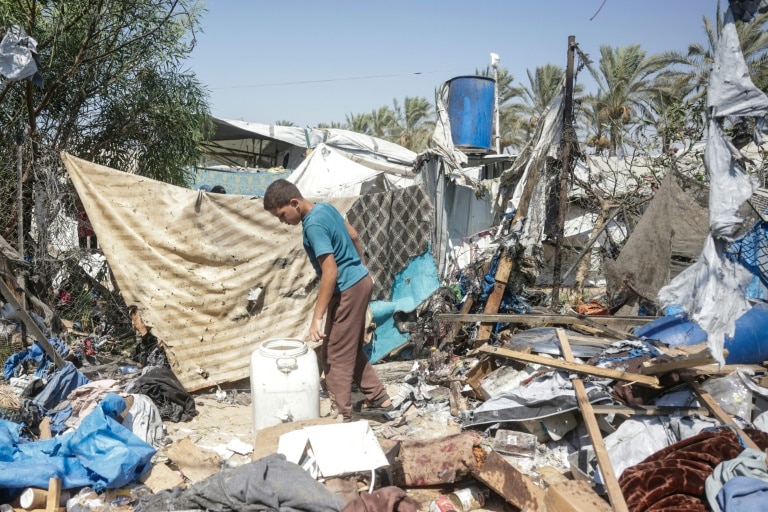
Separately, Bassal confirmed that several more people were wounded when Israeli forces opened fire on a displaced person encampment west of Khan Yunis. In the same area, civil defense teams recovered the body of 10-year-old Suhail Shallouf, who was killed by Israeli gunfire Saturday. According to data from the Hamas-run Gaza Ministry of Health, which the United Nations has deemed reliable, at least 1,262 Palestinians have been killed by Israeli operations across Gaza since the October ceasefire went into effect. The Israeli military has confirmed five combat deaths among its ranks during the same period.