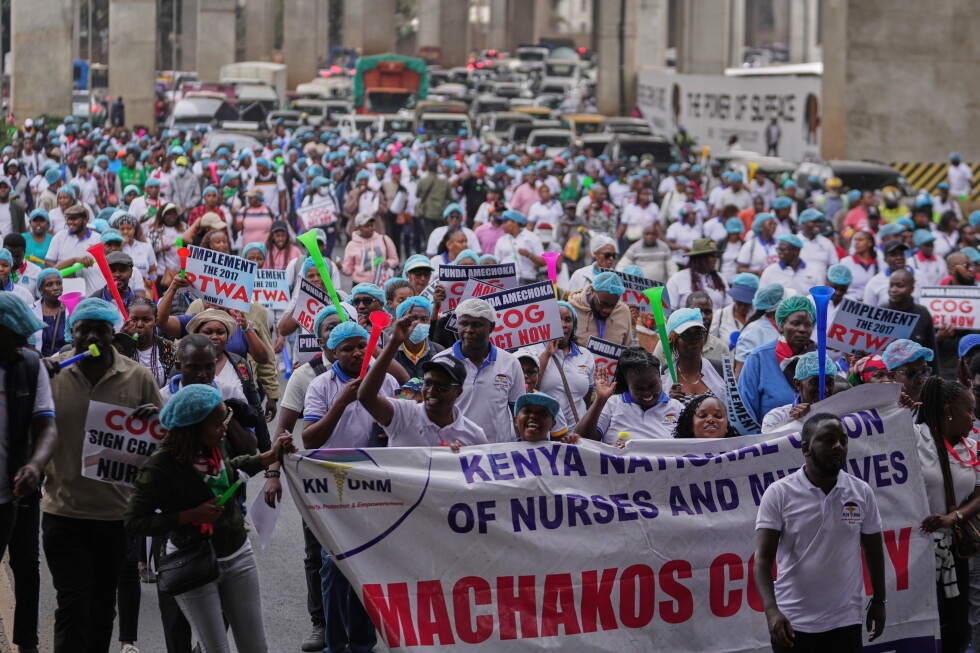
NAIROBI, Kenya — As a nurse-led strike enters its sixth week, Kenya’s healthcare system is facing escalating pressure, with the country’s doctors’ union threatening to join the industrial action if the government fails to resolve the dispute within seven days. The ongoing walkout has already strained hospital operations nationwide, with doctors reporting crippling increases to their already heavy workloads amid persistent staffing shortages.
The roots of the current crisis stretch back to 2017, when nurses signed a collective bargaining agreement with the government following a six-month strike. That agreement, which included promises to adjust uniform and service allowances that had gone unchanged for nearly a decade, has never been implemented. The government has cited binding budgetary constraints as the primary barrier to honoring the terms of the deal, a justification union leaders reject as unfair to frontline nursing staff.
Dr. Davji Bhimji Atellah, secretary-general of the Kenya Union of Doctors, announced the ultimatum in a post on X on Tuesday, emphasizing that the interconnected nature of healthcare means a breakdown in one sector harms the entire system. “We will not watch silently as the healthcare system we have dedicated our lives to serving is allowed to deteriorate,” Atellah wrote. “When one part of healthcare is compromised, we all suffer. And when we stand together, we protect our patients together.” Atellah added that doctors are already overstretched by existing staffing gaps and cannot absorb the additional work left vacant by striking nurses, noting that a functional healthcare system depends on collaborative teamwork across all roles.
Hundreds of striking nurses took to the streets on Tuesday, marching five kilometers to the offices of the Council of Governors (COG), the coordinating body for Kenya’s 47 county governments. James Murimi, one of the marching nurses, explained that the 2017 agreement was meant to update long-outdated allowances that have now accumulated into nine years of unpaid arrears owed to nurses by the national and county governments. “Since then, these allowances have never been improved. And they have so far accumulated for nine years. So the COG, or the government of Kenya, or the National Republic of Kenya, owes us nine years’ worth of arrears,” Murimi said.
Seth Panyako, head of the Kenya National Union of Nurses, accused the government of deliberately sidelining healthcare in its national budgeting process, saying the result is unnecessary suffering for Kenyan patients accessing care at public hospitals. “The excuse that there was no budget to implement the 2017 agreement was unfair to nurses who work hard to provide healthcare services,” Panyako said Monday.
On Tuesday, the COG and the national Salaries and Remuneration Commission were scheduled to hold talks focused on nurse remuneration, a key step toward resolving the dispute. Last week, COG chair Ahmed Abdullahi called on striking nurses to suspend their industrial action and enter good-faith negotiations, noting that a court had already ruled the current strike illegal and warned that individual county governments would take disciplinary action against participating nurses.
The crisis has already drawn condemnation from national legislators, with the Kenyan Senate taking up the issue on Tuesday amid reports of closed dispensaries and rising patient mortality in affected counties. Sen. Samson Cherargei of Nandi County labeled the situation a “national crisis” and blamed the COG and Salaries and Remuneration Commission for a recent “surge in deaths” linked to the service disruptions.