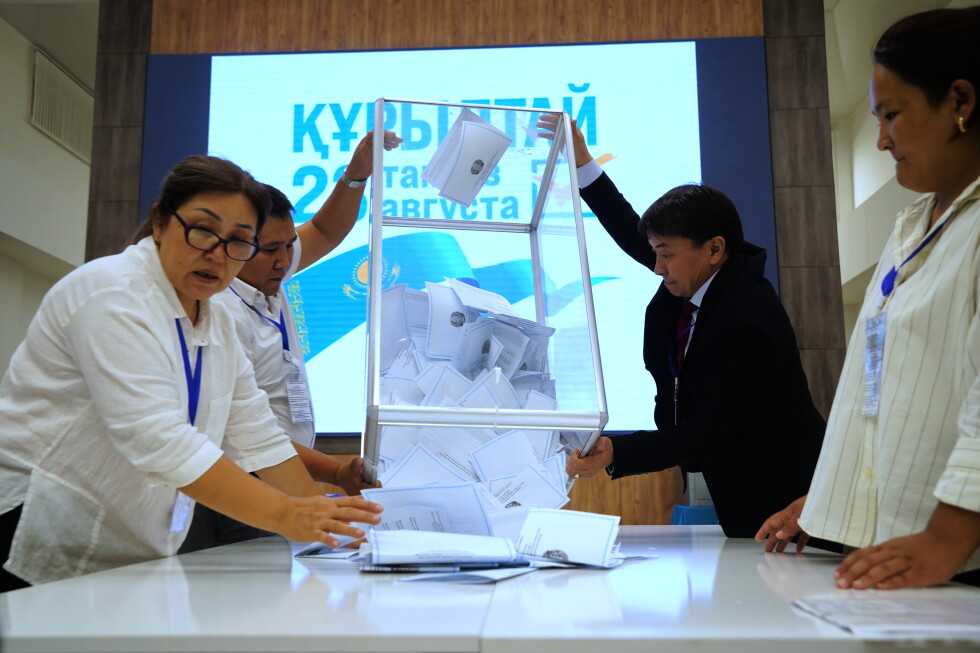
Official preliminary results released Monday confirmed a resounding landslide victory for Kazakhstan’s pro-government Adilet Party in the country’s first parliamentary election for a newly restructured single-chamber legislature, an outcome that political analysts broadly expect to solidify President Kassym-Jomart Tokayev’s control over Central Asia’s largest sovereign state.
Per data from Kazakhstan’s Central Electoral Commission, Adilet — which is headed by Tokayev’s former presidential administration chief — secured 71 percent of the popular vote cast during Sunday’s balloting. The rural-focused Auyl Party finished second with 6.26 percent of the vote, while three additional opposition-leaning parties, the Nationwide Social Democratic Party, Respublica, and Aq Jol, crossed the 5 percent voting threshold required to earn seats in the new legislative body.
International election observers from the Organization for Security and Co-operation in Europe (OSCE) have raised critical concerns about the electoral process, noting that the vote was undermined by a critical lack of meaningful ideological opposition. OSCE monitors emphasized that every contesting party in the election publicly endorses the sitting president’s policy agenda, leaving voters no distinct alternative aligned against Tokayev’s leadership.
The election marked the final step in a sweeping constitutional reorganization launched by Tokayev last March, when 87 percent of Kazakh voters approved a referendum to merge the country’s previous bicameral parliament into the new single-chamber legislature, officially called the Kurultai. Beyond restructuring the legislative branch, the constitutional amendments also grant the president expanded authority to appoint top-tier government officials, a power that only requires formal approval from sitting lawmakers to take effect.
Just one month ago, Kazakhstan’s Constitutional Court issued a landmark ruling that the new constitutional amendments effectively reset the count of Tokayev’s previous presidential terms, removing the legal barrier that would have prevented him from seeking re-election. The ruling clears the way for Tokayev, a 73-year-old former Soviet official and veteran United Nations diplomat who has held the presidency since 2019, to run for another seven-year term when his current mandate expires in 2030. This pattern of adjusting constitutional term limits to extend incumbents’ hold on power mirrors actions taken by leaders across several other former Soviet republics, including Russia, Belarus, Uzbekistan and Tajikistan.
Since the imposition of Western sanctions on Russia following Moscow’s full-scale invasion of Ukraine, Tokayev has pursued a careful balancing act between Russia and Western powers, maintaining economic and diplomatic ties with both blocs. He has publicly defended his constitutional overhaul as a necessary adjustment to enable faster, more agile policy-making amid growing global geopolitical and economic uncertainty.
This electoral contest unfolded against a backdrop of mounting domestic economic pressure and growing public unease in Kazakhstan. Annual inflation hit 10.2 percent in February, and recently implemented national tax increases have stirred widespread public discontent among working- and middle-class Kazakh households. Political analysts note that ongoing economic strain has put Kazakh authorities on high alert for a repeat of the deadly January 2022 unrest, when small-scale protests over a sharp spike in fuel prices escalated into nationwide civil unrest that left more than 200 people dead, including dozens of protesters and police officers. Analysts argue that concentrating greater political power in the presidency is a deliberate strategic move by Tokayev to prevent similar large-scale instability from reoccurring.
The election also coincides with a growing government crackdown on independent press and freedom of expression in the country. International media freedom advocacy organizations have repeatedly called on Tokayev to drop pending criminal charges against multiple journalists currently held under house arrest and revise restrictive national media laws that have been used to stifle dissenting speech. As of the election, Kazakh authorities have opened roughly 10 separate criminal cases against independent journalists and high-profile independent bloggers, according to local press freedom monitors.
Voter turnout for the 2025 parliamentary election reached approximately 74 percent of the country’s 12.6 million registered eligible voters, the Central Electoral Commission confirmed.