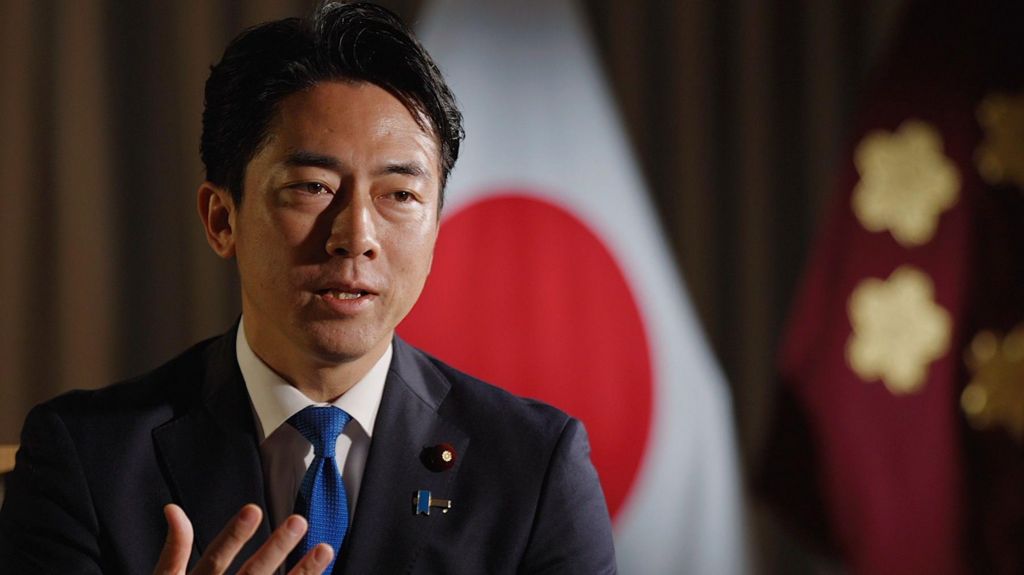
In an exclusive sit-down interview with the BBC’s Tokyo correspondent from his Tokyo office, Japanese Defence Minister Shinjiro Koizumi has laid out the most dramatic reorientation of Japan’s national security posture since the end of World War II, arguing that the country must fundamentally strengthen its defence capabilities and re-examine the pacifist framework that has guided its foreign and military policy for 80 years.
Koizumi framed the sweeping policy changes as a core component of building multi-layered deterrence to prevent new conflict in the Indo-Pacific, a goal that relies on three interconnected pillars: boosting domestic defence capacity, reinforcing the long-standing security alliance with the United States, and expanding defence cooperation with other like-minded nations across the globe.
One of the most significant recent shifts has been the relaxation of Japan’s 50-year-old restrictions on arms exports, a change that opens new doors for Japanese defence manufacturers to sell and transfer defence equipment and lethal weaponry to 17 nations that have signed formal partnership agreements with Tokyo, including the United States and the United Kingdom. Koizumi detailed the early progress of this new policy, noting that Australia has already selected Japanese-built warships, active negotiations are ongoing with the Philippines to transfer used destroyers from Japan’s Maritime Self-Defence Force, deep discussions are underway with Indonesia, and New Zealand has formally expressed interest in acquiring Japanese destroyers. “This vision of trading equipment and assets throughout the Indo-Pacific is something we have never seen before,” Koizumi told the BBC.
Defence policy has jumped to the top of the policy agenda for Prime Minister Sanae Takaichi’s current administration, which took office in October 2025 and has already pushed through historic increases in defence spending, framing the reforms as an urgent response to growing instability across the region. Takaichi, a long-time advocate for stronger defence alliances and a hawkish approach to regional security, has made revising Japan’s iconic Article 9 a core policy priority. Enshrined in Japan’s post-WWII constitution, Article 9 formally renounces war as a sovereign right of the nation, bans the use of force as a tool to resolve international disputes, and prohibits the maintenance of formal land, sea, and air military forces.
Speaking as a member of parliament rather than in his official cabinet role, Koizumi confirmed his full support for amending Article 9, arguing that the dramatic shifts in the regional security environment over the past eight decades demand an update to the country’s founding legal framework. “Japan has not amended its Constitution even once since World War Two. Given how dramatically the security environment has changed, we need to adapt to those changes if Japan is to remain peaceful,” he said.
Koizumi identified Beijing as Japan’s most significant strategic challenge, with China’s claims over self-governing Taiwan representing the latest flashpoint in a long-fraught bilateral relationship. The uninhabited Senkaku Islands, known as Diaoyu in China and claimed by both nations, sit in a strategically critical location along the First Island Chain, a geographic formation long described as a key strategic barrier between China’s coastal waters and the wider Pacific Ocean. Over the past year, Chinese aircraft carriers have conducted intermittent operational activities beyond the islands, a shift that has raised alarm in Tokyo. Japan’s Defence Ministry formally labeled China’s military activity the “greatest strategic challenge” in its most recent cabinet-submitted white paper, and is expected to reaffirm this assessment in its upcoming annual government report.
Last month, Koizumi pushed back against Beijing’s criticism that Japan’s defence shifts amount to a return of “new militarism”, arguing instead that China’s massive expanded weapons arsenal is the source of widespread global concern. Despite the rising tensions, Koizumi stressed that Japan remains committed to maintaining open lines of communication with Beijing. He noted that he met with his Chinese counterpart last November, and conveyed a clear desire to maintain ongoing dialogue despite the deep disagreements between the two nations. “Unfortunately, there have not been many opportunities for direct communication recently. However, as I stated at the Shangri-La Dialogue, Japan is always open to dialogue. We will continue sending that message and hope that opportunities for dialogue can be created whenever necessary,” he said.
Efforts to revise Japan’s post-war security framework are not new: Nobusuke Kishi first pushed for a more normalized military posture in the 1950s, Koizumi’s own father Junichiro Koizumi, who served as prime minister in the early 2000s, also backed constitutional revision including reforms to Article 9, and the late Shinzo Abe, Kishi’s grandson, made amending the pacifist clause a central priority during his time in office. But the pace of change has accelerated sharply under the Takaichi administration, a shift that has sparked some of the largest anti-war protests Japan has seen in decades.
Koizumi also emphasized the need to formalize the legal status of Japan’s Self-Defence Forces (SDF). While the SDF operates as a functional military in practice, Japanese law and political convention have long avoided labeling it as an official military force. “The SDF should be able to carry out its mission with pride and honour, and Japan must possess defence capabilities that remain steadfast even in today’s challenging security environment,” he added.
Critics of the proposed changes, however, argue that formal recognition and expansion of the SDF undermines the core pacifist principles of Article 9, and that the existing constitutional framework is already sufficient to meet Japan’s current defensive needs. “We don’t need to amend Article 9 for defensive operations against China. So it’s more a political agenda than something based on military rationality,” explained Hirohito Ogi, a senior research fellow at the Institute of Geoeconomics specializing in military strategy and defence policy. Ogi noted that even in the event of a threat to Japanese-controlled southern islands claimed by Beijing, or an attack on U.S. military bases located in Okinawa or Kyushu, the current constitution can already be interpreted to recognize such an attack as a direct act of aggression against Japan, justifying a full defensive response.
Koizumi acknowledged that while the ruling Liberal Democratic Party supports constitutional revision, the final decision will rest with the Japanese people. Under Japanese law, constitutional amendments require approval via national referendum, and Koizumi noted that “the timing and circumstances under which the public is asked to make that decision involve major political judgements.”
The evolving defence posture also requires Japan to balance its stance toward China while upholding its core alliance with the United States, which remains the cornerstone of Tokyo’s security policy. Established in the post-WWII era, the alliance hosts roughly 50,000 U.S. troops in Japan, the largest overseas U.S. military deployment in the world. In recent years, however, U.S. leaders – particularly President Donald Trump in his second term – have pushed for greater alliance burden-sharing, demanding that U.S. allies increase their own domestic defence spending. “The era of the United States subsidising the defence of wealthy nations is over,” U.S. Defence Secretary Pete Hegseth declared last month during his keynote address at the Shangri-La Dialogue.
In response to this pressure, and driven by its own security priorities, the Takaichi administration has raised Japan’s defence spending to 2% of GDP, double the long-standing post-war benchmark. The expanded budget is earmarked for the development and deployment of new surface-to-ship missiles and unmanned drone systems for both land and underwater operations.
Defence analysts are divided on the implications of this shift: some argue that Japanese defence-related industries, including shipbuilding and advanced electronic systems, are well-positioned to become increasingly competitive in the global defence export market. The Center for Strategic and International Studies has noted that the emergence of dedicated, full-scale Japanese defence firms focused primarily on the sector will be critical to the success of this new export strategy. Other analysts argue that larger budgets and updated deterrence frameworks are not enough to address the challenge from China, and that Japan needs bolder structural reforms to make its military forces more nimble and adaptable to modern security threats.
Aligning with U.S. regional strategy, Koizumi argued that Japan is ready to take on a more prominent independent role in maintaining Indo-Pacific security, beyond its existing partnership with Washington. “Japan can make contributions to the region that are uniquely Japanese – not solely through our relationship with the US, but also in our own independent role,” he said. “It’s our country. We need to protect it.”