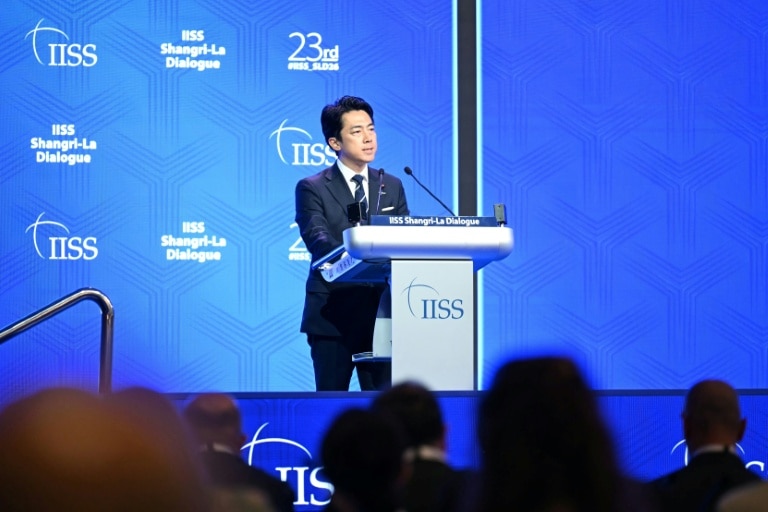
Asia’s premier annual defence summit, the IISS Shangri-La Dialogue, kicked off in Singapore Sunday with sharp rhetorical friction between Japan and China, as Tokyo’s top defence official pushed back against Beijing’s accusations of rising Japanese militarism. Japan’s Defence Minister Shinjiro Koizumi used his platform at the closed-door, high-profile gathering to deliver a veiled rebuke of China, as Tokyo presses forward with a sweeping overhaul of its post-World War II security posture.
Under current Prime Minister Sanae Takaichi, Japan has accelerated its shift toward a far more proactive defence policy, backed by long-standing U.S. encouragement to move away from the pacifist constitutional framework that has guided its military policy for nearly 80 years. This shift has drawn consistent and harsh criticism from Beijing, which has repeatedly labeled Tokyo’s evolving stance as a dangerous turn toward “new militarism” that threatens regional stability.
Koizumi rejected these claims outright in his address. “Nothing could be further from the truth,” he told delegates, before framing a pointed comparison: “Think about it. There is a country that has a huge arsenal of nuclear weapons and strategic bombers. Japan has neither of such weapons. And yet, Japan is labelled ‘new militarism’. Isn’t it strange?” While he did not name China directly, the reference was clear to all in attendance. International defense estimates indicate China possesses hundreds of nuclear warheads and has undertaken a rapid, large-scale expansion of its military capabilities over the past two decades.
Diplomatic tensions between the two major Asian powers have been elevated since last November, when Takaichi suggested Japan could take military action if China attempted to seize control of Taiwan, the self-governing island democracy that Beijing claims as an inalienable part of its territory. Koizumi doubled down on Tokyo’s concerns Sunday, arguing that China’s military buildup has proceeded “without sufficient transparency” and that its regional military activities represent “a matter of serious concern for Japan”.
In contrast, Koizumi stressed that Japan’s own military modernization, which includes expanding capabilities in artificial intelligence, unmanned defense systems, cyber security, and space defense, is being carried out “with a high degree of transparency”. He added that Japan’s decades-long track record as a peace-loving nation is a proven fact recognized by the international community, and that “this fact will not be shaken by false claims”. Koizumi also noted he regretted that China had declined to send its top defense leadership to the summit, meaning no bilateral meeting between the two nations’ defense chiefs could be held this year. For the second consecutive Shangri-La Dialogue, China sent a lower-level, scaled-back delegation without its incumbent defense minister Dong Jun.
Beyond his address, Koizumi held bilateral talks with Philippine Defense Secretary Gilberto Teodoro on Sunday, where the two allies confirmed plans to transfer retired Japanese Abukuma-class destroyers and TC-90 aircraft to the Philippines during Japan’s 2027 fiscal year. The Philippines has sought to acquire the decommissioned Japanese vessels for years, sending a military inspection team to review the ships in 2025.
This defense cooperation comes amid deepening security ties between Tokyo and Manila, both of which have growing territorial and strategic disputes with Beijing in the South China Sea. The two leaders announced they would move forward with talks on intelligence sharing and open maritime border coordination — a step Beijing has already condemned as an illegal violation of its broad, contested territorial claims in the region.
Teodoro echoed Koizumi’s criticism of Beijing in comments after the meeting, stressing that Manila would never compromise its territorial integrity and sovereignty, a commitment enshrined in the country’s constitution. He drew a sharp contrast between the Philippines’ democratic system and what he called “some autocratic systems where the mandate comes from above, dictated down.”
Teodoro’s comments came as China’s People’s Liberation Army Southern Theater Command announced it had carried out new combat readiness patrols in the waters and airspace around Scarborough Shoal, a contested feature at the center of a years-long sovereignty dispute between Beijing and Manila. In its statement, the Chinese command called the patrols an “effective countermeasure to cope with all sorts of rights-violation and provocative acts” around the shoal, which it claims is an inherent part of Chinese territory.
An international arbitration ruling issued in 2016 overwhelmingly rejected Beijing’s sweeping territorial claims to nearly the entire South China Sea, but Beijing has continued to ignore the ruling and expand its military and paramilitary presence in contested areas of the strategic waterway, through which trillions of dollars in global trade passes annually. The Shangri-La Dialogue, now in its 23rd year, brings together top security officials, defense leaders, and policy experts from more than 45 nations to discuss pressing regional security challenges.