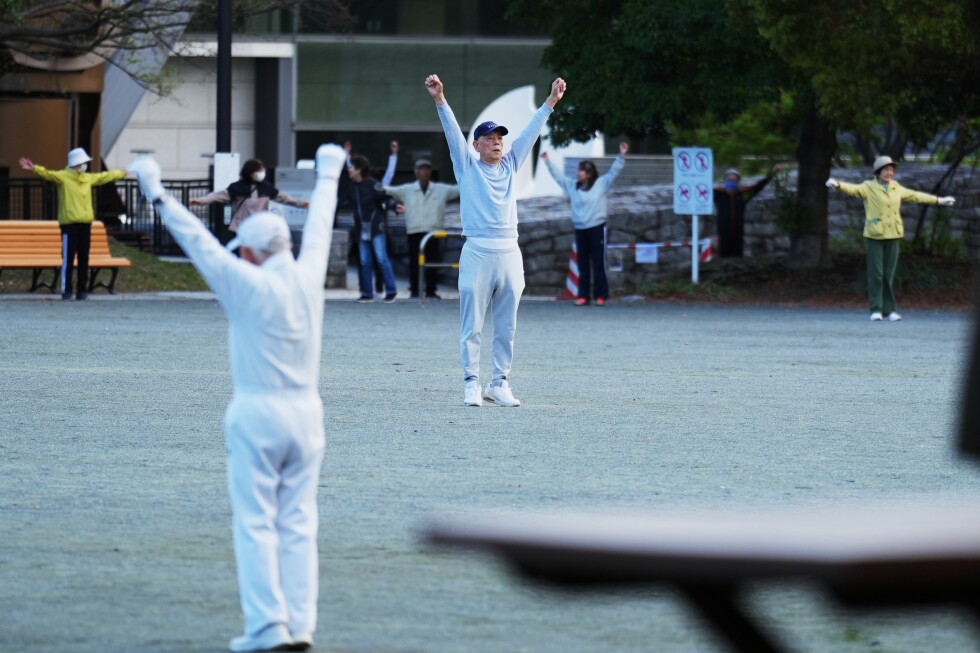
Every morning at 6:30 across Japan, a familiar piano melody drifts through radio airwaves, calling millions of people to begin their day with movement. This centuries-old tradition, known as Radio Taiso (translated as Exercise Radio), has become a woven thread in Japanese daily life, uniting people across generations in parks, office campuses, schoolyards, and living rooms.
What makes Radio Taiso enduringly popular is its remarkable accessibility. The 10-minute routine consists of simple calisthenic movements, from overhead stretches and torso twists to arm swings and gentle squats that can be adjusted to any fitness level. Participants can make the workout as low-impact or as strenuous as they prefer, with options to do every move standing or seated. Split into three 3-minute segments that gradually increase in difficulty, the sequence requires no specialized equipment, and beginners can pick up the choreography after just one or two sessions. Every movement is repeated four to eight times, with consistent cues to breathe slowly and stay relaxed, keeping the routine gentle even for older participants.
### A Tradition Steeped in History
Radio Taiso’s origins trace back 100 years, inspired by a similar radio exercise program launched by Metropolitan Life Insurance in the United States. In the 1920s, Japanese postal ministry officials brought the concept home after observing the program overseas, and Radio Taiso was formally introduced to the public in 1928, coinciding with the enthronement of Emperor Hirohito. Within 10 years, millions of Japanese people were joining the daily routine, with postal workers leading outreach by distributing instructional pamphlets and hosting local training sessions.
After Japan’s defeat in World War II, the group exercise program was banned during the U.S. occupation, with authorities viewing mass collective practice as carrying potential militaristic and totalitarian overtones. But popular demand for the ritual never faded, and group Radio Taiso sessions resumed in 1951, just one year before the formal end of the U.S. occupation. Today, the tradition is stronger than ever: a 2023 survey from the Japan Radio Taiso Federation found that more than 20 million Japanese people practice the routine at least once a week, out of the country’s total population of 122 million. It has also spread globally, with particularly large followings in countries like Brazil, which is home to the world’s largest population of Japanese descent outside Japan. Anyone curious can also find English-language and multilingual Radio Taiso tutorials on YouTube to try the routine at home.
### More Than Exercise: A Community Anchor for Aging Japan
Beyond physical benefits, Radio Taiso has long served as a critical social space, especially for Japan’s large elderly population. In Tokyo’s sprawling Kiba Park, a group of regulars gathers almost every morning to move together. Eighty-eight-year-old Mieko Kobayashi, a longtime participant, says the routine keeps her feeling well, while her 77-year-old friend Yoshiko Nagao notes that the gathering is a lifeline for many elderly residents who live alone. “We even come on New Year’s Day,” Nagao says, explaining that post-workout walks and casual conversation are just as important as the exercise itself.
Eighty-three-year-old Kenji Iguchi, who has practiced Radio Taiso regularly for 20 years and appears decades younger than his age, says the routine keeps his joints — particularly his knees and back — healthy. He wakes at 5 a.m. every day, walks through the park before the 6:30 session, and counts the social connection with familiar fellow participants as one of his favorite weekly rituals.
Japan consistently boasts one of the highest life expectancies in the world, with an average of 85 years — just slightly behind Hong Kong, and six years higher than the United States’ average of 79. Last year, the Japanese government confirmed that 99,763 people aged 100 or older are currently living in the country, marking the 55th consecutive year that the number of centenarians has hit a new national record. Japan holds the global record for the highest share of centenarians per capita, and experts often attribute the country’s longevity to a combination of healthy diet, universal high-quality healthcare, and cultural norms that encourage consistent physical activity across all ages — including the simple daily ritual of Radio Taiso.