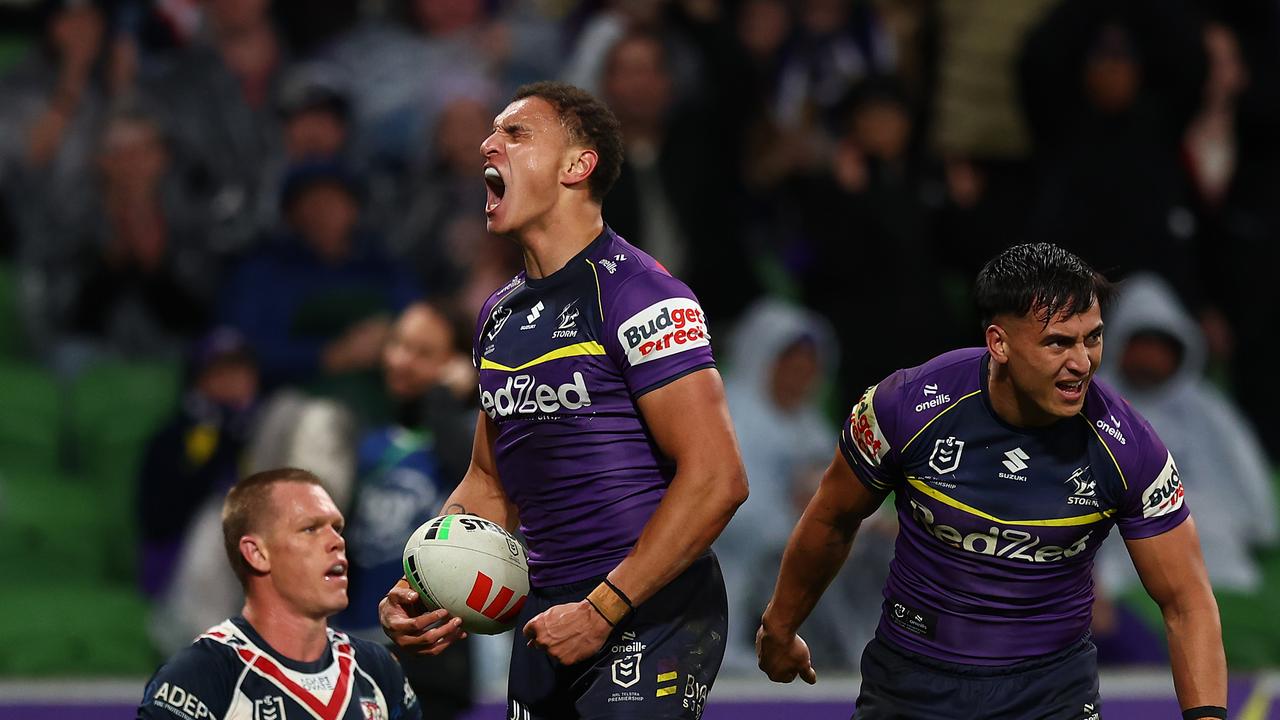
One of Australia’s most storied and successful professional rugby league clubs is breaking new ground in athlete mental health advocacy, launching an unprecedented national initiative to confront the stigma that still prevents millions of Australians from seeking support for mental health challenges. Top National Rugby League (NRL) players from the Melbourne Storm have opened up about their own raw, deeply personal struggles with anxiety, depression, and public pressure to encourage people across the country to speak up about their battles rather than suffering in silence.
For veteran prop Josh King, the relentless mental pressure of early career losses and constant public criticism left him brought to his lowest point. Young utility Alec MacDonald experienced unexplained severe stomach cramps during matches that were later traced to untreated performance anxiety, while winger Will Warbrick battled undiagnosed severe depression for a full year before he finally sought help. These are not isolated stories — they are just a sample of the quiet struggles that many elite athletes face off the field, which inspired the club to host its first ever Mental Health Round, branded “Tackle Tough Together”.
Scheduled to take center stage on June 21 during the club’s Round 16 home match against the Canberra Raiders at Melbourne’s AAMI Park, the event marks the first initiative of its kind for rugby league in Victoria. The day will feature a public march of Storm legends to raise community awareness, free on-site mental health screenings for all attending fans, and fundraising efforts through the sale of commemorative pins, with 100% of proceeds going directly to leading Australian mental health organization Beyond Blue.
Melbourne Storm Chief Executive Justin Rodski emphasized that the initiative aims to redefine what “toughness” actually means, both in sport and everyday life. “We know that in men’s sport, and for men broadly, the expectation is that you stay tough on the field,” Rodski explained. “But this round is about changing that narrative: real toughness isn’t hiding your pain. Real strength is checking in on your friends, and speaking up when you need help. We want men to feel safe to be vulnerable about the hard times they’re going through, to share what they’re feeling and work through it together.”
For King, who joined the Storm in 2022 after a brutal start to his career with the Newcastle Knights, the message comes from years of personal experience. The 31-year-old front-rower lost 20 of his first 21 professional matches, collected two consecutive wooden spoons (for the league’s worst performing team), and faced constant public criticism that left him questioning whether he even wanted to continue playing professional footy. “The mental side of the game really had me on my knees for a while there,” King said. “At some point, everyone goes through a stretch where they’re struggling mentally, stuck in a dark place. For me that was early on in Newcastle. I was young, thrown into the first team too early, getting hammered in the press and on social media, and I didn’t know if I belonged here.”
King eventually recognized he needed to make major changes to protect his mental health, stepping back from social media to cut out constant negativity, starting a regular gratitude practice, and beginning regular sessions with a psychologist. He also credits his volunteer work as a Starlight Children’s Foundation ambassador with changing his whole perspective on life. The Storm recently raised more than AU$100,000 for seriously ill children and their families through the foundation, and King has been volunteering with children’s hospitals since his time in Newcastle. “It sounds selfish, but those kids gave me more perspective than I ever gave them,” King admitted. “I’d be stressing about having a bad game, and there they are fighting for their lives and still smiling every day. Seeing how resilient those kids and their families are, it puts every little problem I have in its place.”
MacDonald, now in his fifth season with the Storm, says the high-pressure environment of professional rugby league forced him to confront his anxiety early, and that experience sparked a new passion that could shape his post-playing career. “When I started playing top-level footy, the pressure was so intense that my anxiety started showing up physically — I had terrible stomach pains during games that no doctor could figure out for a while,” MacDonald explained. “It turned out I was stuck in fight-or-flight mode all the time, which stopped my stomach from digesting food properly. That forced me to start working on my mental health, and I’m actually grateful for it now. It gave me the tools I’ll have for life.”
Like King, MacDonald intentionally limits his social media use, regularly deleting all apps for weeks at a time to avoid the constant negativity that comes with public life. Working through his own anxiety also sparked a passion for mental health, and he is currently studying psychology with the goal of one day helping other athletes and ordinary people work through their own struggles. “I never would have imagined I’d be studying this,” he said. “At first it was just about helping myself play better, but now I see how much good it could do to help other people too.”
Warbrick, the Storm’s young winger, was diagnosed with severe depression at a young age, but hid his struggle for nearly a year because of the stigma around men talking about mental health. “I grew up around the idea that you just crack on and bottle everything up,” Warbrick said. “I didn’t even understand what I was feeling back then. I didn’t know what depression was, it was just a word to me. I tried to handle it on my own for a year, and it ended up taking over everything.”
Warbrick eventually took the step of seeing a doctor and getting a formal diagnosis, which allowed him to access counseling and psychological support. His message to anyone struggling is simple: don’t try to handle it alone. “You can’t fix this by yourself. The first and hardest step is recognizing you need help, and then asking for it. That’s not weakness — that’s the bravest thing you can do,” he said. “It’s so important that big clubs with big platforms like the Storm are shining a light on this. Mental health is a serious issue, and it needs the attention to get better for everyone.”
The inaugural Melbourne Storm Mental Health Round is held in partnership with AIA Australia and supported by Beyond Blue, with organizers encouraging all fans and community members to join the movement to “Tackle Tough Together” on June 21.